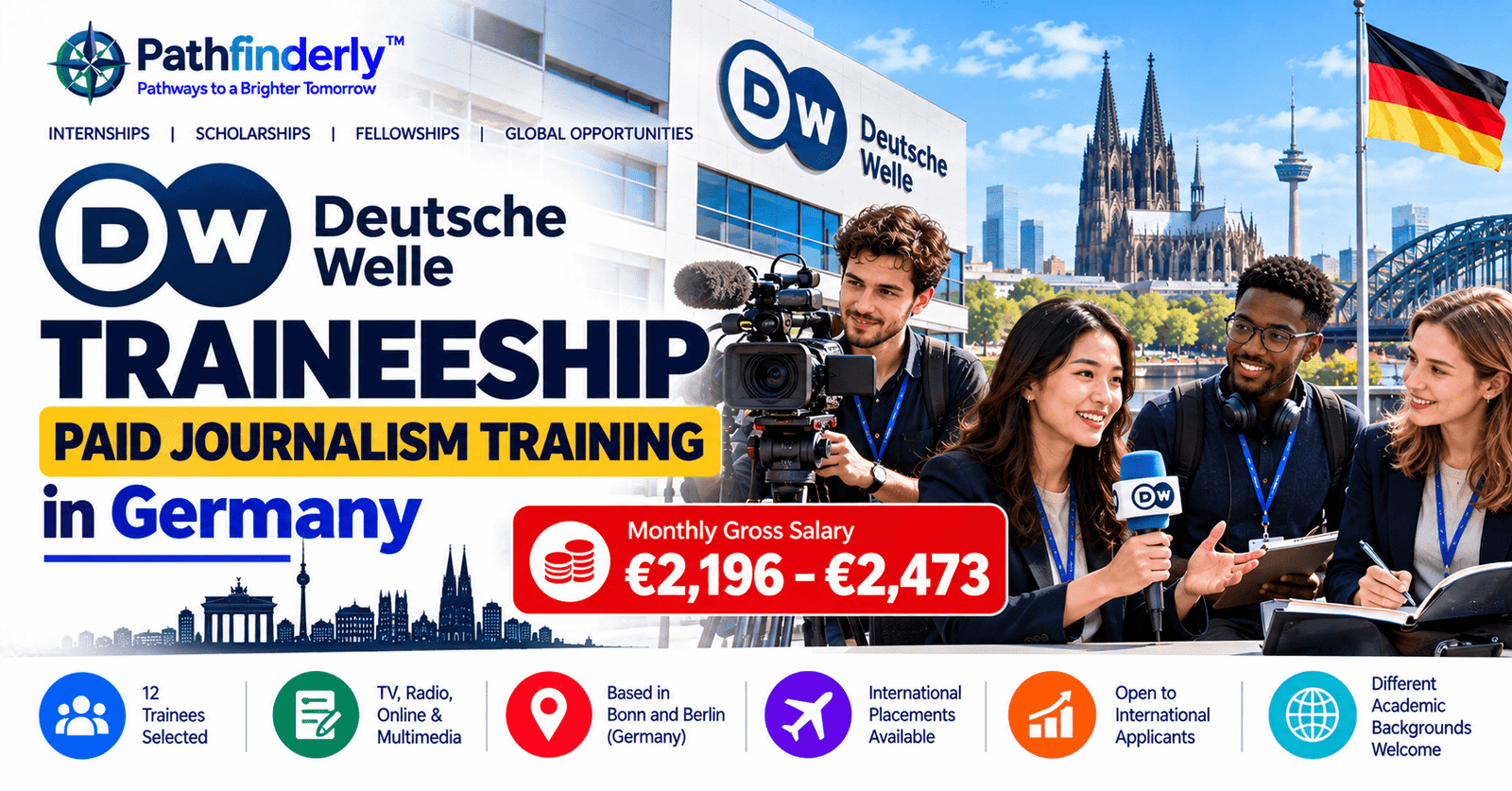
The DW Traineeship 2028/29 offers aspiring journalists and professionals from different academic backgrounds an opportunity to receive paid journalism training in Germany.
Organized by Deutsche Welle (DW), Germany’s international public broadcaster, the program combines professional training with practical newsroom experience.
Selected participants learn how to produce news and multimedia content for television, radio and digital platforms. They also work with experienced journalists and gain exposure to international reporting.
The traineeship lasts 18 months, beginning on January 3, 2028, and continuing until June 2029.
Participants receive a monthly gross salary starting at €2,196, increasing during the program to €2,473.
The opportunity is open to qualified applicants from different countries and professional backgrounds. However, strong language skills, including English and German, are essential.
Applications are open until November 17, 2026, at 12:00 noon German time.
Interested candidates can review the official Deutsche Welle traineeship announcement before applying.
DW Traineeship 2028/29 Overview
| Details | Information |
|---|---|
| Organization | Deutsche Welle (DW) |
| Program | DW International Journalism Traineeship |
| Country | Germany |
| Main Locations | Bonn and Berlin |
| Additional Placements | DW international offices |
| Duration | 18 months |
| Start Date | January 3, 2028 |
| End Date | June 2029 |
| Available Positions | 12 |
| Monthly Salary | €2,196–€2,473 gross |
| Training Areas | TV, radio, online and multimedia journalism |
| Eligible Applicants | International candidates meeting the requirements |
| Education | Completed degree or vocational training |
| Language Requirements | Strong English and German skills |
| Application Method | Online |
| Application Deadline | November 17, 2026 |
| Closing Time | 12:00 noon CET |
What Is the DW Traineeship?
The Deutsche Welle Traineeship is a professional journalism training program offered by Deutsche Welle.
The program is also known as the DW Volontariat.
It prepares participants for careers as multimedia journalists, reporters, editors and other media professionals.
Unlike a short internship, this traineeship provides structured training over 18 months.
Participants attend seminars, complete newsroom placements and work on practical journalism projects.
The program covers traditional reporting skills as well as modern digital journalism.
For example, trainees learn about video production, audio reporting, digital storytelling and data-driven journalism.
They also gain experience in working under deadlines and collaborating with editorial teams.
About Deutsche Welle
Deutsche Welle is Germany’s international broadcaster.
The organization produces journalism for audiences around the world through television, radio, websites and digital platforms.
Its reporting covers international politics, economics, culture, science and other subjects.
DW publishes content in more than 30 languages.
As a result, its editorial teams bring together journalists from different countries, languages and cultural backgrounds.
The traineeship reflects this international working environment.
You can learn more through the official Deutsche Welle website.
How Many Trainees Will Be Selected?
For the 2028/29 intake, Deutsche Welle plans to select:
12 trainees.
The limited number of places makes the selection process competitive.
Applicants must demonstrate creativity, communication skills and an interest in journalism.
However, DW does not restrict the opportunity to candidates who studied journalism at university.
Professionals from other fields are also encouraged to apply.
Is the DW Traineeship Paid?
Yes.
The Deutsche Welle Traineeship is a salaried professional training program.
Selected participants receive a monthly gross salary throughout the 18-month placement.
The salary increases as trainees progress through the program.
Deutsche Welle Traineeship Salary 2028/29
According to DW’s published information, the salary structure is:
| Training Period | Monthly Gross Salary |
|---|---|
| First 6 months | €2,196 |
| Second 6 months | €2,374 |
| Final 6 months | €2,473 |
These are gross monthly amounts, meaning applicable taxes and social insurance contributions may be deducted.
The actual take-home salary will depend on the trainee’s circumstances and German payroll rules.
How Much Can Trainees Earn Over 18 Months?
Based on the published salary progression:
- First six months: €13,176
- Second six months: €14,244
- Final six months: €14,838
Total estimated gross salary: €42,258 over 18 months.
This is a calculation based on the stated monthly rates, not a guaranteed net payment.
Is the DW Traineeship Fully Funded?
The program provides a salary rather than a scholarship stipend.
Therefore, it is more accurate to describe the opportunity as paid journalism training.
The official vacancy does not promise free accommodation, full living expenses or international relocation funding for every participant.
Applicants should consider their expected living costs in Germany.
However, the salary provides financial support while participants gain professional experience.
Where Does the Training Take Place?
The main training locations are:
- Bonn, Germany
- Berlin, Germany
Trainees work at Deutsche Welle’s broadcasting centers in these cities.
They also complete placements with different editorial departments.
Depending on the training schedule, participants may gain experience at international DW offices.
International Training Opportunities
DW’s official vacancy mentions placements in international bureaus, including:
- Brussels
- Washington
- Jakarta
- Jerusalem
- Riga
- Delhi
These placements expose trainees to international journalism and different editorial environments.
However, applicants should not assume they can choose any international office or that every placement will be available to every trainee.
Actual assignments depend on the program’s arrangements.
What Will Participants Learn?
The Deutsche Welle Traineeship combines journalism theory with practical newsroom experience.
Television Journalism
Trainees learn how television news is developed and produced.
Activities may include researching stories, preparing interviews and working with video material.
Participants also gain an understanding of television reporting and production processes.
Radio and Audio Journalism
The program introduces participants to audio storytelling.
This may involve interviewing, writing scripts, recording and editing audio content.
These skills are relevant to radio broadcasting and digital audio journalism.
Digital Journalism
Trainees learn to create content for online audiences.
They explore how digital platforms influence news presentation and audience engagement.
Training can include multimedia reporting and digital storytelling techniques.
Data Journalism
Data journalism is an important part of modern reporting.
Participants learn how data can support investigations, explain complex issues and improve factual reporting.
Social Media Journalism
DW values applicants with social media knowledge.
The traineeship helps participants understand how journalism reaches audiences across digital platforms.
Emerging Journalism Technologies
The program also introduces developments such as virtual reality and other digital reporting methods.
DW’s current recruitment communications highlight the growing importance of artificial intelligence in journalism.
Training content may evolve as newsroom technology changes.
Practical Newsroom Experience
One of the strongest features of the program is its combination of seminars and editorial placements.
Participants do not spend the entire 18 months attending classroom sessions.
Instead, they work with professional newsroom teams and contribute to real journalism projects.
They learn how editors plan coverage, how reporters develop stories and how multimedia content is produced.
This experience helps trainees understand the daily responsibilities of journalists.
Who Can Apply for the DW Traineeship?
DW welcomes applicants with different nationalities, educational backgrounds and professional experiences.
However, candidates must meet the program’s requirements.
The main criteria include:
- Completed university, college or vocational qualification
- Required English and German language skills
- Initial journalism experience
- Creativity and strong communication skills
- Social media knowledge
- Ability to work under deadlines
- Teamwork and professional commitment
DW encourages applications from people with different cultural and professional backgrounds.
Educational Qualifications
Applicants must have completed a university degree, college qualification or apprenticeship.
A journalism degree is not mandatory.
DW particularly welcomes applicants with backgrounds in areas such as:
- Technology and IT
- Science
- Politics
- Economics
- Law
However, candidates from other disciplines can also apply.
This makes the traineeship attractive to professionals interested in changing careers.
Can Applicants Without a Journalism Degree Apply?
Yes.
Deutsche Welle explicitly welcomes candidates from fields outside journalism.
For example, someone with a background in engineering, medicine, economics or law may bring valuable specialist knowledge to a newsroom.
DW is interested in applicants who can turn their knowledge and experiences into engaging journalism.
However, candidates should still demonstrate an interest in reporting and some initial journalism-related experience.
This could include published work, student media, independent reporting or relevant multimedia projects.
Is Previous Journalism Experience Required?
The official vacancy lists initial journalistic experience among its requirements.
However, applicants do not need to be established professional journalists.
Relevant experience may include:
- Writing news or feature articles
- Producing video reports
- Contributing to student publications
- Hosting or producing podcasts
- Working on journalism projects
- Creating researched multimedia stories
- Participating in editorial activities
These are examples of potentially relevant experience, not a separate official eligibility checklist.
Applicants should explain what they have actually done and how it demonstrates their suitability.
English Language Requirements
English proficiency is essential.
DW expects applicants to have excellent English skills, unless their qualifying language background follows the German-native-speaker route.
The program involves international reporting, collaboration and professional training.
Therefore, candidates must be comfortable communicating and producing work in English.
German Language Requirements
German is also important.
The traineeship is bilingual, and applicants need German-language skills appropriate to their language background.
DW’s recruitment information describes the following general pathways:
| Applicant Background | Language Expectations |
|---|---|
| Native speaker of a DW broadcasting language | Excellent English and good German |
| Native English speaker | Good German |
| Native German speaker | Excellent English |
DW’s current recruitment coverage describes excellent proficiency as approximately C1/C2 and good German proficiency as approximately B1/B2.
Applicants should consult the official requirements and FAQs to determine the accepted evidence of their language skills.
Is IELTS Required?
The vacancy emphasizes language proficiency rather than publishing a universal IELTS score.
Therefore, applicants should not assume that everyone must submit the same English-language test.
Follow the instructions in the official application portal and FAQs.
Is There an Age Limit?
DW’s current recruitment information does not specify a general maximum age.
The program welcomes applicants from different professional and personal backgrounds.
Candidates should focus on meeting the educational, language and journalism-related requirements.
Can International Applicants Apply?
Yes.
Deutsche Welle welcomes applications regardless of nationality, provided candidates satisfy the selection requirements.
The program values international perspectives and linguistic diversity.
However, successful applicants who require permission to work and reside in Germany must follow the relevant immigration procedures.
Applicants should not assume that selection automatically guarantees a visa.
Can Students Apply?
The official vacancy requires a completed university, college or vocational qualification.
Therefore, students who have not yet completed an eligible qualification should verify whether they can meet this requirement before the traineeship begins.
The program is primarily designed for candidates ready to undertake professional training.
Is the Program Open to Career Changers?
Yes.
Career changers are an important part of DW’s recruitment approach.
The broadcaster welcomes people who can bring specialized knowledge and different perspectives to journalism.
For example, an IT professional may contribute knowledge about cybersecurity and artificial intelligence.
Similarly, someone with a legal background may be interested in reporting on courts, governance and human rights.
The important question is whether the applicant can demonstrate journalistic potential.
Application Deadline
The official application period is:
Opening: October 13, 2026, at 12:00 noon CEST
Closing: November 17, 2026, at 12:00 noon CET
The deadline follows German local time.
Applicants outside Germany should convert the closing time to their local time zone.
Do not wait until the final hours because the application includes additional mandatory assignments.
How to Apply for DW Traineeship 2028/29
Applications must be submitted online through Deutsche Welle’s official recruitment portal.
Step 1: Visit the Official Vacancy
Open the DW Traineeship application page.
Review the eligibility requirements, job description and application instructions.
Step 2: Check Your Qualifications
Confirm that you meet the education and language requirements.
Also consider whether you can demonstrate initial journalism experience and relevant digital skills.
Step 3: Prepare Your Application Information
Gather the documents and details requested through the recruitment portal.
These may include information about your education, work experience and language skills.
Follow the current portal instructions rather than assuming a fixed document list.
Step 4: Register in the Application Portal
Use the application link during the official application period.
Complete the registration process.
Step 5: Check Your Confirmation Email
After registering, you will receive a confirmation email.
This email contains a link to additional application tasks and related attachments.
Do not overlook this email.
Step 6: Complete the Questionnaire
DW requires applicants to complete a questionnaire.
The questionnaire forms part of the official selection process.
Answer the questions carefully and follow the instructions provided.
Step 7: Prepare the Video Application
Applicants must also produce a video application.
The video assignment is mandatory.
Read the official instructions before recording or editing your video.
Do not assume that a general self-introduction video will satisfy the requirement.
Step 8: Upload All Required Tasks
Upload the completed questionnaire, video and other requested materials to your applicant profile.
These additional tasks must be completed before the application deadline.
Step 9: Submit Your Complete Application
Make sure every required section is complete.
The deadline is November 17, 2026, at 12:00 noon CET.
DW will only consider complete applications submitted through the online recruitment system.
Can You Apply by Email?
No.
Deutsche Welle clearly states that applications must be submitted through its official career portal.
Applications sent by email will not be processed.
This also applies to required supplementary assignments.
Use the portal and follow the instructions in your confirmation email.
Is the Video Application Compulsory?
Yes.
The video application is a mandatory part of the recruitment process.
Applicants must also complete the questionnaire.
Both tasks must be uploaded before the closing deadline.
An application that is missing these materials may be treated as incomplete.
Deutsche Welle Traineeship Selection Process
The selection process involves several stages.
DW evaluates candidates’ journalism potential, creativity, language skills and ability to contribute to its international editorial environment.
The recruitment process can include:
- Initial application screening
- Review of the questionnaire
- Assessment of the video application
- Additional online assessment
- Interviews or other selection activities
DW’s current recruitment announcement confirms a multi-stage selection process and online assessment.
Candidates should follow the instructions communicated by the recruitment team.
How Competitive Is the DW Traineeship?
The program is highly competitive because only 12 trainees are expected to join the cohort.
Applicants compete with candidates from different countries and professional backgrounds.
However, a traditional journalism degree is not the only route to selection.
DW values applicants who demonstrate original ideas, curiosity and the ability to communicate with international audiences.
A strong application should show what makes the candidate’s perspective useful.
How to Strengthen Your Application
Demonstrate Genuine Interest in Journalism
Explain why you want to work in journalism and why Deutsche Welle interests you.
Avoid relying only on the program’s salary or international training opportunities.
Highlight Your Unique Background
If you studied or worked outside journalism, explain how your knowledge could contribute to reporting.
Relevant specialist expertise can be valuable in an international newsroom.
Show Your Previous Work
If the application permits, provide examples of relevant reporting or multimedia work.
Focus on quality and originality rather than quantity.
Prepare the Video Carefully
Follow DW’s exact instructions.
Pay attention to clarity, structure, audio quality and storytelling.
A clear and thoughtful video can be more effective than an unnecessarily elaborate production.
Improve Your German Skills
German proficiency is a meaningful requirement.
Applicants who already meet the minimum expectations can continue improving their communication skills before the program begins.
Develop Digital Journalism Skills
Familiarity with video, audio, social media and data-based storytelling can strengthen your profile.
Submit Early
The additional assignments may take considerable time.
Register early enough to receive the questionnaire and video instructions, complete them properly and upload everything before the deadline.
Career Opportunities After the Traineeship
DW describes strong career prospects as one of the program’s benefits.
Graduates may pursue careers in:
- Television journalism
- Radio and audio reporting
- Online news production
- Multimedia storytelling
- International reporting
- News editing
- Digital journalism
- Data journalism
DW also highlights the possibility of continued professional work with the organization.
However, applicants should not interpret this as a guaranteed permanent position for every trainee.
Future employment depends on performance, organizational needs and available opportunities.
DW Traineeship vs Other International Internships
The Deutsche Welle Traineeship is different from many short-term internships because it offers an 18-month salaried training program.
Students and recent graduates interested in international organizations can also explore the UNU Junior Fellows Internship, which provides professional experience at United Nations University in Japan.
Applicants interested in policy, economics and public administration may consider the OECD Internship Programme, subject to its eligibility requirements.
For those seeking opportunities with an international organization, the United Nations Internship Program provides a broader overview of internships across the UN system.
Professional journalists interested in investigative reporting and international networking can also explore the Global Investigative Journalism Conference, which offers competitive funded fellowships to attend specialist training in the Netherlands.
These programs serve different career goals.
The Deutsche Welle Traineeship is particularly suitable for candidates who want to build a professional career in journalism and multimedia reporting.
Frequently Asked Questions
Are applications open for the DW Traineeship 2028/29?
Yes. Applications opened on October 13, 2026.
What is the deadline?
November 17, 2026, at 12:00 noon German time (CET).
Is the Deutsche Welle Traineeship paid?
Yes. Participants receive a monthly gross salary.
How much is the salary?
The monthly gross salary starts at €2,196, increases to €2,374 and reaches €2,473 during the final six months.
How long is the traineeship?
18 months.
When does it start?
January 3, 2028.
When does it end?
June 2029.
How many trainees will be selected?
DW plans to select 12 trainees.
Where does the training take place?
Primarily in Bonn and Berlin, with additional editorial placements that may include international offices.
Can international applicants apply?
Yes, provided they meet the requirements.
Is a journalism degree required?
No. DW welcomes applicants from different academic and professional backgrounds.
Is previous journalism experience necessary?
The official vacancy lists initial journalism experience among the requirements.
Is German required?
Yes. Applicants need German skills appropriate to the program’s language requirements.
Is English required?
Yes. Strong English proficiency is essential under the relevant language pathways.
Is there an age limit?
The current recruitment information does not specify a general maximum age.
Is the video application mandatory?
Yes.
Is the questionnaire mandatory?
Yes.
Can I apply by email?
No. Applications must be submitted through the official online portal.
Does the traineeship guarantee a permanent Deutsche Welle job?
No. The program offers career prospects, but continued employment is not guaranteed for every participant.
Final Thoughts
The Deutsche Welle Traineeship 2028/29 in Germany offers a valuable opportunity for aspiring journalists and career changers who want professional experience in international media.
The 18-month program combines practical newsroom placements, journalism seminars and multimedia training.
Participants work primarily in Bonn and Berlin, with opportunities to gain experience in DW’s wider international editorial network.
One of the program’s strongest benefits is its salary structure.
Selected trainees receive between €2,196 and €2,473 gross per month, depending on their stage of training.
The program also welcomes applicants from fields outside journalism, including technology, science, economics and law.
However, candidates must demonstrate strong language skills, creativity and an interest in journalism.
Only 12 trainees are expected to be selected, so applicants should prepare carefully.
Applications close on November 17, 2026, at 12:00 noon CET.
Because the application includes a compulsory questionnaire and video assignment, candidates should register early and allow enough time to complete every requirement.
For full details and online applications, visit the official DW Traineeship recruitment page.
Last verified: October 17, 2026
Pathfinderly provides independent educational information about international opportunities. Program benefits, salaries, eligibility conditions and application procedures may change. Always verify the current details with Deutsche Welle before applying.