
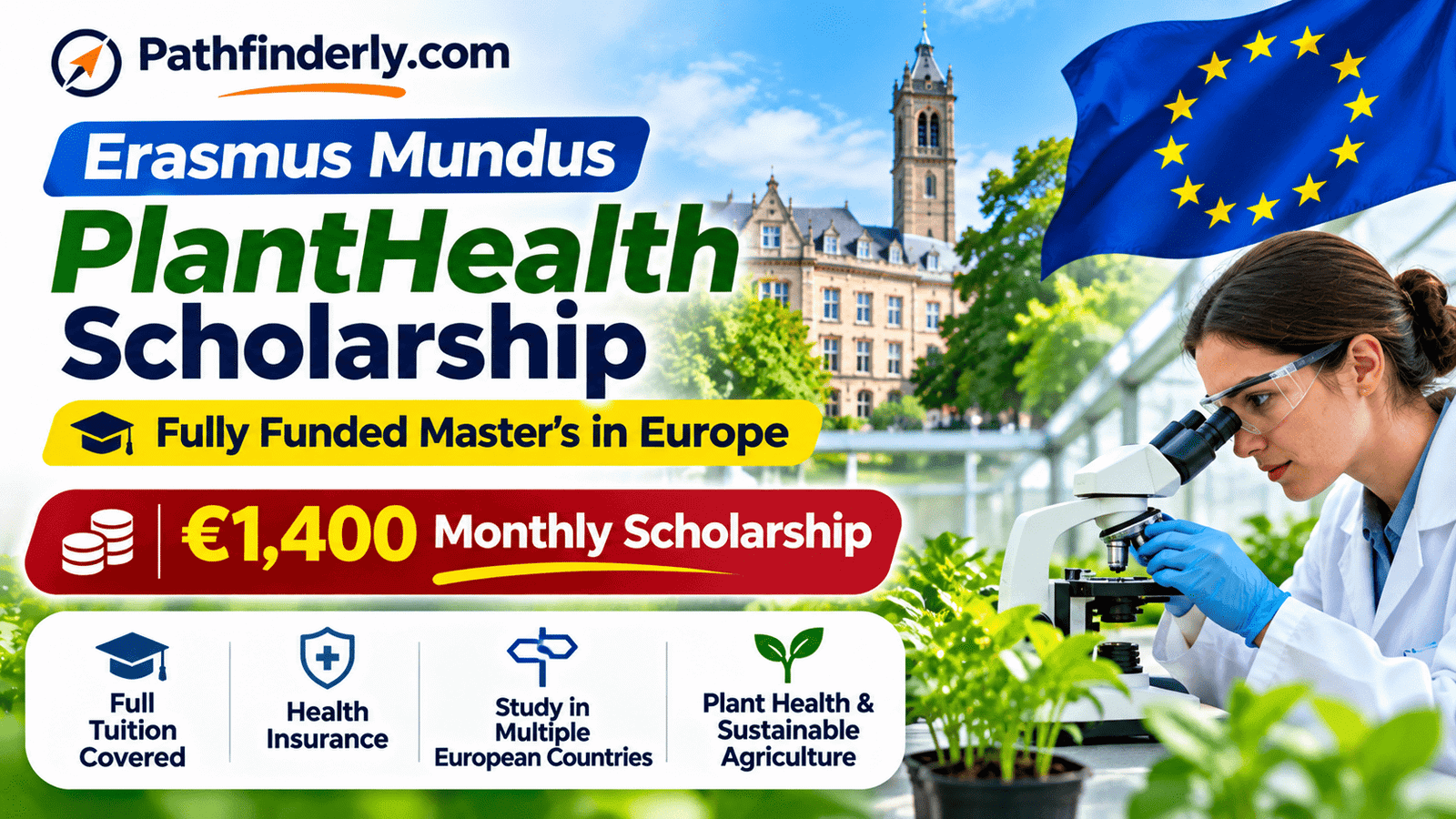
The Erasmus Mundus PlantHealth Scholarship is accepting applications for the 2027–2029 academic intake. This fully funded opportunity allows international students to pursue a two-year master’s degree in Plant Health in Sustainable Cropping Systems at leading European universities. Selected scholarship holders receive full tuition coverage, insurance, and a monthly allowance of €1,400 for up to 24 months.
The PlantHealth program brings together universities in Spain, Italy, Germany, and France. Moreover, it combines academic learning, practical training, international mobility, and research experience.
Students from European and non-European countries can apply. However, applicants must meet the academic and English language requirements.
The scholarship application deadline is 31 December 2026.
Erasmus Mundus PlantHealth Scholarship 2027–2029 Overview
| Details | Information |
|---|---|
| Scholarship | Erasmus Mundus PlantHealth Scholarship |
| Program | Master’s Degree in Plant Health in Sustainable Cropping Systems |
| Academic intake | 2027–2029 |
| Host region | Europe |
| Countries | Spain, Italy, Germany, France |
| Duration | Two years |
| Academic credits | 120 ECTS |
| Degree level | Master’s |
| Scholarship type | Erasmus Mundus Joint Masters |
| Monthly allowance | €1,400 |
| Maximum allowance | €33,600 over 24 months |
| Tuition fees | Fully covered for scholarship holders |
| Eligible nationalities | EU and non-EU applicants |
| Application method | Online |
| Scholarship deadline | 31 December 2026 |
| Official website | https://planthealth.upv.es/web/ |
What Is the Erasmus Mundus PlantHealth Program?
The Erasmus Mundus PlantHealth program is an international master’s degree that focuses on protecting crops and improving sustainable agricultural production.
Modern agriculture faces several challenges. Plant diseases, pests, climate change, and environmental pressures can reduce crop productivity and threaten food security.
Therefore, agricultural researchers and professionals need advanced knowledge of plant protection and sustainable farming practices.
The PlantHealth program addresses these challenges through scientific education and practical training.
Students explore plant diseases, crop protection, sustainable cropping systems, and related research methods.
In addition, the program allows participants to study at different European universities and learn from international experts.
The master’s degree consists of 120 ECTS credits over two academic years.
Participating Universities and Countries
The PlantHealth consortium includes five universities and higher education institutions across four European countries.
1. Universitat Politècnica de València – Spain
The Polytechnic University of Valencia coordinates the PlantHealth program.
It offers academic training in agricultural sciences and related fields. Students can also benefit from research facilities and collaboration with specialists.
2. University of Padova – Italy
The University of Padova is another participating institution.
Its academic programs support research and learning in agriculture, biological sciences, and related disciplines.
3. University of Göttingen – Germany
The University of Göttingen contributes expertise in agricultural research and sustainable crop production.
Students assigned to this institution can explore advanced topics related to plant health.
4. AgroParisTech – France
AgroParisTech specializes in agriculture, food systems, environmental sciences, and related areas.
Its involvement helps connect scientific knowledge with practical agricultural challenges.
5. L’Institut Agro – France
L’Institut Agro also participates in the master’s consortium.
It contributes teaching and research expertise in agriculture, plant sciences, and sustainable production.
Can Students Study in More Than One Country?
Yes. International mobility is an essential part of the PlantHealth program.
Students complete their first academic year at one partner university and continue their second year at another institution.
However, the consortium assigns academic pathways according to available places, student profiles, and program requirements.
Applicants can indicate their preferred mobility options, but the consortium does not guarantee their first choice.
Erasmus Mundus PlantHealth Scholarship Benefits
Selected Erasmus Mundus scholarship holders receive financial support throughout the master’s program.
1. Full Tuition Fee Coverage
The scholarship covers 100% of participation costs.
These include tuition fees, mandatory academic charges, and compulsory insurance.
As a result, scholarship holders do not need to pay the standard program participation fees.
2. Monthly Allowance of €1,400
Selected students receive €1,400 per month for up to 24 months.
The maximum total allowance is:
€1,400 × 24 months = €33,600
This amount helps students manage their living expenses during the program.
3. Travel, Visa, and Relocation Support
The monthly allowance is intended to help cover travel, visa, installation, and living costs.
However, applicants should not assume that the program provides separate airfare or relocation payments in addition to the monthly scholarship.
4. Health Insurance
The scholarship includes compulsory insurance during the academic program.
This provides an important benefit for students who move between European countries.
5. International Academic Experience
Students attend partner universities in different countries.
Consequently, they gain exposure to different teaching approaches, research environments, and agricultural systems.
6. Research and Practical Training
The master’s program includes practical learning and research activities.
Students also complete a master’s thesis, which allows them to investigate a topic related to plant health or sustainable cropping systems.
Erasmus Mundus PlantHealth Scholarship Eligibility Criteria
Applicants must satisfy the program’s academic and language requirements.
Academic Qualifications
Candidates should hold a Bachelor of Science degree equivalent to at least 180 ECTS credits.
Relevant fields include:
- Agronomy
- Agricultural Sciences
- Crop Science
- Plant Protection
- Plant Pathology
- Other closely related scientific disciplines
Applicants should also have at least 4 ECTS credits in Plant Health or Crop Protection, or equivalent academic preparation.
The selection committee reviews academic transcripts to determine whether applicants meet these requirements.
English Language Requirements
Applicants must demonstrate English proficiency at B2 level under the Common European Framework of Reference for Languages.
However, candidates whose bachelor’s degree was taught entirely in English may submit an official letter from their university as proof.
An English language certificate can strengthen an application, even when the university accepts an alternative document.
Students should also review the language requirements of their proposed academic pathway, particularly for courses in France.
Nationality Requirements
The Erasmus Mundus PlantHealth Scholarship welcomes applicants from EU and non-EU countries.
Therefore, students from different regions can compete for available scholarships.
Some additional scholarships may prioritize applicants from specific geographical regions.
Previous Erasmus Mundus Scholarship Holders
Applicants who have already received an Erasmus Mundus Joint Masters scholarship cannot receive another EMJM scholarship.
In addition, students cannot receive overlapping EU funding that violates Erasmus Mundus scholarship rules.
Required Documents
Applicants should prepare their documents before opening the online application.
The program requires academic records, proof of qualifications, and supporting documents.
These may include:
- Bachelor’s degree certificate or appropriate evidence of academic completion.
- Official academic transcripts.
- Proof of English language proficiency.
- Two reference letters using the official PlantHealth template.
- Identification documents requested by the application system.
- Other supporting documents required for the chosen application category.
Applicants should also prepare information about their academic background, motivation, and preferred mobility pathway.
The online system provides the detailed document requirements.
Important: The program requires two reference letters using its official template. Applicants should not replace them with ordinary recommendation letters without checking the instructions.
Erasmus Mundus PlantHealth Selection Criteria
The PlantHealth consortium evaluates applicants according to academic merit and supporting evidence.
The official selection criteria assign the following weights:
| Selection criterion | Weight |
|---|---|
| Academic record and achievements | 60% |
| Reference letters | 20% |
| Personal motivation | 20% |
| Total | 100% |
Academic Performance
Academic records carry the greatest weight.
Therefore, applicants should provide complete transcripts and clearly document relevant coursework.
Reference Letters
Two academic or professional references help the committee evaluate an applicant’s potential.
Strong references should provide specific examples of academic ability, research experience, or professional achievements.
Personal Motivation
Applicants should explain why they want to study plant health and sustainable cropping systems.
They should also describe how the master’s degree connects to their future goals.
For example, candidates may discuss agricultural research, sustainable food production, plant disease management, or environmental protection.
How to Apply for the Erasmus Mundus PlantHealth Scholarship 2027–2029
Applicants must submit their applications through the official online platform.
Follow these steps.
Step 1: Visit the Official Website
Open the PlantHealth application procedure page.
Read the eligibility requirements and application instructions carefully.
Step 2: Create an Online Account
Visit the official PlantHealth application portal.
Create a username and password, and enter your email address.
Step 3: Complete the Application Form
Provide accurate personal and academic information.
In addition, select your preferred mobility pathway according to the available options.
Step 4: Upload Required Documents
Upload academic certificates, transcripts, language evidence, and reference letters.
The application system specifies the accepted document formats and upload limits.
Step 5: Review Your Application
Check all information before submitting.
Once submitted, the application cannot be edited directly. Applicants who need to correct a submission must create a new account and submit a replacement application.
Step 6: Submit Before the Deadline
Complete the application before 31 December 2026 at 23:59 CET.
Only candidates who apply during the first application round can compete for Erasmus Mundus scholarships.
Erasmus Mundus PlantHealth Application Deadline
The official application calendar lists two rounds for the 2027–2029 intake.
| Application stage | Date |
|---|---|
| First round opens | 1 October 2026 |
| Scholarship application deadline | 31 December 2026 |
| First-round selection results | End of February 2027 |
| Second round opens | 20 May 2027 |
| Second round closes | 15 June 2027 |
Important Difference Between the Two Rounds
The first round includes applicants seeking Erasmus Mundus scholarships.
However, the second round is only for self-funded students or candidates with external funding.
Therefore, students who need a fully funded Erasmus Mundus scholarship must apply during the first round.
Other PlantHealth Funding Opportunities
The program also lists additional financial support options.
PlantHealth Consortium Scholarships
Outstanding applicants may receive a tuition fee waiver through the PlantHealth consortium.
However, these awards do not cover accommodation, travel, or living expenses.
Erasmus+ Mobility Grants
Some self-funded students may qualify for Erasmus+ mobility support during their second year.
The program lists indicative support of approximately €350 per month and a travel contribution of around €300, depending on the destination.
These grants are not intended to cover all living expenses.
Special Needs Funding
Eligible students with special needs may request financial assistance for essential participation-related costs.
Applicants must provide the required documentation before the program begins.
Paid Master’s Thesis Internships
Some students may receive financial compensation when completing their master’s thesis with a company.
However, paid placements depend on the employer and are not guaranteed.
Career Opportunities After the PlantHealth Master’s
Graduates can pursue careers related to agriculture, crop protection, research, and sustainable food production.
Potential career paths include:
- Plant health researcher
- Agricultural scientist
- Crop protection specialist
- Plant pathology researcher
- Sustainable agriculture consultant
- Agricultural policy specialist
- Research and development professional
- Doctoral researcher
The master’s degree can also prepare graduates for further academic research.
However, employment opportunities depend on individual qualifications, experience, and local professional requirements.
Tips for a Strong PlantHealth Scholarship Application
The Erasmus Mundus scholarship selection process is competitive.
Therefore, applicants should prepare their documents carefully.
Highlight Relevant Academic Knowledge
Explain your background in agriculture, crop science, plant protection, or related fields.
Use specific examples from your academic studies.
Write a Clear Motivation Statement
Describe why you want to study plant health.
In addition, connect your interests to sustainable agriculture, food security, or scientific research.
Choose Suitable Referees
Request references from people who understand your academic or professional abilities.
Give them enough time to complete the official reference template.
Explain Your Future Goals
Show how the program will help you develop useful knowledge and skills.
For example, you might discuss a future career in agricultural research, crop protection, or sustainable farming.
Apply Early
Do not wait until the final day.
Early preparation gives applicants time to resolve document, translation, or upload problems.
Frequently Asked Questions
Is the Erasmus Mundus PlantHealth Scholarship fully funded?
Yes. Selected EMJM scholarship holders receive full participation-cost coverage, compulsory insurance, and €1,400 per month for up to 24 months.
Can international students apply?
Yes. The program accepts eligible EU and non-EU applicants.
Is IELTS mandatory?
Not necessarily. The program requires B2 English proficiency and accepts an official English-medium instruction letter under its stated conditions.
What is the scholarship’s total value?
The monthly allowance can total €33,600 over 24 months. Full tuition and mandatory academic costs are covered separately.
Can students apply without an agricultural sciences degree?
Applicants from related fields may qualify if their academic preparation meets the program’s requirements.
How many students does the program admit?
The official application procedure states that PlantHealth recruits up to 30 students. However, this does not mean that every admitted student receives an Erasmus Mundus scholarship.
When will applicants receive selection results?
The program expects to publish first-round results at the end of February 2027.
Can students apply in June 2027 for an Erasmus Mundus scholarship?
No. The second application round is reserved for self-funded applicants and candidates with external financial support.
Explore More International Scholarship and Research Opportunities
Students interested in international scientific research can also explore the EPFL Summer Research Program, which offers research experience in Switzerland.
Another relevant opportunity is the ETH Summer Research Fellowship, which provides research opportunities for eligible students.
For those considering research training in the United States, the MIT Summer Research Program is also worth exploring.
These programs have different academic requirements and funding arrangements. Therefore, applicants should review their eligibility before applying.
Final Thoughts
The Erasmus Mundus PlantHealth Scholarship 2027–2029 offers an opportunity for international students who want to specialize in plant health and sustainable agriculture.
Its two-year master’s program combines academic training, research experience, and study at different European universities.
Moreover, selected scholarship holders receive full tuition coverage and a monthly allowance of €1,400.
Interested applicants should prepare their academic documents, confirm their English language eligibility, and submit their applications during the first round.
Application Deadline: 31 December 2026
Official Sources and Application: