
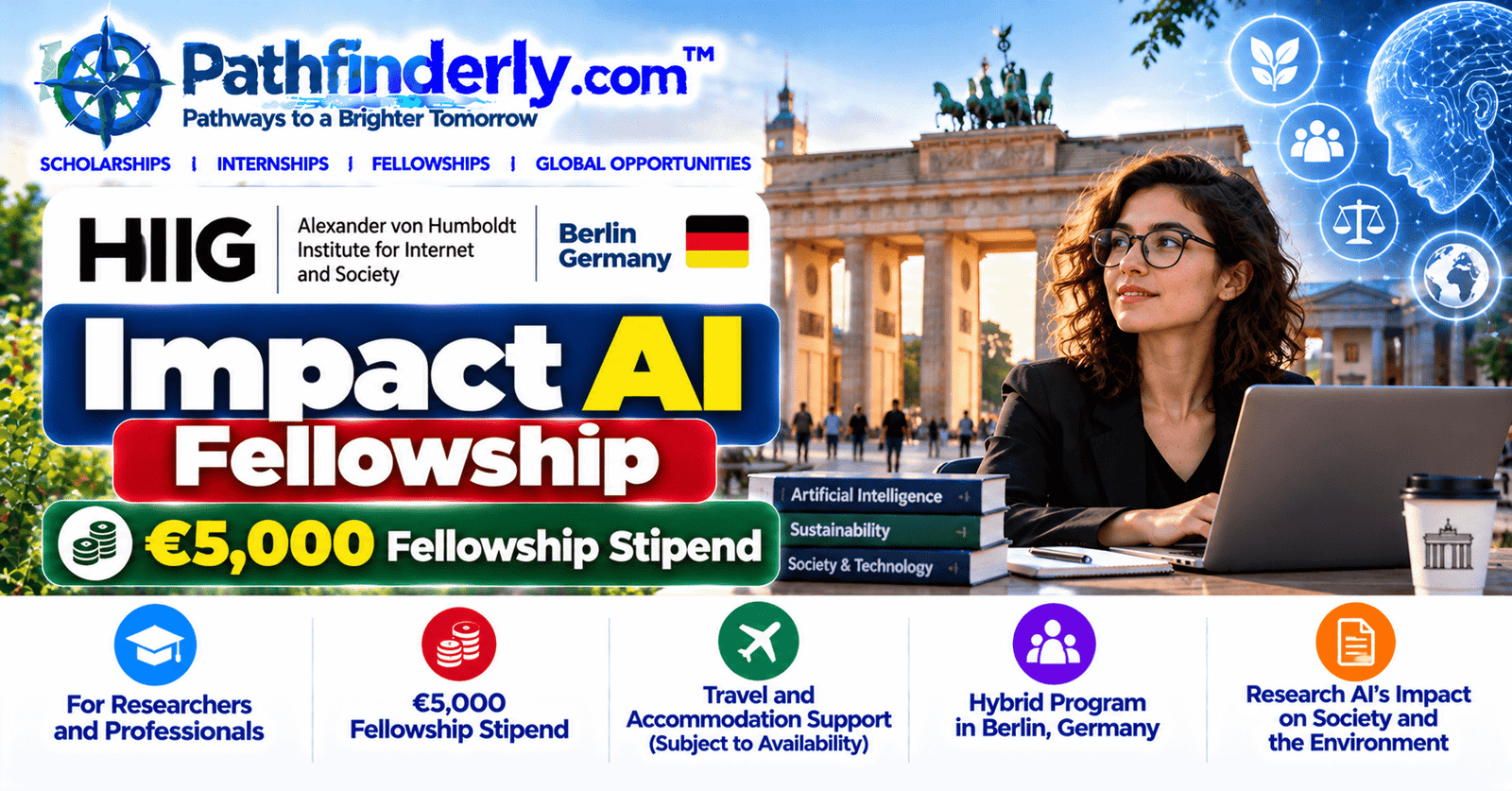
The Impact AI Fellowship 2027 in Germany is accepting applications from researchers and professionals interested in understanding how artificial intelligence affects society and the environment. Hosted by the Alexander von Humboldt Institute for Internet and Society (HIIG) in Berlin, this ten-week research fellowship offers a fixed stipend of €5,000.
The programme welcomes applicants from different professional backgrounds, including academia, journalism, civil society, public institutions and companies.
Selected fellows will learn a structured research method for evaluating the real-world impact of artificial intelligence. They will then apply this approach to a specific AI project and prepare an assessment report.
The fellowship combines in-person workshops in Berlin with independent research, online meetings and expert supervision.
Participants must attend two compulsory in-person weeks in Germany. During other weeks, remote or part-time participation may be possible through individual arrangements.
HIIG also offers financial assistance for necessary travel and accommodation, depending on individual circumstances and available resources.
However, the fellowship is not automatically fully funded. Participants generally remain responsible for visa fees, health insurance, meals and other personal expenses.
Applications close on 15 January 2027.
Interested candidates can review the official Impact Fellowship announcement and application form.
Impact AI Fellowship 2027 Overview
| Details | Information |
|---|---|
| Fellowship | Impact AI Fellowship |
| Year | 2027 |
| Host Institution | Alexander von Humboldt Institute for Internet and Society |
| Country | Germany |
| Main Location | Berlin |
| Fellowship Duration | 10 weeks |
| Fellowship Dates | 16 August – 22 October 2027 |
| Stipend | €5,000 total |
| Travel Support | Available on an individual basis, subject to resources |
| Accommodation Support | Available on an individual basis, subject to resources |
| Programme Format | Hybrid |
| Mandatory Berlin Attendance | Two weeks |
| Research Area | AI, society, sustainability and public interest |
| Academic Requirement | Master’s degree generally expected; equivalent experience considered |
| Eligible Backgrounds | Research, journalism, civil society, public institutions and industry |
| Application Deadline | 15 January 2027 |
| Application Method | Official online application form |
What Is the Impact AI Fellowship?
The Impact AI Fellowship is a research and professional development programme that examines the effects of artificial intelligence on people, society and the environment.
Artificial intelligence is increasingly used in healthcare, education, public services, environmental monitoring and many other fields.
Some applications aim to solve social or environmental problems. However, even well-intentioned technologies can produce unexpected consequences.
For example, an AI system may improve access to information while also raising concerns about privacy, bias or accountability.
Similarly, an environmental AI application might provide useful data but require considerable energy and computing resources.
The fellowship encourages participants to examine these trade-offs using a structured assessment method.
Instead of simply accepting claims that an AI application benefits society, fellows investigate the available evidence.
They will evaluate one real-world AI use case and prepare a report describing its impacts.
About the Host Institution
The Alexander von Humboldt Institute for Internet and Society is a research institute based in Berlin, Germany.
Commonly known as HIIG, the institute studies how digital technologies influence society.
Its research covers topics such as digital transformation, artificial intelligence, governance, public interest and social change.
HIIG brings together researchers and professionals from different disciplines to examine technological developments and their consequences.
The Impact AI project is one of its research initiatives.
It is conducted in partnership with Greenpeace Germany and Economy for the Common Good (ECOnGOOD).
These partners contribute knowledge about environmental sustainability, social responsibility and public-interest assessment.
Official website: Alexander von Humboldt Institute for Internet and Society
What Is the Impact AI Research Project?
Impact AI is a research project focused on evaluating artificial intelligence applications that claim to benefit society or the environment.
The project examines whether these technologies produce their intended positive outcomes.
It also considers possible negative effects.
For example, an AI application may support biodiversity monitoring, improve access to public information or help organizations track environmental data.
However, the technology may also raise questions about energy consumption, fairness, transparency or the use of personal information.
The project aims to assess these different effects systematically.
Researchers have developed the Impact AI Method to support this work.
The method helps evaluators examine AI applications using a consistent and evidence-based approach.
Through the fellowship, participants will learn this method and apply it to an actual AI use case.
Learn more through the official Impact AI research project page.
What Will Fellows Do?
The fellowship combines research training with practical assessment activities.
Each participant will investigate a specific AI application.
The main activities include the following.
Learn the Impact AI Method
Fellows will receive training in the structured method developed by the Impact AI research team.
They will learn how to evaluate the societal and environmental effects of AI systems.
Conduct Research Interviews
Participants will prepare and conduct interviews relevant to their selected AI case.
These interviews may help them understand how the application operates and affects different groups.
Collect and Analyze Evidence
Fellows will examine information gathered through interviews, documentation and other relevant sources.
The purpose is to evaluate the AI application’s actual effects rather than relying only on its stated goals.
Assess a Real-World AI Application
Each fellow will apply the assessment method to one specific AI use case.
The selected application should be suitable for meaningful evaluation within the fellowship period.
Prepare an Assessment Report
Participants will produce a written report presenting their findings.
This report is one of the fellowship’s main expected outputs.
Participate in Workshops
The programme includes workshops led by researchers and practitioners.
These sessions will help fellows develop their research and assessment skills.
Collaborate With Other Fellows
Participants will work in an interdisciplinary learning environment.
They will have opportunities to exchange ideas, discuss challenges and receive feedback.
Receive Research Supervision
The Impact AI research team will provide guidance throughout the fellowship.
This support is intended to help participants complete their assessments with appropriate research quality.
Fellowship Duration and Schedule
The programme runs from 16 August to 22 October 2027.
However, participants must also attend a preparatory online session before the fellowship begins.
The schedule includes compulsory in-person activities in Berlin and periods of independent research.
| Activity | Date | Format |
|---|---|---|
| Preparatory Session | 11 May 2027 | Online |
| Introduction and Training | 16–20 August 2027 | In person, Berlin |
| Independent Research | 23 August – 1 October 2027 | Remote participation possible |
| Assessment Workshops | 4–8 October 2027 | In person, Berlin |
| Final Report Preparation | 11–22 October 2027 | Independent work |
Mandatory Preparatory Session
The programme begins with an online preparation session on 11 May 2027.
This meeting is compulsory.
It takes place approximately three months before the official fellowship begins because research interviews require advance planning.
First In-Person Week in Berlin
From 16 to 20 August 2027, fellows will attend workshops at HIIG.
These sessions will introduce the Impact AI Method and help participants prepare for their research activities.
Independent Research Phase
From 23 August to 1 October 2027, participants will work on their assessments.
This phase includes data collection, interviews, analysis and online meetings.
Remote or part-time arrangements may be possible.
Second In-Person Week in Berlin
From 4 to 8 October 2027, fellows must return to HIIG for another compulsory workshop week.
They will present and discuss their assessment results.
Final Report Preparation
During the final programme period, participants will complete their assessments and prepare their reports.
The fellowship ends on 22 October 2027.
Financial Benefits of the Impact AI Fellowship
The programme provides a fixed stipend and several professional development benefits.
1. €5,000 Fellowship Stipend
Each selected fellow receives a fixed stipend of €5,000 for the entire ten-week fellowship.
This amount is not a monthly payment.
It also includes any tax or social security costs that may apply in the fellow’s country of origin.
Participants should therefore consider their personal tax obligations.
2. Travel Assistance
HIIG may provide financial support for travel required to attend the in-person programme in Berlin.
However, this assistance is assessed individually.
The amount depends on the fellow’s circumstances and the institute’s available resources.
Applicants should not assume that all travel expenses will automatically be reimbursed.
3. Accommodation Assistance
Financial support may also be available for accommodation needed during the compulsory in-person sessions.
As with travel, this assistance depends on individual arrangements and funding capacity.
4. Research Training
Participants receive training in the Impact AI Method.
This can help them develop practical skills in evaluating AI systems.
5. Individual Supervision
The research team will guide fellows during their assessment work.
6. Workshops and Expert Input
Fellows will participate in workshops led by researchers and practitioners.
7. Research Report Authorship
Participants are expected to take a leading authorship role in their case assessment reports.
8. Future Research Opportunities
The programme may create opportunities for future collaboration or publication based on the research data.
However, these opportunities are not guaranteed.
Is the Impact AI Fellowship Fully Funded?
The fellowship offers meaningful financial support, but it should not be described as universally fully funded.
The confirmed financial benefit is the €5,000 stipend.
Travel and accommodation assistance is conditional.
| Expense | Funding Arrangement |
|---|---|
| Fellowship stipend | €5,000 total |
| Required travel | Individual financial support, subject to capacity |
| Accommodation | Individual financial support, subject to capacity |
| Research training | Provided |
| Workshops | Provided |
| Research supervision | Provided |
| Visa expenses | Generally the fellow’s responsibility |
| Health insurance | Generally the fellow’s responsibility |
| Meals | Generally the fellow’s responsibility |
| Other personal expenses | Fellow’s responsibility |
HIIG may consider additional necessary support in exceptional circumstances.
However, applicants should not rely on such assistance without written confirmation.
Before accepting an offer, selected candidates should clarify which expenses will be covered.
Who Can Apply for the Impact AI Fellowship?
The programme welcomes applicants from different academic and professional backgrounds.
Candidates should have a strong interest in research and the societal or environmental impacts of artificial intelligence.
1. Academic Background
A master’s degree is generally expected.
However, applicants without a master’s degree are not automatically excluded.
Candidates with equivalent professional experience or training may still be considered.
They should demonstrate that their background prepares them for the programme’s research requirements.
2. Research Experience or Professional Expertise
Applicants should have relevant research experience or professional expertise.
Suitable fields may include artificial intelligence, sustainability, technology assessment, governance or public-interest work.
3. Interest in Artificial Intelligence
Candidates should be interested in understanding how AI systems affect society.
They do not necessarily need to be software developers.
However, they must be willing to learn and apply a structured assessment method.
4. Research Motivation
Participants should demonstrate a genuine interest in rigorous research.
They must be prepared to collect evidence, analyze findings and produce a written report.
5. Interdisciplinary Collaboration
The programme brings together people with different professional experiences.
Applicants should be comfortable working with researchers and professionals from other fields.
6. Independent Working Ability
Fellows must be capable of organizing their research and completing assigned tasks.
7. Programme Availability
Selected participants must attend the mandatory online and in-person activities.
They must also commit to producing the required research outputs.
8. Fellowship Agreement
Participants must agree to the fellowship contract and its requirements.
Which Professional Backgrounds Are Eligible?
HIIG specifically welcomes applicants from several sectors.
Academic Researchers
Researchers working on artificial intelligence, technology, society or sustainability may find the programme relevant.
Journalists
Journalists investigating AI systems, digital technologies or public-interest issues may apply.
Civil Society Professionals
People working with non-governmental organizations or advocacy groups may bring valuable perspectives on the social effects of technology.
Public Sector Professionals
Applicants from government institutions and public organizations may contribute experience in policy, governance or public services.
Industry Professionals
Professionals working in companies engaged with AI, sustainability or public-interest applications may also apply.
The programme values diverse experiences.
Applicants should explain how their background relates to the fellowship’s research objectives.
Can International Applicants Apply?
The official announcement welcomes applicants from diverse backgrounds and does not specify a nationality restriction.
Therefore, international applicants may apply if they meet the programme’s requirements.
However, participants must be able to attend the compulsory sessions in Berlin.
Applicants from countries requiring a visa to enter Germany should consider the relevant immigration procedures.
The institute does not promise automatic visa approval or universal reimbursement of visa costs.
Candidates should clarify their travel and participation arrangements before accepting a fellowship offer.
Can Applicants Without a Master’s Degree Apply?
Yes, potentially.
HIIG states that a master’s degree is generally expected, but not having one does not automatically disqualify an applicant.
Candidates with equivalent experience and training are encouraged to apply.
However, applicants without sufficient research experience or relevant expertise may be less competitive.
Someone without a master’s degree should use their application to explain their professional background and demonstrate their ability to conduct rigorous research.
Is Programming Experience Required?
The official announcement does not establish programming as a universal eligibility requirement.
The fellowship focuses on assessing the effects of AI applications rather than developing software.
Applicants may come from social sciences, journalism, public policy, sustainability and other relevant fields.
However, understanding AI systems and their practical implications can strengthen an application.
Candidates should accurately describe their technical knowledge and research experience.
Do Applicants Need to Propose an AI Project?
No.
Proposing an AI project is optional.
Applicants who already know a suitable real-world AI application may describe it in their application.
However, candidates without a project can still apply.
HIIG supports fellows in identifying and connecting with suitable AI cases through a separate call for projects.
This makes the fellowship accessible to applicants who have relevant expertise but do not already manage an AI system.
What Kind of AI Projects Can Be Assessed?
The Impact AI research project focuses on AI applications intended to support sustainability or the public interest.
Possible areas include:
Environmental Monitoring
AI systems may be used to monitor biodiversity, track environmental changes or analyze ecological information.
Climate and Sustainability
Some applications support environmental data analysis or the monitoring of emissions.
Public Information
AI tools may help people access information or understand complex public issues.
Democracy and Governance
Some systems aim to improve transparency, support public debate or strengthen civic participation.
Social Services
AI applications may be used to support services intended to benefit communities.
These examples illustrate relevant fields rather than guaranteeing that every proposed project will be accepted.
The selected case must be suitable for assessment using HIIG’s research method.
What Is the Impact AI Method?
The Impact AI Method is a structured approach developed by the research project at HIIG.
It evaluates how AI applications affect people, society and the environment.
The method examines both potential benefits and possible harms.
For example, an AI application may improve access to information while also creating risks related to discrimination or accountability.
Similarly, a system designed to support sustainability may have environmental costs associated with its operation.
The method helps researchers examine these issues systematically.
It includes seven assessment steps and 25 criteria.
The approach considers factors connected with sustainability, the public interest, human rights and democratic values.
The aim is to move beyond broad claims and provide evidence about actual effects.
Fellows will learn the method and apply it to their selected cases.
More information is available through the official Impact AI project.
Documents Required for Application
Applicants must complete the official online form and submit supporting documents.
All required documents should be combined into one file.
1. Curriculum Vitae
Maximum length: Four pages
The CV should highlight relevant education, research, professional experience and technical skills.
2. Motivation Letter
Maximum length: Two pages
The motivation letter should describe the applicant’s interest in the fellowship.
It should also explain their level of AI expertise and organizational background.
If relevant, applicants may describe their organization’s motivation for supporting participation.
3. Optional AI Project Description
Maximum length: Two pages
Applicants who wish to propose an AI project may include a short description.
This document is optional.
Candidates without a proposed project do not need to create one simply to apply.
How to Write a Strong Motivation Letter
A motivation letter should explain why the applicant is suitable for the fellowship.
Introduce Your Background
Begin with a brief explanation of your academic or professional experience.
Explain Your Interest in AI
Describe why you want to investigate the effects of artificial intelligence.
Highlight Relevant Experience
Discuss research, journalism, policy work, technology assessment or other relevant activities.
Demonstrate Research Skills
Provide examples of interviews, data analysis, report writing or evidence-based investigation.
Explain Your Interest in Sustainability
Describe how your work connects with social responsibility, environmental sustainability or the public interest.
Discuss Your Future Plans
Explain how you intend to use the Impact AI Method after the fellowship.
Demonstrate Availability
Confirm your ability to participate in the required activities, including the compulsory sessions in Berlin.
Keep the letter clear, specific and within the two-page limit.
How to Apply for the Impact AI Fellowship 2027
Applications must be submitted through the official HIIG fellowship webpage.
Step 1: Visit the Official Announcement
Open the Impact AI Fellowship 2027 application page.
Review the programme description and eligibility requirements.
Step 2: Check Your Eligibility
Consider your education, professional experience and research interests.
Step 3: Review the Fellowship Schedule
Make sure you can attend the compulsory online preparation session and the two in-person weeks in Berlin.
Step 4: Prepare Your CV
Create an updated CV of no more than four pages.
Step 5: Write Your Motivation Letter
Explain your interest, relevant experience, AI expertise and professional goals.
Step 6: Prepare an Optional Project Description
If you want to propose an AI application for assessment, prepare a description of no more than two pages.
Step 7: Combine Your Documents
Combine the CV, motivation letter and optional project description into one file.
Step 8: Complete the Online Form
Find the application form on the official fellowship page.
Enter the requested information accurately.
Step 9: Upload Your Documents
Attach the combined file.
Step 10: Review the Application
Check your information and ensure that your documents meet the page limits.
Step 11: Submit Before the Deadline
Complete the application by 15 January 2027.
Step 12: Monitor Official Communications
Watch for messages from HIIG concerning your application and possible next steps.
Official Application: Impact AI Fellowship 2027 – HIIG
Impact AI Fellowship Application Deadline
The official deadline is 15 January 2027.
Applicants should prepare their documents well before this date.
Since the fellowship involves research commitments and travel to Germany, candidates should also consider their availability in advance.
The organizers may publish further information about the application or selection process.
Applicants should follow the official HIIG website for updates.
Online Information Sessions
HIIG has announced two optional online information sessions for interested applicants.
| Session | Date | Time |
|---|---|---|
| First Information Session | 10 November 2026 | 10:00 AM CET |
| Second Information Session | 17 November 2026 | 3:00 PM CET |
These sessions offer an opportunity to learn more about the programme.
According to HIIG, registration is not required.
Interested candidates can access the joining information through the official fellowship announcement.
Is the Fellowship Completely Remote?
No.
The programme has a hybrid structure.
Fellows must attend two full-time in-person weeks in Berlin.
These take place from 16–20 August and 4–8 October 2027.
Other parts of the fellowship may be completed remotely or on a part-time basis.
However, these arrangements must be agreed individually.
All fellows must attend compulsory online check-ins and complete their research responsibilities.
Applicants should not interpret the hybrid format as permission to skip the in-person sessions.
Visa and Travel Considerations
International applicants may need a visa to travel to Germany.
Visa requirements depend on nationality, residence status and the intended activities.
Applicants should review the applicable German immigration rules.
They should also clarify whether HIIG can provide documentation supporting their visa application.
The fellowship announcement does not guarantee that visa fees will be reimbursed.
Travel and accommodation assistance is offered individually and depends on available resources.
Selected candidates should confirm these arrangements before making financial commitments.
Health Insurance and Living Expenses
Fellows are generally responsible for arranging their own health insurance.
They must also cover meals and other personal expenses unless additional assistance is specifically agreed.
The €5,000 stipend may help participants meet some of these costs.
However, applicants should prepare a realistic budget.
Living expenses will depend on the participant’s circumstances and the amount of time spent in Berlin.
Candidates should not assume that all costs will be covered automatically.
Research Experience and Career Benefits
The fellowship can be valuable for professionals interested in responsible artificial intelligence.
Participants will gain experience applying a structured assessment method to a real-world AI application.
They may also strengthen their ability to conduct interviews, analyze evidence and prepare research reports.
The programme provides opportunities to collaborate with researchers from different disciplines.
In addition, fellows will take a leading role in preparing their case assessment reports.
These experiences may support future work in research, technology governance, journalism, civil society or public policy.
However, the fellowship does not guarantee employment or future research funding.
Other International Fellowships to Explore
Applicants interested in research and professional development can also explore other international fellowship opportunities.
The KAUST Global Fellowship Program may interest researchers seeking opportunities to advance scientific research in Saudi Arabia.
Those working on sustainability and practical water-sector innovations may consider the IWA & Grundfos SDG 6 Fellowship.
For additional programmes across different fields, explore our latest international fellowships on Pathfinderly.
Each opportunity has its own eligibility requirements, financial benefits and application deadline.
Frequently Asked Questions
What is the Impact AI Fellowship 2027?
It is a ten-week research fellowship hosted by HIIG in Germany. Participants evaluate the societal and environmental impacts of real-world AI applications.
Where is the fellowship held?
The in-person activities take place in Berlin, Germany.
How long does the fellowship last?
The programme runs for ten weeks, from 16 August to 22 October 2027.
How much is the stipend?
Each fellow receives €5,000 for the entire fellowship period.
Is the €5,000 stipend monthly?
No. It is the total stipend for ten weeks.
Is the fellowship fully funded?
Not automatically. The €5,000 stipend is confirmed, while travel and accommodation support depends on individual arrangements and available resources.
Does HIIG cover international flights?
Travel support may be available, but the announcement does not guarantee full reimbursement for every fellow.
Is accommodation provided?
Financial support for necessary accommodation may be available on an individual basis.
Are visa fees covered?
Visa fees are generally the fellow’s responsibility.
Is health insurance covered?
No general health insurance benefit is guaranteed.
Can international applicants apply?
Yes. The official announcement does not specify a nationality restriction.
Is a master’s degree compulsory?
A master’s degree is generally expected, but applicants with equivalent experience and training may be considered.
Can journalists apply?
Yes. HIIG specifically welcomes applicants from journalism.
Can civil society professionals apply?
Yes.
Can government employees apply?
Applicants working in public institutions are among the intended candidates.
Do I need to be a programmer?
No universal programming requirement is specified.
Do I need an AI project before applying?
No. Proposing an AI project is optional.
Is the fellowship available remotely?
Part of the programme may be completed remotely, but two in-person weeks in Berlin are compulsory.
When are the mandatory Berlin sessions?
16–20 August and 4–8 October 2027.
Is there a preparation session?
Yes. A compulsory online preparatory session is scheduled for 11 May 2027.
What documents are required?
A CV of up to four pages, a motivation letter of up to two pages and an optional AI project description of up to two pages.
Should the documents be submitted separately?
No. HIIG asks applicants to combine them into one file.
What is the application deadline?
15 January 2027.
Where can I apply?
Through the official HIIG Impact AI Fellowship webpage.
Final Thoughts
The Impact AI Fellowship 2027 in Germany offers an opportunity for researchers and professionals who want to examine the real-world effects of artificial intelligence.
Hosted by HIIG in Berlin, the programme combines research training, expert supervision, interdisciplinary collaboration and practical assessment work.
Selected fellows receive a fixed stipend of €5,000 for the ten-week programme.
Additional financial assistance for travel and accommodation may be available, although the amount depends on individual arrangements and available resources.
The fellowship welcomes applicants from academia, journalism, civil society, public institutions and industry.
A master’s degree is generally expected, but equivalent professional experience may also be considered.
Interested candidates should review the official eligibility requirements, prepare their application documents and submit the online form before the deadline.
Application Deadline: 15 January 2027
Official Source and Application: Impact AI Fellowship 2027 – Alexander von Humboldt Institute for Internet and Society
Official Research Project: Impact AI – HIIG
Last Verified: 30 October 2026
Pathfinderly.com is an independent opportunities information website and is not affiliated with HIIG. Programme requirements, financial arrangements and application procedures may change. Applicants should confirm the latest information through official sources before applying.