
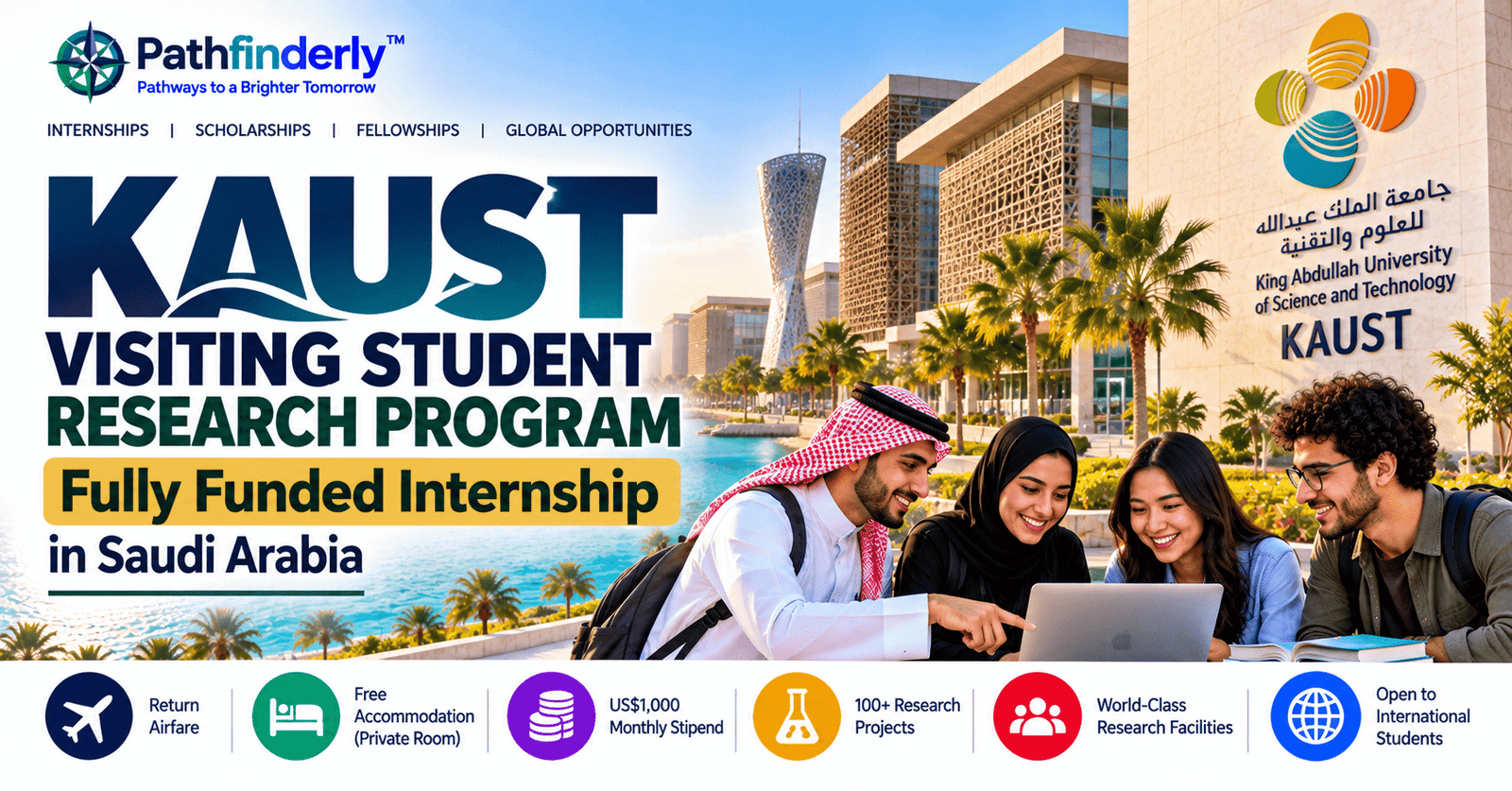
The KAUST Visiting Student Research Program offers fully funded research internships for students interested in science, technology, engineering and mathematics.
The program takes place at the King Abdullah University of Science and Technology (KAUST) in Saudi Arabia.
Unlike many summer internships, the KAUST program operates throughout the year. Students can choose from more than 100 active research projects and arrange internship dates according to the selected project’s requirements.
Internships generally last between 2 and 6 months.
KAUST provides substantial financial support to accepted interns. The current package includes a US$1,000 monthly stipend, private accommodation and return airfare.
This makes the program especially useful for international students who want research experience before applying for a Master’s or PhD.
Applications are accepted year-round through the official KAUST internship portal.
KAUST Visiting Student Research Program Overview
| Details | Information |
|---|---|
| University | King Abdullah University of Science and Technology |
| Short Name | KAUST |
| Program | Visiting Student Research Program |
| Program Type | Research Internship |
| Location | Thuwal, Saudi Arabia |
| Eligible Level | 3rd/4th-year Bachelor’s and Master’s students |
| Fields | STEM |
| Duration | 2–6 months |
| Research Projects | 100+ active projects |
| Monthly Stipend | US$1,000 |
| Accommodation | Private bedroom and bathroom |
| Airfare | Return airfare provided |
| Application Deadline | Year-round |
| International Students | Eligible |
| Funding | Fully Funded |
What Is the KAUST Visiting Student Research Program?
The Visiting Student Research Program, commonly called VSRP, allows students to work on research projects with KAUST faculty and researchers.
Instead of following a general classroom-based internship, applicants select a particular research project that matches their academic background and interests.
Successful applicants then join a research group at KAUST.
Projects span different areas of science and engineering. Depending on the project, interns may work in laboratories, conduct experiments, develop computational models, analyze data or contribute to ongoing research.
The program can therefore provide valuable preparation for students considering research careers or graduate study.
Is the KAUST VSRP Fully Funded?
Yes.
KAUST currently describes its VSRP internship as a fully funded program.
The funding package reduces many of the major expenses that normally make international research internships difficult for students.
Current benefits include:
- US$1,000 monthly stipend
- Private bedroom and bathroom
- Return airfare
- Social and cultural activities
- Access to KAUST Core Labs
- Access to research facilities
- Access to university community facilities
Some individual KAUST research project pages also list health insurance and visa-related support as benefits.
Applicants should still read the conditions attached to their particular internship offer.
US$1,000 Monthly Stipend
Accepted VSRP interns currently receive:
US$1,000 per month
The stipend helps students cover their living expenses during the internship.
For example, an intern staying for four months could receive:
US$4,000
over the internship period, subject to the terms of the award.
A six-month placement could provide:
US$6,000
in monthly stipends.
The final amount therefore depends on the length of the internship.
Free Accommodation
Housing is another major benefit.
KAUST currently lists:
Private bedroom and bathroom
as part of the VSRP funding package.
This is especially valuable because international interns do not need to independently arrange standard private accommodation near the university for the duration of the placement.
Interns live within KAUST’s international campus environment.
Return Airfare
KAUST provides airfare for accepted VSRP interns.
The current program information states that the package covers travel:
to KAUST and back.
Therefore, eligible accepted interns do not normally need to finance their international return flight as part of the standard VSRP package.
Travel arrangements should still follow the instructions given by KAUST after acceptance.
Research Facilities
VSRP interns receive access to KAUST’s research infrastructure.
This includes access to:
- Core laboratories
- Specialized research facilities
- Scientific equipment
- Research expertise
- Training opportunities
- Community facilities
The exact facilities an intern uses will depend on the selected research project.
For students who come from universities with limited laboratory resources, this can be one of the most valuable parts of the program.
Social and Cultural Activities
The internship is not limited to laboratory work.
KAUST also lists:
Social and cultural activities
among the program benefits.
International interns live within a university community that includes students and researchers from many countries.
This gives participants opportunities to build professional networks while experiencing life in Saudi Arabia.
Who Can Apply for KAUST VSRP?
The current KAUST program primarily targets:
- Third-year Bachelor’s students
- Fourth-year Bachelor’s students
- Master’s students
Applicants should be studying in a relevant STEM field.
Academic background must also match the requirements of the research project selected by the applicant.
Can International Students Apply?
Yes.
The KAUST Visiting Student Research Program welcomes international students.
KAUST has a highly international academic and research community, and the VSRP brings students from universities around the world to Saudi Arabia.
Nationality alone is therefore not a reason to avoid applying.
Applicants still need to satisfy the academic and project-specific eligibility requirements.
GPA Requirement
KAUST’s current research-project portal lists a cumulative GPA benchmark of:
3.5 out of 4.0
Some individual projects can be more competitive or require stronger academic preparation.
Applicants using another grading system should not simply convert their grades themselves and assume eligibility.
KAUST will evaluate academic records according to its admissions process.
English Language Requirement
Applicants need sufficient English ability to participate in research and communicate with faculty and research teams.
KAUST’s current VSRP information lists the following English benchmark:
Duolingo English Test: 110 overall, with at least 100 in each individual section.
An English test score is not required if the applicant earned a qualifying degree through in-person study at an accredited institution in:
- United States
- Canada
- United Kingdom
- Ireland
- Australia
- New Zealand
KAUST also notes that official test scores may be requested during application evaluation.
Where an applicant does not meet the English requirement, KAUST says it can provide a Duolingo test token to take the examination.
Therefore, students should follow the instructions they receive during evaluation rather than assuming they must purchase a test immediately.
Fields Available for KAUST Research Internships
VSRP research projects connect with KAUST’s STEM degree areas.
Opportunities can include subjects such as:
Computer Science
Projects may involve:
- Artificial intelligence
- Machine learning
- Data science
- Computer vision
- Algorithms
- Computational research
Electrical and Computer Engineering
Research can include:
- Electronics
- Communications
- Semiconductor technologies
- Photonics
- Sensors
- Intelligent systems
Applied Mathematics and Statistics
Students may work on:
- Mathematical modelling
- Computational methods
- Statistics
- Optimization
- Data analysis
Bioscience and Bioengineering
Possible areas include:
- Molecular biology
- Genetics
- Biotechnology
- Biomedical research
- Biological systems
Environmental Science and Engineering
Projects can address:
- Sustainability
- Environmental systems
- Water
- Climate
- Pollution
- Ecosystems
Marine Science
KAUST’s Red Sea location provides research opportunities connected with marine environments and ecosystems.
Chemical Engineering and Chemistry
Research areas can include:
- Materials
- Catalysis
- Chemical processes
- Energy
- Molecular science
Materials Science
Projects may involve advanced materials for applications in areas such as:
- Energy
- Electronics
- Semiconductors
- Sustainability
Mechanical Engineering
Research opportunities can involve:
- Robotics
- Fluid mechanics
- Energy systems
- Manufacturing
- Computational engineering
Plant Science
Projects can focus on plant biology, food systems and environmental challenges.
These are only examples. Applicants should explore the current KAUST research internship projects rather than selecting a field based only on a general list.
More Than 100 Research Projects
One of the strongest features of VSRP is that applicants do not simply submit one generic internship application.
KAUST currently lists more than 100 active research projects.
Each project page can provide information about:
- Research topic
- Faculty researcher
- Recommended student background
- Internship duration
- Research objectives
- Expected outcomes
For example, current projects cover areas ranging from artificial intelligence for Red Sea fisheries monitoring to energy storage, semiconductors and advanced materials.
This structure allows applicants to target a project that genuinely matches their academic skills.
How Long Is the KAUST Internship?
The main KAUST admissions page currently describes VSRP internships as lasting:
2 to 6 months
Individual projects can specify their own preferred period.
Many current project listings show placements of:
3–6 months.
Others may require a particular duration because the intern needs enough time to complete experimental or research work.
Therefore, always check the project page before applying.
When Does the KAUST Internship Start?
There is no single universal summer start date.
This is one of the main advantages of the program.
KAUST states that internships are flexible and can start at different times:
throughout the year.
Start and end dates depend on factors such as:
- Project requirements
- Faculty availability
- Student availability
- KAUST approval
This makes VSRP different from internships that accept students only during June, July or August.
Application Deadline
There is no single annual deadline.
Applications are accepted:
All year round
Students can therefore search for available projects throughout the year.
However, year-round applications do not mean every project will always remain available.
Projects depend on research needs, faculty availability and available positions.
Applying early is sensible when you find a project that closely matches your background.
Documents Required
Applicants should prepare the following documents:
Official Academic Transcript
KAUST requires official transcript information in English for relevant degrees.
If your academic documents are not originally in English, follow KAUST’s instructions regarding acceptable translations.
Curriculum Vitae
Prepare an academic CV highlighting:
- Education
- Research experience
- Laboratory skills
- Technical skills
- Programming languages
- Projects
- Publications, if any
- Relevant internships
- Awards
- Academic activities
Keep the information relevant to the research project.
Statement of Purpose
The Statement of Purpose should explain your motivation for joining the selected research project.
It should show:
- Why the project interests you
- Your relevant academic background
- Skills you can contribute
- Research interests
- What you hope to learn
- Your future academic or professional plans
Avoid sending the same generic statement to unrelated research projects.
Faculty Recommendation
Applicants need a:
Letter of recommendation from a faculty member at their current institution.
Choose someone who understands your academic performance or research potential.
Valid Passport
KAUST currently requires a valid passport with:
at least six months of validity.
Check your passport before starting the application.
How to Apply for the KAUST Visiting Student Research Program
The application process is project-based.
Step 1: Visit the Official Internship Portal
Start with the official KAUST internship page.
Read the current program requirements before applying.
Step 2: Search Available Research Projects
Open the KAUST research project database.
Do not choose a project simply because its title sounds impressive.
Read the complete description.
Step 3: Check Your Academic Match
Look at the recommended student background.
Ask yourself whether you have relevant:
- Coursework
- Laboratory experience
- Programming knowledge
- Research experience
- Technical skills
A strong match is more useful than applying randomly to many unrelated projects.
Step 4: Select the Project
Once you identify a suitable project, use the Apply option on its project page.
Step 5: Prepare Your Documents
Have your:
- Transcript
- CV
- Statement of Purpose
- Faculty recommendation
- Passport
ready according to the application requirements.
Step 6: Submit the Application
Complete the online application carefully.
Make sure the information in your application matches your supporting documents.
Step 7: Wait for Evaluation
KAUST reviews the application and evaluates the candidate’s suitability for the selected research project.
Shortlisted candidates may move to additional evaluation or interview stages.
Step 8: Follow KAUST’s Travel Instructions
If accepted, follow the official instructions regarding:
- Visa procedures
- Flights
- Arrival
- Housing
- Internship start date
Do not independently book travel unless KAUST instructs you to do so.
How to Choose the Right Research Project
Project selection can strongly affect your application.
Start with your strongest academic area.
For example, a computer science student with machine-learning projects should generally look for research involving:
- AI
- Machine learning
- Data science
- Computer vision
- Computational modelling
A chemical engineering student may be better suited to projects involving:
- Chemical processes
- Catalysis
- Energy storage
- Materials
- Electrochemistry
Your application should show a logical connection between your previous experience and the proposed research.
How to Strengthen Your Application
Match Your CV to the Project
Put the most relevant experience near the top.
If the project requires Python, MATLAB or laboratory techniques, make those skills easy to find.
Write a Project-Specific Statement
Mention the research problem that interests you.
Explain why your previous studies prepare you for that work.
Show Evidence of Research Potential
You do not necessarily need published papers.
Useful evidence can include:
- Final-year projects
- Laboratory projects
- Research assistant work
- Independent technical projects
- Coding projects
- Conference participation
- Academic competitions
Choose Your Recommender Carefully
A recommendation from a professor who knows your work well can be more useful than a generic letter from someone with a senior title.
Apply to Projects That Fit Your Background
A targeted application is usually stronger than an application to a project requiring skills you have never studied.
Do You Need Research Experience?
Previous research experience can strengthen an application, but students should not automatically assume that they are ineligible without publications or formal research jobs.
VSRP is designed to provide students with hands-on research experience.
Academic projects, laboratory courses and technical work can also demonstrate potential.
The individual project description is the best guide to the skills expected.
Do You Need Publications?
There is no general requirement that every VSRP applicant must already have research publications.
Publications can strengthen an application where relevant, but they are not a universal prerequisite.
A strong academic record, appropriate technical background, good recommendation and clear research motivation can all matter.
Can Master’s Students Apply?
Yes.
The program accepts eligible Master’s students in relevant STEM areas.
A Master’s student should select a project that fits their existing academic and research preparation.
Can Bachelor’s Students Apply?
Yes, but the current program primarily targets students who have reached the later stages of their undergraduate studies.
KAUST specifically identifies:
third- and fourth-year Bachelor’s students
as eligible groups.
Students in their first or second undergraduate year should therefore consider waiting until they reach the required stage.
Can PhD Students Apply?
The main VSRP program is aimed at advanced Bachelor’s and Master’s students rather than students already enrolled in PhD programs.
PhD students should search for research opportunities specifically designed for doctoral researchers instead of assuming VSRP is the correct route.
Why Consider a KAUST Research Internship?
The program combines several benefits that are difficult to find together.
Students can gain:
- International research experience
- Faculty mentorship
- Laboratory experience
- Access to advanced facilities
- Practical research skills
- Exposure to interdisciplinary research
- International networking
- Experience living in Saudi Arabia
The fully funded structure also makes the program more accessible to students who could not otherwise finance several months abroad.
KAUST VSRP vs Regular Summer Internships
A typical summer internship has a fixed annual schedule.
KAUST VSRP is different.
Applications are available year-round, and students choose from faculty-led research projects.
The program is also research-focused rather than primarily corporate.
Therefore, it may be particularly suitable for students considering:
- Master’s study
- PhD study
- Academic research
- Research and development careers
- Scientific or engineering careers
KAUST VSRP vs Other International Internships
Students interested in technology careers can also explore the Google Software Developer Internship, which focuses more on software engineering in a corporate environment.
Those interested in aerospace and engineering can consider the Airbus Internship Program, which offers opportunities across several technical and business disciplines.
Applicants interested in quantitative research, finance and technology can explore the AQR Internship.
Students interested specifically in biological and biomedical research can also explore the EPFL Summer Research Program, an eight-week funded research internship in Switzerland for high-achieving life-sciences students.
These programs have different objectives. KAUST VSRP is particularly suited to students who want academic and scientific research experience.
Frequently Asked Questions
What does KAUST VSRP stand for?
VSRP stands for Visiting Student Research Program.
Where is KAUST located?
KAUST is located in Thuwal, Saudi Arabia, on the Red Sea coast.
Is the KAUST internship fully funded?
Yes. KAUST currently describes VSRP as fully funded.
How much is the stipend?
The current monthly stipend is:
US$1,000.
Is accommodation provided?
Yes. The current package includes a private bedroom and bathroom.
Does KAUST pay for flights?
Yes. The current VSRP package includes airfare to KAUST and back.
How long does the internship last?
The main program currently states 2–6 months, although many individual projects list 3–6 months.
Is there a fixed application deadline?
No. Applications are accepted all year round.
Can international students apply?
Yes.
Can Bachelor’s students apply?
Eligible third- and fourth-year Bachelor’s students can apply.
Can Master’s students apply?
Yes.
Is the program limited to computer science?
No. Research projects span numerous STEM areas.
What GPA is required?
The current project portal lists a 3.5/4.0 cumulative GPA benchmark.
Do I need IELTS?
KAUST’s current program information uses the Duolingo English Test benchmark and provides exemptions for certain qualifying English-medium degrees. Follow the instructions issued during your application evaluation.
How many projects are available?
KAUST currently lists more than 100 active research projects.
Can I choose my research project?
Yes. Applicants search available projects and apply to a specific opportunity that fits their background.
Final Thoughts
The KAUST Visiting Student Research Program is one of the more flexible fully funded research internships available to STEM students.
Unlike internships with a short annual application period, VSRP accepts applications throughout the year.
Eligible third- and fourth-year Bachelor’s and Master’s students can choose from more than 100 research projects and spend approximately 2–6 months working with researchers at KAUST.
The current funding package is also substantial.
Accepted interns receive a US$1,000 monthly stipend, private accommodation and return airfare, along with access to KAUST’s research and community facilities.
However, selection is competitive.
Applicants should focus on finding a research project that genuinely matches their academic background rather than sending a generic application.
Start by reviewing the official KAUST Visiting Student Research Program and then browse the current research projects.
Last verified: October 2026
Pathfinderly provides educational information about international opportunities. Program benefits, project availability, eligibility requirements and application procedures can change. Always verify the current information on the official KAUST website before applying.