
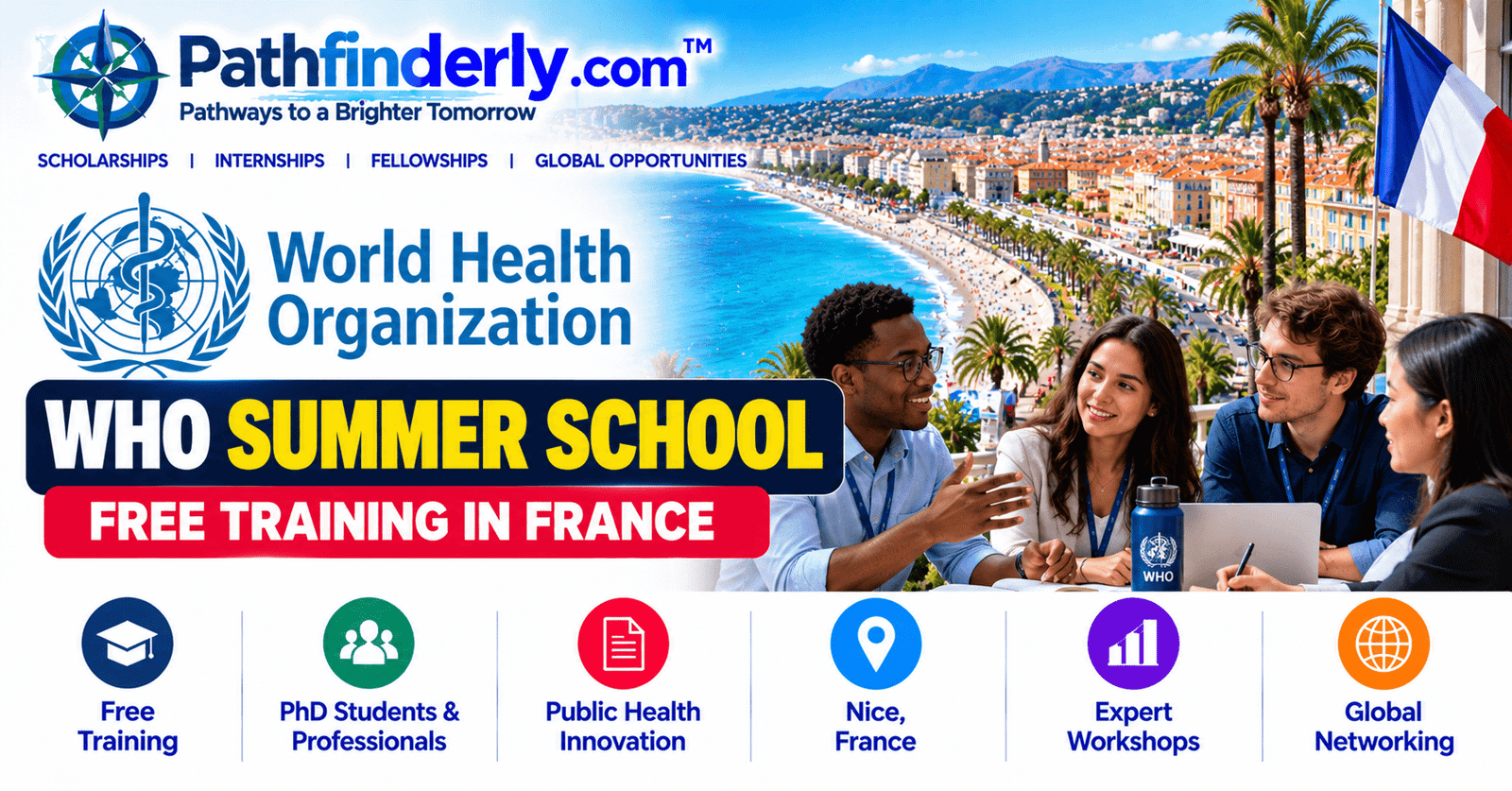
The WHO Summer School 2027 in France offers a free, four-day training opportunity for PhD students, researchers, postgraduate students and public health professionals interested in improving population health.
Organized through a collaboration involving the World Health Organization (WHO) Regional Office for Europe, Université Côte d’Azur and Ulysseus European University, the programme will take place in Nice, France, from 20 to 23 July 2027.
The summer school focuses on Systems Thinking and Innovation for the Prevention of Noncommunicable Diseases and a Healthy Ageing Population in the WHO European Region.
Participants will explore how public health challenges are connected to social, economic, environmental and policy factors. They will also learn practical approaches to developing more effective health interventions.
The programme is free to attend. Selected participants will receive training, daily lunches, coffee breaks, a welcome dinner and a certificate of participation.
However, international travel, accommodation and other personal expenses are not covered. Therefore, applicants should not confuse this opportunity with a fully funded programme.
Only 30 participants will be selected for the in-person training.
Applications are open, and the deadline is 23 November 2026.
Interested candidates can read the official WHO Summer School announcement.
WHO Summer School 2027 Overview
| Details | Information |
|---|---|
| Programme | WHO Summer School 2027 |
| Host Country | France |
| Location | Nice |
| Organizers | WHO Regional Office for Europe, Université Côte d’Azur and Ulysseus European University |
| Programme Dates | 20–23 July 2027 |
| Duration | Four days |
| Format | In-person |
| Language | English |
| Available Places | 30 |
| Training Fee | Free |
| Meals | Daily lunches, coffee breaks and a welcome dinner |
| Travel Expenses | Not covered |
| Accommodation | Not covered |
| Certificate | Certificate of participation |
| Target Participants | PhD students and early- to mid-career professionals |
| Application Deadline | 23 November 2026 |
| Selection Notification | By 18 December 2026 |
| Application Method | Online |
What Is the WHO Summer School?
The WHO Summer School is a short professional training programme designed to strengthen participants’ understanding of important public health challenges.
The 2027 edition focuses on systems thinking and innovation.
Rather than examining health problems in isolation, the programme encourages participants to understand how different factors interact.
For example, obesity is not simply a matter of individual food choices. Food prices, advertising, urban planning, education, income and public policies can all influence eating habits and health outcomes.
Systems thinking helps researchers and policymakers understand these connections.
As a result, they can develop interventions that address several contributing factors instead of focusing on only one.
The summer school combines academic learning with practical exercises and collaborative activities.
Participants will also have opportunities to apply the methods to their own professional or research projects.
Who Organizes the Programme?
The summer school is organized through cooperation between three institutions.
WHO Regional Office for Europe
The WHO Regional Office for Europe works with countries and partners to improve public health across the European Region.
Its activities include disease prevention, health promotion, public health policy and strengthening health systems.
For this programme, WHO’s Division of Prevention and Health Promotion is involved in organizing the training.
Université Côte d’Azur
Université Côte d’Azur is a French university based in the Nice area.
Its WHO Collaborating Centre contributes expertise in systems thinking and innovation for preventing noncommunicable diseases.
Ulysseus European University
Ulysseus European University is a collaborative European higher education initiative.
It supports cooperation in education, research and innovation.
Together, these institutions aim to provide participants with practical skills that can support better public health policies.
Where Will the Summer School Take Place?
The programme will be held in Nice, France.
Nice is a major city on the French Mediterranean coast and an important center for education, research and international activities.
The training will take place in person.
According to the official schedule:
- Start: 20 July 2027 at 9:00 AM
- End: 23 July 2027 at 2:00 PM
Participants should plan to attend the full programme.
Those traveling from another country should also allow sufficient time for their arrival, departure and any necessary visa arrangements.
Is WHO Summer School 2027 Fully Funded?
No.
The programme offers free training, but it does not provide full financial support for participants.
Understanding this distinction is important before applying.
What Is Provided?
Selected participants will receive:
- Free access to the four-day training programme
- Lectures and workshops delivered by experts
- Practical learning activities
- Lunch and coffee breaks on each training day
- A welcome dinner on 21 July 2027
- A certificate of participation
What Is Not Covered?
Participants must arrange and pay for:
- International or domestic travel to Nice
- Accommodation
- Visa application costs, where applicable
- Personal transportation
- Meals not included in the programme
- Travel insurance and other personal expenses
WHO explicitly states that applicants are responsible for their own travel, accommodation and other costs associated with their stay.
Therefore, students should assess their budget before submitting an application.
Who Can Apply for WHO Summer School 2027?
The programme is designed for people who have an academic or professional interest in public health, particularly noncommunicable disease prevention and healthy ageing.
The organizers specifically identify the following groups.
PhD Students
Doctoral researchers studying public health, epidemiology, health policy or related subjects may find the programme relevant.
Postgraduate Students
Postgraduate students with suitable academic backgrounds and interests may also be considered.
However, the programme is not presented as a general summer course for all undergraduate students.
Early-Career Researchers
Researchers beginning their professional careers can benefit from the practical training and expert discussions.
Mid-Career Professionals
Professionals with established experience in public health, healthcare, policy or related areas are also encouraged to consider the programme.
Healthcare Practitioners
Health professionals interested in disease prevention and population health may find the training useful.
Policymakers
People involved in developing, implementing or evaluating health policies are among the intended participants.
Public Health Innovators
Professionals working on new approaches to disease prevention, health promotion or healthcare systems may also have relevant experience.
Applicants should demonstrate how the programme connects with their current work, research or professional goals.
Can International Applicants Apply?
The official announcement does not specify a general nationality restriction.
However, it focuses on public health challenges within the WHO European Region.
Applicants should therefore understand that selection will consider the relevance of their education, professional experience and interests to the programme’s objectives.
The absence of a published nationality restriction should not be interpreted as guaranteed eligibility for every applicant worldwide.
International candidates should review the official application form and confirm any additional requirements before submitting their applications.
Furthermore, selected applicants who require permission to enter France will need to arrange the appropriate travel documents.
The organizers do not advertise visa sponsorship or financial support for international travel.
What Will Participants Learn?
The programme covers systems-thinking approaches and practical innovation in public health.
The organizers have identified several curriculum areas.
1. Systems Thinking for Public Health
Participants will explore the principles of systems thinking and how they can be applied to health challenges.
They will learn why public health problems often involve multiple interacting causes.
2. Noncommunicable Disease Prevention
The training will examine approaches to preventing and controlling noncommunicable diseases.
These include conditions such as cardiovascular diseases, diabetes, cancer and chronic respiratory diseases.
3. Healthy Ageing
Participants will study how policies and interventions can support healthier lives as populations grow older.
4. Systems Archetypes
The course will introduce recurring patterns that appear in complex systems.
Recognizing these patterns can help professionals understand why certain policies succeed or fail.
5. Policy Scenario Development
Participants will explore methods for examining possible policy choices and their potential effects.
6. Practical Systems-Thinking Tools
Workshops will introduce tools that participants can apply to real public health problems.
7. Research Design
The programme will address how systems-thinking approaches can inform research projects.
8. Decision-Making Tools
Participants will learn methods that support better analysis and decision-making.
9. Public Health Innovation
The training will explore ways to develop and implement innovative health interventions.
10. Artificial Intelligence in Public Health
The curriculum will consider opportunities for using artificial intelligence in public health.
11. Innovation Ecosystems
Participants will examine how researchers, institutions, policymakers and other stakeholders can work together to develop solutions.
The official curriculum is still being finalized, so individual sessions and activities may change.
How Will the Training Be Delivered?
The summer school will combine different teaching methods.
Expert Lectures
Participants will attend lectures delivered by WHO specialists and international experts.
Workshops
Interactive workshops will help participants explore public health challenges and possible solutions.
Practical Exercises
Hands-on activities will allow participants to use systems-thinking methods.
Real-Life Scenarios
The programme will use practical examples to connect theory with professional work.
Project-Based Learning
Participants will have opportunities to consider how the methods could apply to their own projects.
Group Discussions
Collaborative activities will encourage participants to exchange perspectives and experiences.
The programme aims to build skills that participants can use after returning to their institutions or workplaces.
Why Does Systems Thinking Matter in Public Health?
Many health problems have several interconnected causes.
For example, reducing tobacco use may require action involving taxation, advertising rules, education, healthcare services and community support.
Similarly, preventing obesity can involve food systems, transport policies, school environments and economic conditions.
A policy targeting only one factor may have limited effects.
Systems thinking helps professionals examine these relationships.
It can also help them anticipate unintended consequences and identify opportunities for cooperation.
The WHO Summer School aims to strengthen these abilities so participants can contribute to more effective health policies.
Benefits of Attending WHO Summer School
Free Professional Training
Participants can attend the course without paying tuition or training fees.
Learning From International Experts
The programme includes teaching from WHO experts and specialists in public health and systems thinking.
Practical Skills
Participants can develop tools and methods that may support their research or professional work.
International Learning Environment
The in-person format allows participants to exchange ideas with professionals from different backgrounds.
Public Health Knowledge
The programme provides focused learning on disease prevention and healthy ageing.
Professional Networking
Participants may develop useful connections with researchers, practitioners and policymakers.
Certificate of Participation
Selected participants who complete the programme will receive a certificate of participation.
Application to Real Projects
The training encourages participants to connect new knowledge with their own professional challenges.
However, the programme does not guarantee employment, research funding or admission to a degree programme.
WHO Summer School Selection Criteria
Applications will be reviewed by a selection panel.
The official announcement identifies several factors that will be considered.
Relevant Professional Experience
Experience related to public health, innovation, healthy ageing, noncommunicable diseases or their risk factors will be important.
Education
The selection panel will consider applicants’ academic backgrounds.
Experience and Expertise
Relevant research, professional activities or practical projects may strengthen an application.
Personal Statement
Applicants should explain their motivation and how the programme relates to their goals.
Potential for Future Collaboration
The organizers will also consider applicants’ potential to contribute to future cooperation and professional activities.
Since only 30 participants will be selected, candidates should prepare thoughtful applications.
How to Apply for WHO Summer School 2027
Applications must be submitted online through the official application system.
Step 1: Visit the Official WHO Announcement
Open the WHO Summer School 2027 announcement.
Read the programme information and eligibility details.
Step 2: Open the Application Form
Use the Apply here link provided in the official announcement.
This directs applicants to WHO’s application platform.
Step 3: Review the Form Requirements
Check which personal, academic and professional details are requested.
Step 4: Prepare Your Information
Gather information about your education, current position, relevant experience and professional interests.
Step 5: Explain Your Motivation
Describe why you want to participate and how the programme relates to your work.
Step 6: Highlight Relevant Experience
Include examples of research, projects or professional activities connected to public health.
Step 7: Explain How You Will Use the Training
Describe how you expect to apply systems-thinking methods after completing the programme.
Step 8: Complete the Application
Provide accurate information in all required fields.
Step 9: Review Your Submission
Check for errors or missing information.
Step 10: Submit Before the Deadline
Complete your application no later than 23 November 2026.
Step 11: Wait for the Selection Results
Successful applicants are expected to be informed by 18 December 2026.
Step 12: Arrange Travel if Selected
Selected participants should plan their accommodation, travel and any necessary visa arrangements.
Documents and Information to Prepare
The official announcement does not provide a complete universal document checklist.
Therefore, applicants should follow the requirements shown in the application form.
Useful information to prepare may include:
- Personal and contact information
- Academic qualifications
- Current university or employer details
- Relevant professional experience
- Research interests or projects
- A personal statement explaining motivation
- Examples of relevant work or collaboration
A CV or other supporting documents may be requested by the application system, but applicants should not assume they are mandatory unless the form specifies them.
How to Write a Strong Personal Statement
The personal statement is one of the factors considered during selection.
Applicants should use it to demonstrate a clear connection between their background and the programme.
Explain Your Professional Interests
Describe the public health challenges that interest you.
Show Relevant Experience
Mention research, professional responsibilities or projects connected to disease prevention or healthy ageing.
Explain Why Systems Thinking Matters
Discuss how understanding complex relationships could improve your work.
Describe Your Learning Goals
Identify the skills you hope to develop during the training.
Explain Your Future Plans
Show how you intend to apply the knowledge after the programme.
Highlight Collaboration
If relevant, explain how the training could support future cooperation with researchers, institutions or policymakers.
A strong statement should be specific, realistic and consistent with the applicant’s experience.
WHO Summer School 2027 Application Deadline
The application deadline is:
23 November 2026
The official announcement was published on 15 October 2026.
Applications are currently open.
The organizers expect to inform successful applicants by 18 December 2026.
Candidates should submit their applications early enough to avoid technical problems or last-minute delays.
Official application: Apply through the WHO Summer School announcement
Important Considerations Before Applying
Travel Budget
Participants must pay for travel and accommodation.
Programme Availability
The course requires in-person attendance in Nice.
Professional Relevance
Applicants should be able to explain how the training relates to their research or work.
Limited Places
Only 30 participants will be selected.
Language
The programme will be delivered in English.
Visa Requirements
International participants must check the entry requirements applicable to their nationality and travel circumstances.
Programme Dates
Applicants should confirm their availability from 20 to 23 July 2027.
WHO Summer School vs WHO Internship
The WHO Summer School and WHO Internship Programme serve different purposes.
| Feature | WHO Summer School | WHO Internship Programme |
|---|---|---|
| Opportunity Type | Short professional training | Internship |
| Main Purpose | Learning and skill development | Practical workplace experience |
| Duration | Four days | Depends on internship arrangements |
| Location | Nice, France | Depends on the position |
| Training Fee | Free | Not a tuition-based programme |
| Travel and Accommodation | Self-funded | Depends on programme arrangements |
| Certificate | Certificate of participation | Depends on internship arrangements |
| Application Process | Summer school application form | WHO internship recruitment procedures |
Students should not confuse the two opportunities.
The summer school focuses on structured learning, while internships involve practical work assignments.
Other Public Health Opportunities to Explore
Students interested in international public health can also explore the WHO Internship Programme, which provides information about internship opportunities connected with the World Health Organization.
Another relevant option is the PAHO Internship Programme, which introduces students to public health work associated with the Pan American Health Organization.
Those interested in broader international development may also explore the United Nations Internship Program.
Each opportunity has its own eligibility requirements, recruitment process and funding arrangements.
Applicants should review the official information before applying.
Frequently Asked Questions
What is WHO Summer School 2027?
It is a four-day professional training programme focused on systems thinking, noncommunicable disease prevention and healthy ageing.
Where will it take place?
In Nice, France.
What are the programme dates?
20–23 July 2027.
Is WHO Summer School free?
Yes. The training is free of charge.
Is the programme fully funded?
No. Participants must cover their travel, accommodation and other personal expenses.
Does WHO cover airfare?
No.
Is accommodation provided?
Accommodation costs are the responsibility of participants.
Are meals included?
Daily lunches, coffee breaks and a welcome dinner on 21 July 2027 are included.
How many participants will be selected?
Who can apply?
The programme targets PhD students, postgraduate students and early- to mid-career professionals with relevant public health interests or experience.
Can international applicants apply?
The announcement does not state a blanket nationality restriction, but applicants must satisfy the programme’s selection criteria and any requirements in the official application form.
Can undergraduate students apply?
The programme primarily targets postgraduate students and professionals. Undergraduate students should not assume they meet the intended participant profile.
Is an English-language test required?
The announcement specifies English as the teaching language but does not list a mandatory IELTS or TOEFL score.
What is the application deadline?
23 November 2026.
When will results be announced?
Successful applicants are expected to be informed by 18 December 2026.
Will participants receive a certificate?
Yes. A certificate of participation will be provided.
Is this an online programme?
No. It will be delivered in person.
What subjects will be covered?
Systems thinking, public health innovation, disease prevention, healthy ageing, decision-making tools and related topics.
Is there an application fee?
The official announcement does not identify an application fee.
Does the programme provide a job?
No. It is a professional training opportunity, not an employment offer.
How can I apply?
Use the official application link provided in the WHO announcement.
Final Thoughts
The WHO Summer School 2027 in France offers a valuable learning opportunity for postgraduate students, researchers and professionals working in public health.
The programme brings together WHO experts and international specialists to explore systems thinking, disease prevention and healthy ageing.
Selected participants will attend four days of free training in Nice, France, from 20 to 23 July 2027.
The organizers will also provide daily lunches, coffee breaks, a welcome dinner and a certificate of participation.
However, applicants must pay for their own travel, accommodation and personal expenses.
With only 30 places available, candidates should prepare their applications carefully and demonstrate how the training relates to their professional goals.
The deadline is 23 November 2026, and successful applicants are expected to be informed by 18 December 2026.
Interested candidates should review the official announcement and submit their applications before the closing date.
Official WHO Summer School Announcement and Application: WHO Summer School 2027 in France
Last verified: 24 October 2026
Pathfinderly is an independent educational opportunities website and is not affiliated with the World Health Organization or the programme organizers. Applicants should verify all requirements through the official announcement before applying.