
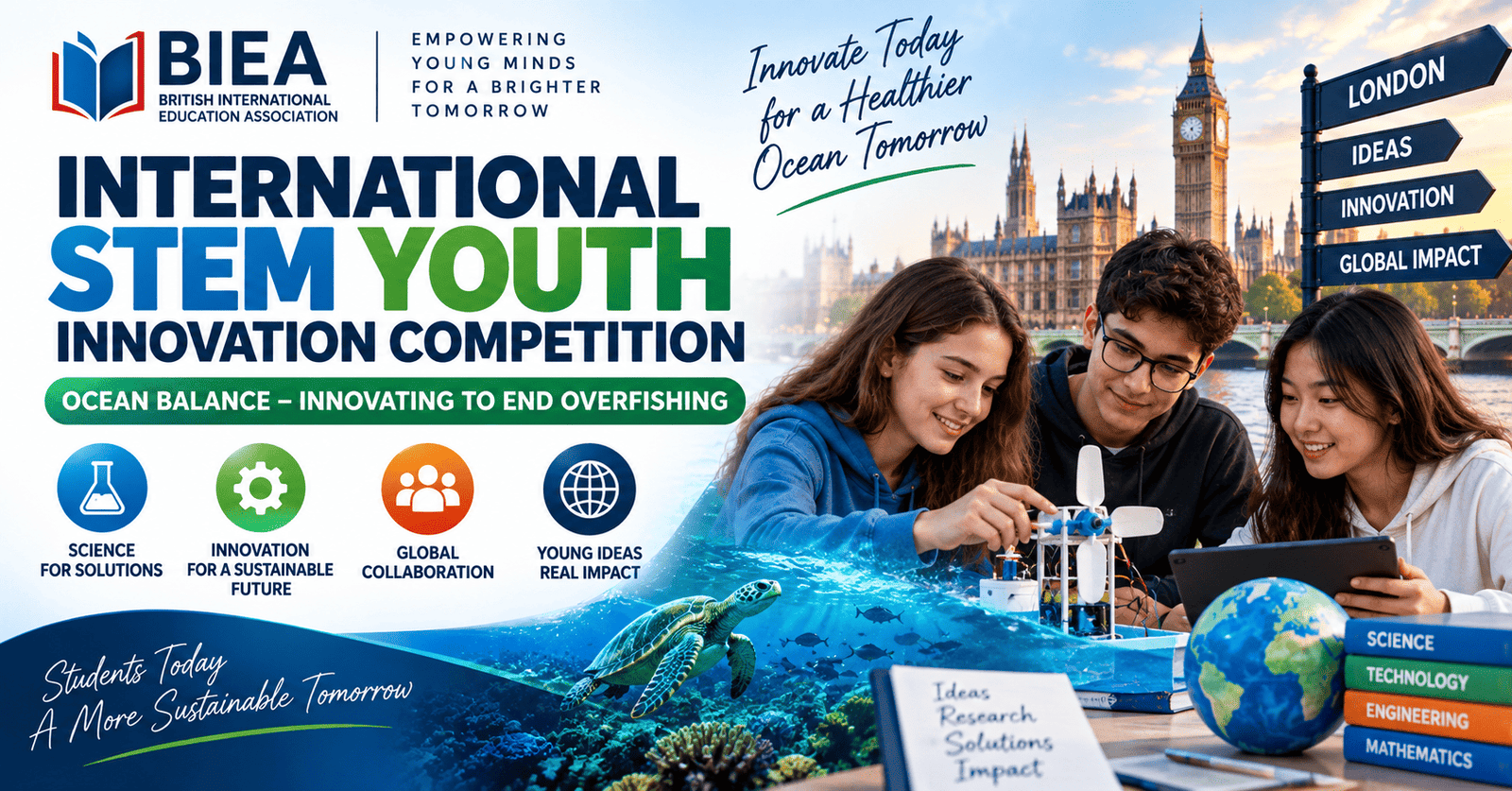
Young innovators from around the world can now take part in the BIEA International STEM Youth Innovation Competition 2027. The competition gives students an opportunity to use science, technology, engineering, and mathematics to develop practical solutions to a real global problem.
The 2027 competition focuses on ocean sustainability and the growing problem of overfishing. Student teams will research the issue, develop an innovative solution, create a design or prototype, and explain their work through a short presentation.
The competition is primarily designed for school students, while undergraduate university teams can also participate. Entries are submitted online, making the early stages accessible to young people from different countries.
Final activities are scheduled to take place in London, United Kingdom, in July 2027.
BIEA International STEM Competition 2027 Overview
Here are the main details:
- Competition: BIEA International STEM Youth Innovation Competition 2027
- Organizer: British International Education Association (BIEA)
- Theme: Ocean Balance – Innovating to End Overfishing
- Eligibility: International students
- Main age range: 6–18 years
- University category: Undergraduate students can also enter
- Team size: 3–5 students
- Individual applications: Not accepted
- Initial submission: Online
- Submission deadline: December 18, 2026
- International Final and Showcase: July 13, 2027
- Youth Voice Forum: July 14, 2027
- Final location: London, United Kingdom
- STEM Star requirement: Required for every participant
Applicants should check the official BIEA website before submitting because competition dates and arrangements may change.
About the BIEA International STEM Youth Innovation Competition
The BIEA International STEM Youth Innovation Competition brings young people together around science, technology, engineering, and mathematics.
Rather than testing students only on textbook knowledge, the competition asks participants to investigate a real-world problem and develop an innovative response.
Students work as teams. This encourages them to combine research, creativity, communication, problem-solving, and practical STEM skills.
The competition has an international focus. Teams can take part from different countries, and students are even allowed to form teams with members from different schools or countries.
This makes the program particularly interesting for young people who enjoy scientific research, environmental issues, engineering, technology, innovation, and teamwork.
Theme of the 2027 Competition
The 2027 theme is:
“Ocean Balance – Innovating to End Overfishing.”
Teams are challenged to explore how STEM can help reduce overfishing.
Overfishing affects marine ecosystems, food security, fish populations, and communities that depend on the ocean. Participants are expected to investigate these challenges and develop an innovative solution.
Projects can focus on areas such as:
- Reducing bycatch
- Monitoring illegal fishing
- Improving enforcement
- Sustainable aquaculture
- Selective fishing technology
- Low-impact fishing methods
- Other innovative approaches to reducing overfishing
Teams should concentrate on a specific part of the journey from sea to table rather than trying to solve every aspect of the problem at once.
Who Can Participate?
The competition welcomes young people from around the world.
For the 2027 season, the official guidelines provide age categories covering:
- 6–8 years
- 9–11 years
- 12–14 years
- 15–18 years
- 18–21 years / university undergraduate
University undergraduate teams are welcomed as exemplar projects that can inspire younger participants.
A participant’s competition age is based on their age on August 31, 2027. Where a team contains students of different ages, the team should follow the requirements that apply to its oldest member.
Team Requirements
This is a team competition.
Each entry must consist of three to five students. Individual entries are not accepted.
BIEA uses the team format to encourage collaboration, communication, leadership, shared responsibility, and the exchange of different ideas.
Students from different schools can form a team. Teams may also include students from different countries.
Schools can enter more than one team, giving institutions the opportunity to involve several groups of students.
BIEA STEM Star Requirement
There is an important requirement that every applicant should understand before entering.
Each participant must hold a valid BIEA STEM Star Certificate or register for a STEM Star Project as part of the competition process.
Students who do not already have a qualifying certificate can complete a BIEA STEM Star Project.
The official registration information currently lists the cost as £25 per certificate/student.
A STEM Star Certificate obtained through the required process can be used for competition entry for three years.
Therefore, while BIEA describes the competition itself as free to enter, new participants who do not already hold the required STEM Star qualification should take the £25 STEM Star cost into account.
Always confirm the latest fee and requirements on the official website before making a payment.
What Do Teams Have to Submit?
The 2027 competition requires teams to complete three main tasks.
Task 1: Research Report
Teams must prepare a research report about the problem of overfishing and their proposed solution.
The report should show that participants understand the issue they have selected. Teams are expected to research the environmental problem and explain how their proposed innovation could help.
Requirements vary according to age category.
Older students are expected to provide more detailed analysis. University undergraduate teams must also use appropriate academic referencing.
The report should be submitted as a PDF and can be up to 2,500 words in English.
Sources used during research must be referenced.
Task 2: Innovation Design
Teams must turn their research into an innovative design.
Participants are expected to develop a solution that could help reduce overfishing or bycatch. Depending on the project, this may involve creating and testing a prototype or model.
The final design submission should explain how the proposed solution works.
Teams may use diagrams, photographs, illustrations, experimental results, and other appropriate material to communicate their idea.
The design should connect directly with the solution developed in the research report.
Task 3: Short Presentation Video
Teams must also prepare a short video explaining their project.
The presentation should feature the team talking about its work and must be no longer than three minutes.
This gives participants an opportunity to demonstrate not only their technical understanding but also their communication skills.
Can Participants Use Artificial Intelligence?
BIEA has specific rules regarding the use of artificial intelligence.
AI tools may be used to support research and idea development, but students cannot use AI to write or substantially rewrite their competition report for them.
The final writing, ideas, designs, and conclusions must represent the team’s own work and understanding.
AI-generated artwork or images also cannot simply be submitted as the students’ own creative work.
Where AI has been used during research, participants should acknowledge the tool and its use according to the competition guidelines.
This is an important rule. Teams should read BIEA’s latest AI guidance carefully before preparing their final submission.
Competition Submission Deadline
The current deadline for the 2027 project submission is:
December 18, 2026
Teams are expected to submit their required competition materials by this date.
The deadline also applies to the relevant BIEA STEM Star registration requirement shown in the current competition timeline.
Do not wait until the final days to begin preparing the project. The competition requires research, design work, experimentation, teamwork, and a presentation video.
Starting early gives teams more time to test and improve their ideas.
What Happens After Submission?
BIEA reviews the submitted projects through its judging process.
Shortlisted teams may be invited to take part in online finalist panel sessions expected around February or March 2027.
The competition then moves toward its international events in London.
The International Final and Showcase is currently scheduled for:
July 13, 2027
The BIEA Youth Voice Forum is scheduled for:
July 14, 2027
Participants should monitor official communications because the competition timeline is subject to change.
International Final and Showcase in London
The International Final and Showcase gives young participants an opportunity to present their STEM innovations on an international platform.
The 2027 final is planned as an in-person event in London.
BIEA also plans to hold its Youth Voice Forum the following day. This provides another opportunity for young people to discuss ideas and engage with international participants.
Teams considering travel to London should carefully review the organizer’s latest information about attendance, travel arrangements, visas, insurance, and expenses.
Participation in the competition should not be interpreted as automatic funding for international travel.
Awards and Recognition
BIEA recognizes strong projects through a range of competition awards.
The exact awards for the 2027 season may be updated, but previous competition awards have included:
- Champion
- First Prize
- Second Prize
- Third Prize
- Outstanding Achievement Award
- Best Report Award
- Rising Stars
- Chairman’s Award
- BIEA STEM Star Awards
Applicants should treat the current official 2027 page as the final source for confirmed awards and prizes.
Recognition can be valuable for young students building their academic and extracurricular profiles. More importantly, the competition gives participants experience in research, innovation, teamwork, and problem-solving.
Why Is This a Good Opportunity for Students?
The BIEA competition is different from a conventional examination.
Students are asked to investigate a genuine environmental challenge and create something of their own.
Participants can strengthen several skills during the process, including:
- Scientific research
- Critical thinking
- Engineering and design
- Problem-solving
- Environmental awareness
- Creativity
- Teamwork
- Leadership
- Presentation skills
- Academic writing
The international nature of the competition also gives students a chance to see how young people in other countries approach similar global problems.
For students considering future study in STEM subjects, an experience like this can also help them explore their interests outside the classroom.
Tips for Preparing a Strong Project
Start by understanding the problem before thinking about a complicated invention.
A simple but realistic solution can be stronger than an ambitious idea that cannot be explained or tested properly.
Teams should choose one specific aspect of overfishing and research it carefully.
Use credible sources and keep a record of every source consulted. Older students should pay particular attention to the referencing requirements in their age category.
Divide responsibilities among team members, but make sure everyone understands the complete project.
Testing is also important. If your team creates a prototype, explain what you tested, what happened, and what you learned from the results.
Most importantly, make the work your own. BIEA specifically requires original student work and places restrictions on the use of AI-generated content.
How to Enter the BIEA STEM Competition 2027
Interested students should begin through the official BIEA competition website.
Step 1: Form Your Team
Create a team of three to five eligible students.
Make sure you know which age category applies to your group.
Step 2: Check the STEM Star Requirement
Confirm whether each team member already holds a valid BIEA STEM Star Certificate.
Those who do not should follow the official instructions for registering and completing the required STEM Star Project.
Step 3: Read the 2027 Guidelines
Study the complete competition guidelines before beginning your project.
Pay particular attention to the requirements for your age category.
Step 4: Choose Your Problem
Select one area connected with overfishing.
Research the issue and identify a problem your team believes could be addressed through STEM innovation.
Step 5: Develop Your Solution
Design an original solution.
Build or develop your concept and carry out the required testing appropriate to your age category.
Step 6: Prepare the Required Materials
Complete your research report, innovation design material, and short presentation video.
Follow the format and length requirements given by BIEA.
Step 7: Submit Before the Deadline
Review the entire entry carefully before submission.
Make sure all team details, documents, references, designs, and required materials are complete.
Submit through the method provided on the official BIEA website before the deadline.
Important Dates
Keep these dates in mind:
Project submission deadline: December 18, 2026
Online finalist sessions: Expected February/March 2027
International Final and Showcase: July 13, 2027
BIEA Youth Voice Forum: July 14, 2027
These dates are subject to change. Always check the official competition website for the latest schedule.
Looking for more opportunities? Explore our latest international opportunities for youth summits, exchange programs, leadership programs, competitions, and other global programs.
Interested in international leadership programs too? Read about the Istanbul Youth Summit in Türkiye, another global opportunity for young people.
Final Thoughts
The BIEA International STEM Youth Innovation Competition 2027 is an interesting opportunity for young people who want to apply STEM knowledge to a global environmental challenge.
Its 2027 focus on overfishing allows participants to explore marine sustainability while developing practical research, innovation, teamwork, and communication skills.
Students from different countries can participate, and undergraduate teams are also welcomed. However, applicants should pay close attention to the team rules, STEM Star requirement, submission requirements, and deadline.
A successful project does not need to be unnecessarily complicated. Strong research, an original idea, careful testing, and clear communication can make a meaningful difference.
Official Source: British International Education Association (BIEA)
Pathfinderly shares international opportunities for informational purposes. Eligibility rules, fees, deadlines, event dates, awards, and other competition arrangements may change. Always confirm the latest information through the official organizer before registering or making any payment.
1 thought on “BIEA International STEM Youth Innovation Competition 2027”