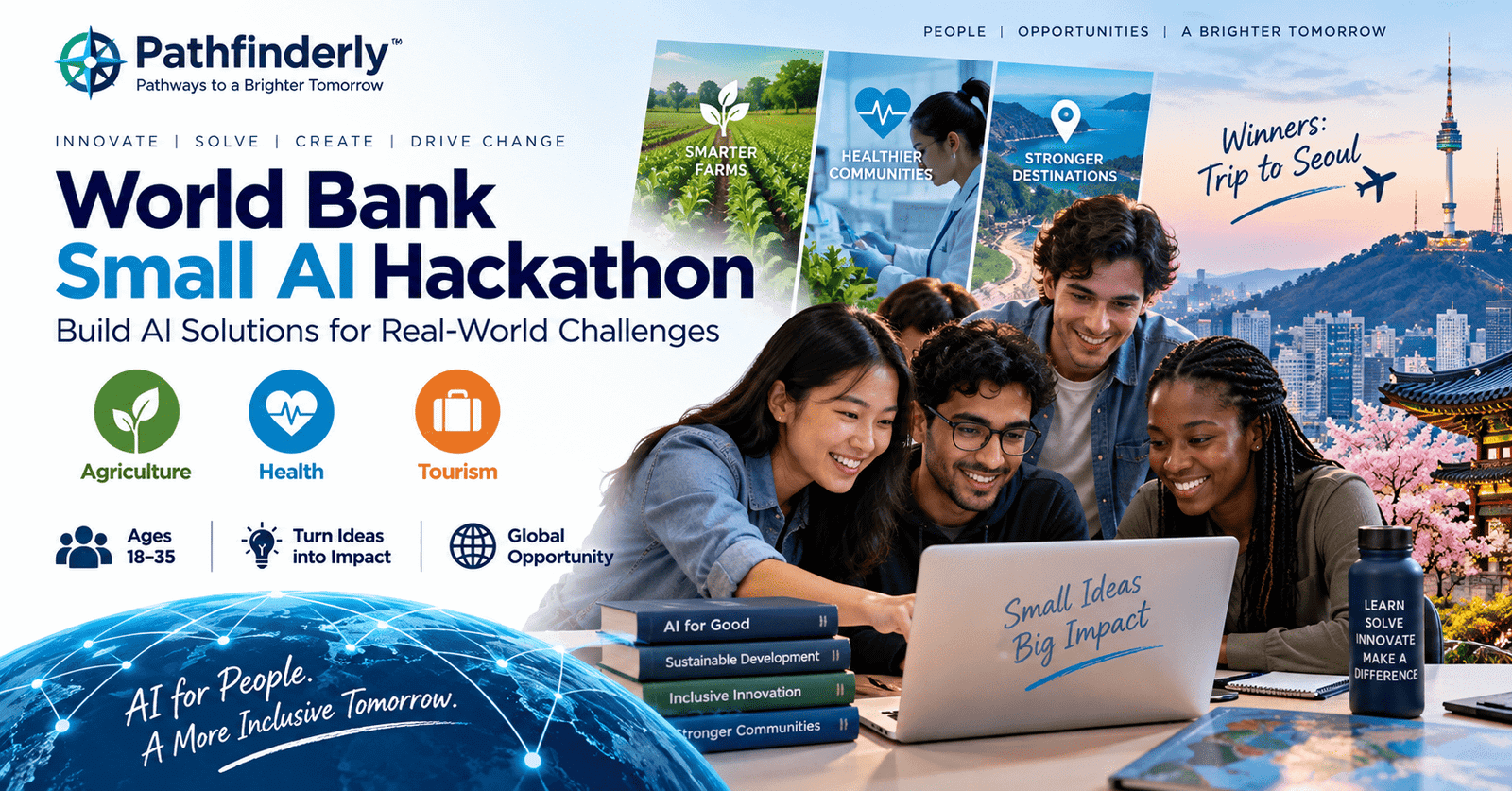
The World Bank Small AI Hackathon is a global challenge for young innovators who want to use artificial intelligence to solve practical development problems.
Officially called the Small AI for Development Hackathon Challenge, the competition invites participants to build focused AI solutions for real-world challenges in agriculture, health, or tourism. The World Bank Group is sponsoring the competition and will serve as the final judging authority, while Hack-Nation manages the competition platform.
Three winning entries will be selected. A representative from each winner will travel to Seoul, South Korea, to present at the Global AI & Digital Summit 2026. Reasonable travel, accommodation, and designated event-related expenses for the selected representatives will be covered under the organizers’ rules.
Applications close on 26 September 2026, so interested applicants have very little time to register.
Young people searching for similar international programs can explore our latest global opportunities, including competitions, leadership programs, volunteering, innovation challenges, and international events.
Challenge Overview
| Details | Information |
|---|---|
| Organizer/Sponsor | World Bank Group |
| Challenge | Small AI for Development Hackathon Challenge |
| Competition Manager | Hack-Nation |
| Eligible Age | 18–35 |
| Participation | Individual or team of up to 4 |
| Eligible Countries | World Bank member countries |
| Challenge Areas | Agriculture, Health, Tourism |
| Application Language | English |
| Application Deadline | 26 September 2026 |
| Hackathon | 3–4 October 2026 |
| Winners Announced/Prepared | 5–6 October 2026 |
| Seoul Travel | By 18 October 2026 |
| Global AI & Digital Summit | 19–22 October 2026 |
| Winner Presentation | 21 October 2026 |
| Location of Summit | Seoul, South Korea |
| Award | Covered Seoul trip for selected winner representatives |
What Is the Small AI for Development Challenge?
The competition asks young people to think differently about artificial intelligence.
Instead of focusing on increasingly large AI systems requiring powerful infrastructure and constant connectivity, participants must develop practical AI solutions that can work under real-world constraints.
The World Bank describes Small AI as a targeted approach built around solving a specific problem. Such systems might work through basic phones, sensors, microcontrollers, SMS, voice tools, or models operating locally with limited connectivity.
The important question is not how large the AI model is.
Instead, participants should ask whether their solution is affordable, accessible, locally relevant, and capable of addressing a genuine development challenge.
Why Is the World Bank Running This Challenge?
Artificial intelligence offers major opportunities, but access remains highly unequal.
The World Bank says billions of people remain offline, while many others lack affordable devices, sufficient data, or digital skills. Small AI is one approach to building technology that can function despite these limitations.
Examples already exist.
Small AI approaches can help farmers identify crop diseases, assist healthcare teams with screening, and provide educational support through accessible devices.
Who Can Apply?
The competition is open to young innovators aged:
18 to 35 years
Applicants must come from World Bank member countries.
The organizers particularly encourage participation from emerging economies, although eligibility is not restricted only to those countries.
Participants can enter:
- Individually, or
- As a team of up to four people.
Every team member must register separately and satisfy the eligibility requirements.
All applications and hackathon submissions must be completed in English.
Can Students Apply?
The official eligibility rules are based primarily on age and country eligibility rather than requiring applicants to hold a particular university degree.
Therefore, eligible university students, graduates, developers, researchers, entrepreneurs, and other young innovators can consider participating if they meet the official requirements.
However, applicants need enough technical and problem-solving ability to develop a working Small AI solution during the competition weekend.
Can Teams Apply?
Yes.
A team can contain up to four members.
Every participant must register individually, meet all eligibility requirements, and be identified as part of the same team before registration closes.
Once the hackathon begins, team membership cannot be changed.
A person may participate in only one competition entry.
If a team wins, the award belongs to the team collectively rather than to each individual member separately.
Who Cannot Participate?
Active World Bank Group staff members are not eligible.
The restriction also covers World Bank Group consultants and interns.
Other applicants should carefully review the complete competition terms before registering.
Three Challenge Areas
Participants must choose one sector challenge.
The three available areas are:
Agriculture
Participants can develop AI solutions addressing practical challenges affecting agriculture.
The goal should be measurable development impact rather than simply demonstrating an impressive technical model.
Potential solutions may involve areas such as information access, productivity, decision support, or other problems identified in the official challenge materials.
Health
The health challenge provides an opportunity to develop accessible AI tools for real healthcare or public-health problems.
Solutions should take account of practical limitations such as connectivity, infrastructure, available devices, and local conditions.
Tourism
Participants choosing tourism should consider how targeted AI can address challenges within the sector while remaining accessible and practical.
Again, the emphasis is on a solution that works under realistic constraints.
Applicants should use the official sector briefs when developing their ideas rather than relying solely on general descriptions of these three areas.
What Kind of AI Solution Should You Build?
This is not simply a competition to build another general chatbot.
The World Bank’s Small AI approach emphasizes specific, use-case-driven solutions.
A successful idea could potentially use:
- Basic mobile phones
- SMS
- Voice interfaces
- Sensors
- Microcontrollers
- Locally running AI models
- Limited-connectivity systems
- Locally relevant data
The solution can involve predictive, generative, or agentic AI. What matters is whether it solves a clearly defined problem in the conditions where it is intended to operate.
What Will Judges Look For?
Technical quality matters, but it is not the only consideration.
The official challenge information says entries will also be judged according to areas such as:
- Development relevance
- Design
- Inclusivity
- Ability to operate under constraints
- Practical value
- Local relevance
Participants are encouraged to think carefully about trade-offs between capability, accessibility, ambition, and risk.
This means an extremely complicated AI system is not automatically better than a simpler solution.
A focused tool that works reliably in its intended environment may fit the challenge much better.
Hackathon Format
The main competition takes place over two days:
3–4 October 2026
Registered and accepted participants will develop and submit their Small AI solutions during this competition window.
The submission must follow the technical, originality, team, format, and deadline requirements published through the competition platform.
Hack-Nation will evaluate eligible submissions and provide a shortlist to the World Bank Group.
The World Bank Group then acts as the final judging authority and selects the winners.
How Many Winners Will Be Selected?
There will be three winning entries:
- One winner from Agriculture
- One winner from Health
- One winner from Tourism
Each winning solution will have an opportunity to be featured at the Global AI & Digital Summit in Seoul.
What Do Winners Receive?
The main award is particularly attractive.
Winning entries will be invited to participate in the Global AI & Digital Summit 2026 in Seoul.
The three winning solutions will be featured during relevant Summit sessions, with presentations scheduled for 21 October 2026.
Winners may also have opportunities for facilitated meetings with investors, private-sector representatives, government officials, MSMEs, or other Summit participants, depending on availability and mutual interest.
Is the Trip to Seoul Fully Funded?
This needs precise wording.
For each winning entry, a representative will be selected to travel to Seoul.
The organizers state that travel expenses for that representative will be covered in full, subject to reasonable travel costs, accommodation, and designated event-related expenses under their internal logistics guidelines.
Therefore, we can accurately describe the prize as a funded or all-expenses trip for the selected winner representative.
However, we should not describe the entire hackathon as fully funded for every participant.
That would be misleading.
What Happens If a Team Wins?
Winning as a team does not mean all four members automatically receive funded travel to Seoul.
The team must nominate one representative who is best suited to represent the winning entry at the Summit.
The World Bank Group judging panel makes the final determination regarding the representative.
This distinction is important.
The funded Seoul travel applies to the approved representative of the winning team.
Visa Information
Visa guidance and support will be communicated directly to winners.
However, the organizers state that they are not responsible for visa acquisition or related expenses unless those costs have been expressly approved in writing.
Winning the challenge therefore does not guarantee that a visa will be issued.
Participants selected for travel should follow the instructions provided by the organizers immediately.
About the Global AI & Digital Summit
The Global AI & Digital Summit 2026 will take place in Seoul from 19–22 October 2026.
It is hosted by the World Bank Group together with the Republic of Korea’s Ministry of Finance and Economy and Ministry of Science and ICT.
The Summit brings together representatives from areas including:
- Government
- Development organizations
- Business
- Investment
- Technology
- Research
- Civil society
- Youth
Its broader focus is how AI and digital technologies can create jobs, increase productivity, improve services, and expand economic opportunity.
How to Apply for World Bank Small AI Hackathon
The competition has two required stages.
Applicants should read the complete rules and registration instructions on the official World Bank challenge page before applying.
Step 1: Register for the Hackathon
Eligible applicants must complete the official Hack-Nation application process by:
26 September 2026
Applications must be submitted in English.
Registration alone does not count as a competition entry.
Step 2: Participate and Submit Your Solution
Accepted participants then take part in the hackathon on:
3–4 October 2026
During the competition window, participants develop and submit their Small AI solution through the designated submission portal.
The entry must follow all technical, originality, format, team, and deadline requirements.
Referral Code
The official World Bank page currently instructs applicants to use the referral code:
WBGSmallAIGADS
when requesting to join through the application process.
Applicants should verify that this instruction remains visible on the official page when they register.
Important Dates
Application deadline: 26 September 2026
Hackathon: 3–4 October 2026
Winner notification and preparation: 5–6 October 2026
Travel to Seoul: By 18 October 2026
Global AI & Digital Summit: 19–22 October 2026
Winner presentation: 21 October 2026
Applicants should not wait until the final day to register.
Tips for a Strong Entry
Start with the problem, not the technology.
A common mistake in AI competitions is deciding to use a particular model first and then searching for a problem that fits it.
This challenge encourages the opposite approach.
Identify a genuine problem in agriculture, health, or tourism. Then ask what type of Small AI solution could realistically address it.
Think about the environment where your tool would operate.
For example:
- Is internet access reliable?
- What devices do users actually have?
- What language do they speak?
- Is local data available?
- Can the system work offline?
- Is the solution affordable?
- How will users interact with it?
- What happens when the AI makes a mistake?
- Can the solution scale beyond a prototype?
These questions align much more closely with the development focus of the competition than simply building the largest possible AI model.
Common Mistakes to Avoid
Applicants should avoid:
- Missing the 26 September registration deadline
- Assuming registration itself is the competition submission
- Joining more than one team or entry
- Changing team members after the hackathon starts
- Submitting material in a language other than English
- Ignoring the official sector brief
- Building an AI solution without a clearly defined development problem
- Assuming all team members receive funded travel
- Describing the entire competition as fully funded
- Ignoring low-connectivity or infrastructure constraints
- Leaving technical requirements until the final hours
Carefully read the official rules before beginning your solution.
Why This Opportunity Is Worth Considering
The challenge combines artificial intelligence, youth innovation, and international development.
Participants are not being asked merely to demonstrate coding ability. They are being encouraged to think about how AI can work for people who may have limited connectivity, infrastructure, devices, or access to advanced technology.
The competition can therefore be relevant to young developers, researchers, entrepreneurs, students, data scientists, engineers, health innovators, agricultural technology enthusiasts, and others interested in practical AI.
For the three winners, the opportunity goes further.
Their solutions can be presented in Seoul before an international audience participating in the World Bank Group’s Global AI & Digital Summit.
Young innovators interested in solving real-world problems can also explore the BIEA International STEM Youth Innovation Competition, which focuses on creative solutions to global challenges.
Those interested in international leadership and cross-cultural collaboration can also explore the HPAIR Conference, which brings together students and young professionals to discuss global challenges and develop new ideas.
Final Thoughts
The Small AI for Development Hackathon Challenge gives young innovators aged 18–35 an opportunity to turn practical AI ideas into solutions for development challenges.
Participants can enter individually or in teams of up to four and choose a problem in agriculture, health, or tourism.
Three winning entries will be selected. Their approved representatives will travel to Seoul to present their solutions at the Global AI & Digital Summit, with reasonable travel, accommodation, and designated event-related expenses covered according to the organizers’ rules.
The most important consideration right now is time.
Applications close on 26 September 2026, followed by the competition weekend on 3–4 October.
Eligible applicants should therefore review the official rules and register as soon as possible rather than waiting until the deadline.
Last verified: September 2026
Pathfinderly provides opportunity information for educational purposes. Eligibility, dates, awards, travel arrangements, competition rules, and application procedures can change. Always verify current details through the World Bank Group before applying.