
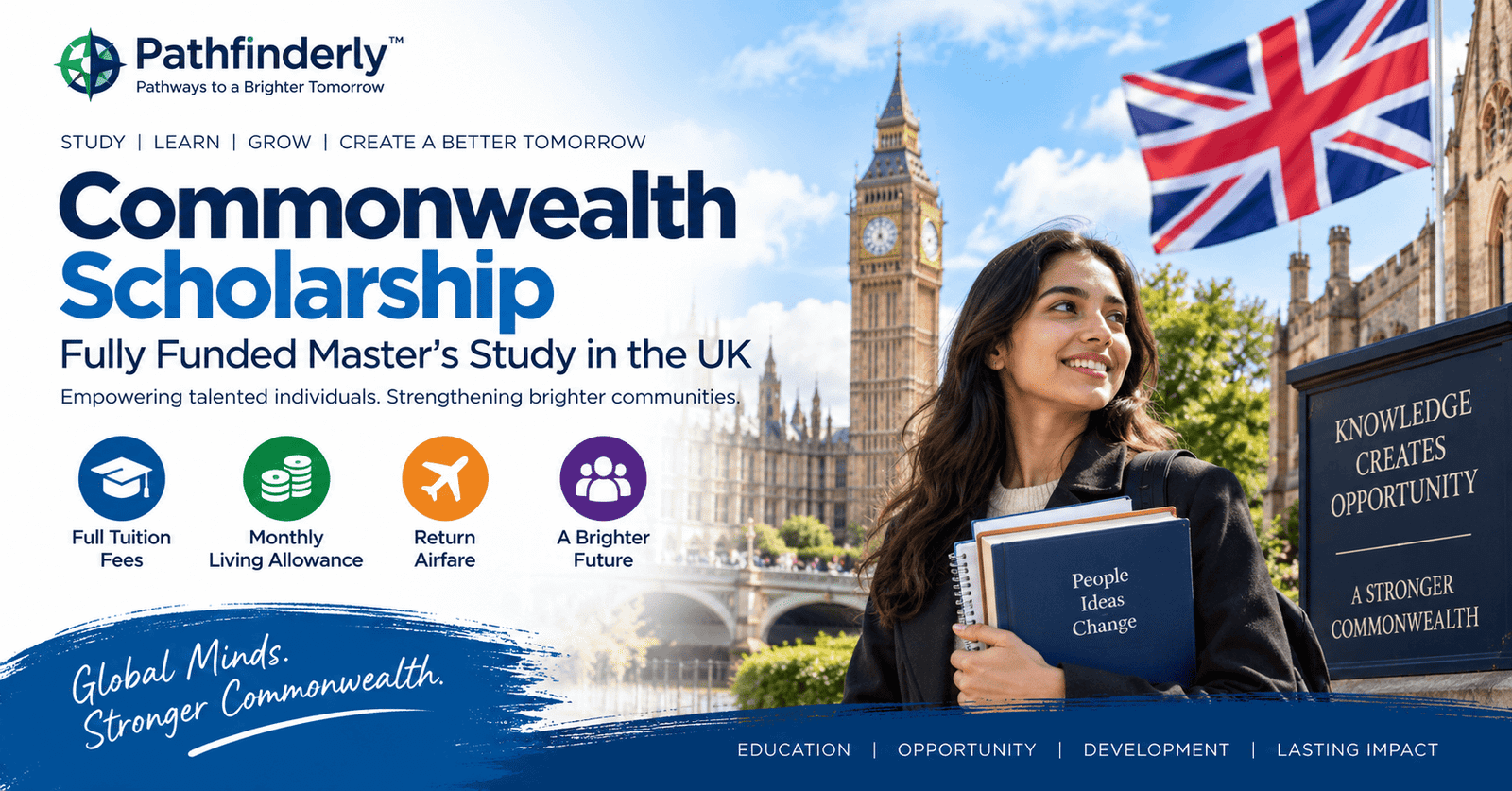
The Commonwealth Scholarship offers students from eligible low- and middle-income Commonwealth countries an opportunity to complete a fully funded Master’s degree in the United Kingdom.
The UK Foreign, Commonwealth & Development Office (FCDO) funds the programme through the Commonwealth Scholarship Commission in the UK (CSC). It supports talented candidates who can contribute to sustainable development in their home countries but could not otherwise afford to study in the UK.
Applications for the 2027/28 academic year are currently open. Candidates must complete the CSC application by 20 October 2026 at 16:00 BST and also follow the separate requirements of an approved nominating agency.
Students comparing funding opportunities in different countries can also explore our latest international scholarships for more fully funded and partially funded study programs worldwide.
Commonwealth Scholarship Overview
| Details | Information |
|---|---|
| Scholarship | Commonwealth Master’s Scholarships |
| Funded by | UK Foreign, Commonwealth & Development Office |
| Administered by | Commonwealth Scholarship Commission |
| Study Country | United Kingdom |
| Study Level | Master’s |
| Study Type | Full-time taught Master’s |
| Eligible Applicants | Selected low- and middle-income Commonwealth countries |
| Tuition Fees | Fully covered |
| Living Allowance | Provided |
| Airfare | Approved return airfare |
| Application Opens | 8 September 2026 |
| CSC Deadline | 20 October 2026, 16:00 BST |
| Studies Begin | September/October 2027 |
| Application System | CSC Central |
The official programme is specifically intended for candidates from eligible Commonwealth countries who would otherwise be unable to afford postgraduate study in the UK.
What Are Commonwealth Master’s Scholarships?
Commonwealth Master’s Scholarships support postgraduate education connected with sustainable development.
Successful candidates undertake a full-time taught Master’s degree at a UK university.
The programme is not simply based on academic grades. Applicants are also expected to show how their proposed studies relate to development needs and how they could use their knowledge after returning home.
The CSC assesses Master’s applications using academic merit, the quality of the study plan, and potential development impact.
Applicants should read the complete conditions on the official Commonwealth Master’s Scholarships page before starting an application.
Who Can Apply?
Applicants must satisfy several core requirements.
For the 2027/28 Master’s awards, candidates must normally:
- Be a citizen of an eligible Commonwealth country, have refugee status granted by an eligible country, or be a British Protected Person.
- Be permanently resident in an eligible Commonwealth country.
- Be available to begin studies in the UK by the start of the academic year in September 2027.
- Hold the required academic qualification by September 2027.
- Be unable to afford UK study without the scholarship.
Meeting these conditions does not guarantee selection.
Applicants must also satisfy the requirements of their nominating agency and the admission requirements of their chosen UK university.
Academic Requirements
Candidates normally need a first degree equivalent to at least a UK upper second-class (2:1) honours degree.
Applicants with a lower second-class degree may still qualify if they also hold a relevant postgraduate qualification, normally a Master’s degree
Universities may impose additional academic or English-language requirements for individual courses.
Therefore, candidates should check both the scholarship rules and their proposed university’s admission conditions.
Eligible Countries
The programme is designed for applicants from eligible low- and middle-income Commonwealth countries.
Current eligible Asian countries include:
Bangladesh, India, Malaysia, Maldives, Pakistan, and Sri Lanka.
Eligible countries are also available across Africa, the Caribbean and Americas, the Pacific, and eligible British Overseas Territories.
Because eligibility can change between scholarship rounds, applicants should use the current official list rather than relying on lists from older scholarship articles.
What Does the Scholarship Cover?
This is a genuinely fully funded scholarship.
The current 2027/28 Master’s scholarship information provides several major forms of financial support.
Full Tuition Fees
Approved tuition fees are covered through an agreement between the CSC and the UK university.
Scholars are not expected to pay any part of the approved tuition fee themselves.
Return Airfare
The award provides approved airfare from the scholar’s home country to the UK.
It also covers the approved return journey at the end of the scholarship.
However, the CSC does not normally reimburse journeys made before the award is formally confirmed or the airfare of dependants.
Monthly Living Allowance
The current published stipend for the 2027/28 Master’s programme is:
£1,712 per month
or
£2,000 per month for scholars studying at universities in the London metropolitan area.
These are the rates currently quoted by the CSC and may be subject to its conditions.
Study Travel Grant
Scholars can receive a study travel grant toward approved study-related travel within the UK or overseas.
Support for Scholars With Disabilities
Applicants who disclose a disability can receive a full assessment of their needs and eligibility for additional financial support.
Child Allowance in Certain Cases
A scholar who is widowed, divorced, or a single parent may qualify for child support when eligible children live with them at the same UK address.
Current published amounts are £622 per month for the first child and £154 per month for the second and third children under 16.
The CSC makes clear that these family allowances are contributions rather than a guarantee that all family living expenses will be covered.
Which Courses Can You Study?
The scholarship supports full-time taught Master’s study at a UK university.
Applicants should choose a course that fits their academic background, professional goals, and proposed development impact.
A strong course choice should have a clear connection to the problem the applicant hopes to address after completing the degree.
This matters because the CSC does not evaluate academic ability in isolation. Development relevance forms an important part of the selection process.
Six CSC Development Themes
Commonwealth Scholarships operate within six development themes:
- Science and technology for development
- Strengthening health systems and capacity
- Promoting innovation and entrepreneurship
- Strengthening global peace, security and governance
- Strengthening resilience and response to crises
- Access, inclusion and opportunity
Applicants should identify which theme most closely relates to their proposed study and development objectives.
How Does the Nomination Process Work?
This is one of the most important parts of the application.
Candidates cannot simply apply directly to the CSC and bypass the nomination process.
Applicants must apply through an eligible nominating body as well as complete the required CSC application.
Nominators can include national nominating agencies and selected non-governmental or charitable organizations. Each nominator may run its own selection process and impose additional eligibility requirements
Therefore, applicants must check their nominator’s instructions carefully.
A nominating organization may also set an earlier deadline than the main CSC deadline.
Is Nomination the Same as Winning the Scholarship?
No.
A nominating body selects candidates to put forward to the CSC.
The CSC then considers candidates from the pool of nominations before making its final selections.
The Commission explicitly states that nomination does not guarantee selection.
For the current cycle, nominators are expected to submit their nominations by December 2026.
Applicants can expect scholarship outcomes by July 2027.
Selection Criteria
The CSC assesses candidates competitively.
For Master’s applicants, major considerations include:
- Academic merit
- Quality of the proposed study plan
- Potential development impact
Academic achievements therefore matter, but they are only one part of the application.
Candidates should clearly explain why their chosen course matters, what development challenge they hope to address, and how they intend to use their education after returning home.
Development Impact
This section deserves particular attention when preparing an application.
Commonwealth Scholarships are designed around sustainable development.
Your application should therefore establish a logical connection between:
your previous experience → proposed UK study → new knowledge and skills → development impact after returning home.
Avoid making broad statements such as “I want to help my country.”
Instead, identify a specific challenge.
Explain what you have already done in that area, what skills you still need, and how your proposed Master’s degree could help you contribute more effectively.
Documents and Information to Prepare
Applicants should prepare their information well before the deadline.
Depending on the current application requirements and nominating body, candidates may need academic information, qualifications, references, employment or professional history, development-impact statements, study plans, university/course choices, and supporting documents.
Do not wait until the final day to collect these materials.
Applicants should follow the exact document requirements shown inside CSC Central for the current cycle.
How to Apply for the Commonwealth Scholarship
The application involves more than one stage.
Step 1: Check Your Eligibility
First, confirm that your country appears on the current eligible-country list.
Then check the academic, residency, financial-need, and other eligibility conditions.
Use the official Commonwealth Master’s Scholarships information rather than an older third-party eligibility list.
Step 2: Find Your Nominating Agency
Identify an approved nominating body available to applicants from your country.
Read its requirements separately because nominating organizations can use their own procedures and deadlines.
Step 3: Choose Suitable UK Courses
Research UK Master’s programs that fit your academic background and development objectives.
Pay close attention to university admission requirements and course deadlines.
Scholarship eligibility does not automatically mean you qualify for admission to every UK university.
Step 4: Complete the CSC Application
Applications to the Commission are submitted through CSC Central, its online application system.
Use the application access provided through the official Commonwealth Master’s Scholarships page.
The CSC does not accept direct applications outside the required nomination arrangements.
Step 5: Complete Your Nominator’s Process
Submitting your CSC form may not complete the entire process.
Follow your nominating agency’s separate instructions.
Its deadline can differ from the CSC deadline, so check both dates carefully.
Step 6: Monitor Your Email
Successful and unsuccessful applicants are expected to receive the outcome by July 2027.
Candidates should monitor their normal inbox as well as spam and junk folders because failure to respond to an offer within the required period can result in its withdrawal.
Application Deadline
The main CSC deadline for the current cycle is:
20 October 2026 at 16:00 BST
The scholarships support courses beginning in September or October 2027.
However, do not assume October 20 is the only deadline that matters.
Your nominating agency may impose its own earlier closing date.
University admission deadlines can also differ.
Can International Students Apply?
Yes, but this scholarship is not open to every nationality worldwide.
Applicants must belong to an eligible Commonwealth country and satisfy the programme’s residency and other conditions.
This makes the programme different from scholarships that accept applicants from virtually all countries.
Do You Need a University Admission Offer Before Applying?
Candidates should research their courses carefully and follow university admission procedures.
University applications and scholarship processes can involve separate requirements and timelines.
Do not assume that submitting a scholarship application automatically creates an application for admission to your chosen university.
Check each university’s requirements directly.
Can You Work During the Scholarship?
Scholars are expected to focus on their approved programme.
The CSC states that scholars must obtain its approval before undertaking paid employment during the award.
Applicants should therefore not plan to finance their studies through regular employment.
The scholarship already provides tuition and maintenance support for the approved study period.
Do Scholars Have to Return Home?
Yes. This is an important condition.
The purpose of the programme is to help scholars gain knowledge and skills that can contribute to development in their home countries.
The CSC requires scholars to return to their home country after completing their award. It does not normally support remaining in the UK through the Graduate route for employment.
Candidates should understand this condition before accepting an award.
Commonwealth Master’s vs Commonwealth Shared Scholarships
These are related but different scholarship routes.
Commonwealth Master’s Scholarships use approved nominating agencies.
Commonwealth Shared Scholarships are jointly funded by the CSC and participating UK universities and apply only to selected courses at participating institutions.
Tips for a Strong Application
Start with development impact rather than writing a generic scholarship essay.
Show a clear relationship between your education, experience, proposed Master’s program, and future contribution.
Choose courses carefully. Your selections should make sense when compared with the development challenge described in your application.
Use concrete examples of achievements instead of unsupported claims about leadership or ambition.
Your study plan should also explain why the chosen UK course provides knowledge or training that will help you achieve your goals.
Finally, give yourself enough time for references, supporting information, university research, and your nominating agency’s requirements.
Common Mistakes to Avoid
Applicants should avoid:
- Waiting until 20 October without checking the nominator’s deadline
- Assuming the scholarship is open to every country
- Ignoring university admission requirements
- Writing vague development-impact statements
- Selecting courses unrelated to career or development goals
- Assuming nomination guarantees a scholarship
- Confusing Commonwealth Master’s with Commonwealth Shared Scholarships
- Providing inconsistent information across different parts of the application
- Leaving references and supporting documents until the final day
A technically complete application is not necessarily a competitive one.
The different sections should tell one consistent story about your background, proposed studies, and future development contribution.
Other Fully Funded Scholarships to Explore
Students comparing major international postgraduate awards can also explore the Gates Cambridge Scholarship, which provides full-cost funding for eligible postgraduate study at the University of Cambridge.
Students interested in studying across more than one European country can also explore the Erasmus Mundus MAPP Scholarship, a two-year joint Master’s programme in Public Policy with Erasmus Mundus funding available to highly ranked international applicants.
Researchers interested in doctoral study at Oxford can consider the Ellison Graduate Scholars Programme, which supports selected DPhil candidates working in major research areas.
For opportunities elsewhere in Europe, our guide to the Swiss Government Excellence Scholarships explains another government-funded route for international researchers and postgraduate applicants.
If you are exploring fully funded postgraduate opportunities in Europe, consider the Swedish Institute Scholarship, which supports eligible international professionals pursuing master’s degrees in Sweden. The scholarship covers tuition fees and provides financial support for living and travel expenses.
These internal links give us a strong scholarship cluster without overloading this article.
Final Thoughts
The Commonwealth Master’s Scholarships provide substantial support for talented students who want to pursue postgraduate study in the United Kingdom and contribute to sustainable development after returning home.
The award covers approved tuition fees and airfare and provides a monthly living allowance along with other eligible support.
However, applicants should pay particular attention to the nomination requirement. Completing the CSC application alone is not enough if the relevant nominating body’s process has not also been followed.
For the 2027/28 academic year, the CSC application closes at 16:00 BST on 20 October 2026. Candidates should check their nominator and university deadlines well before that date.
Last verified: September 2026
Pathfinderly provides scholarship information for educational purposes. Eligibility, financial support, deadlines, participating countries, nomination procedures, and scholarship conditions can change. Always verify current information through the Commonwealth Scholarship Commission before applying.