
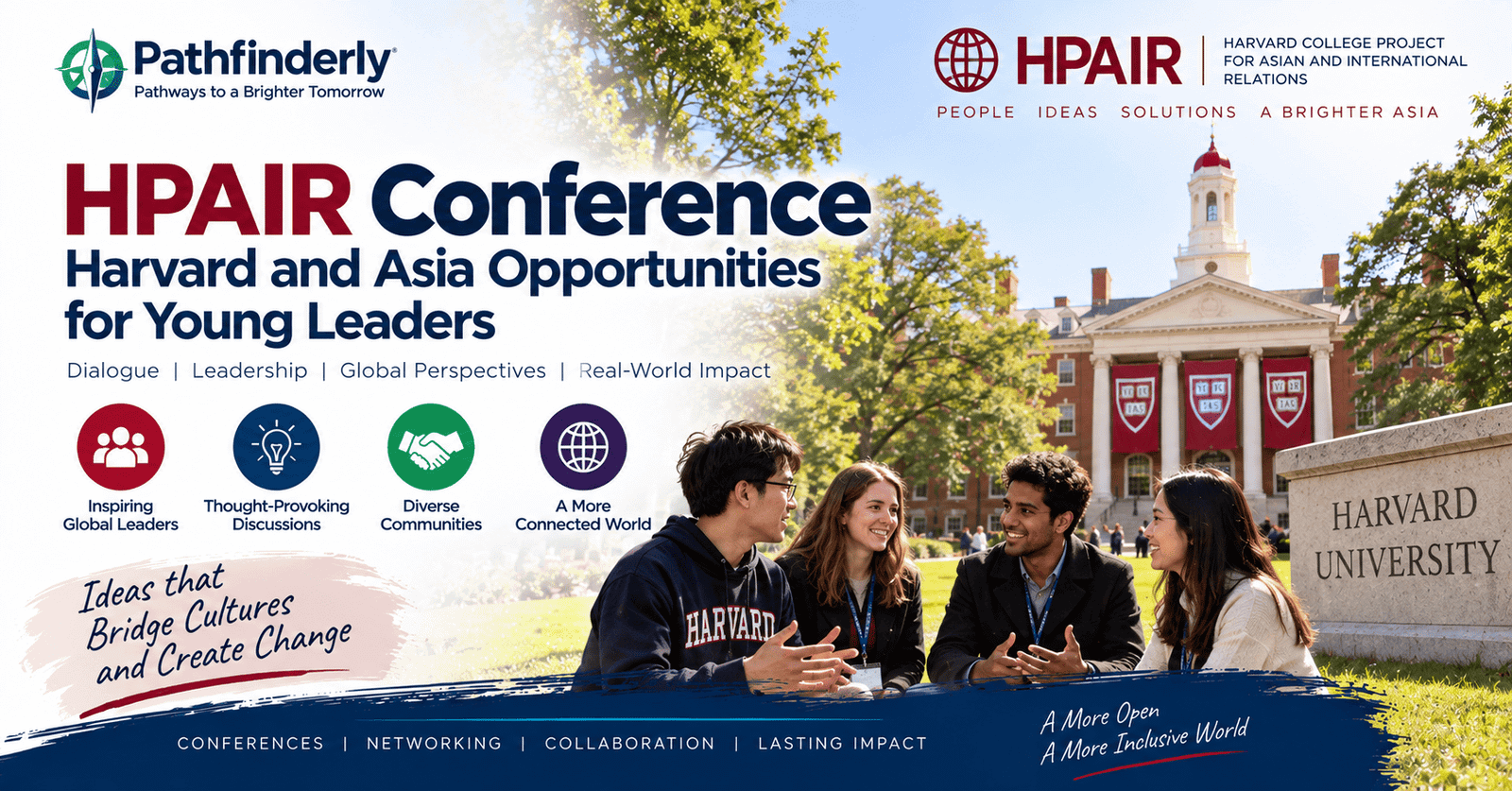
The HPAIR Conference brings together students, young professionals, emerging leaders, and experts to discuss important economic, political, technological, and social issues affecting Asia and the wider world.
HPAIR stands for the Harvard College Project for Asian and International Relations. Founded in 1991, the student-run organization at Harvard College has developed an international platform connecting young people with leaders from business, government, academia, and other sectors.
HPAIR normally organizes major conferences and related programs throughout the year. These include its Harvard Conference, Asia Conference, Virtual Conference, and youth-focused leadership initiatives. Each format offers a different way for participants to develop ideas, expand their international networks, and engage with global issues.
Young people looking for similar international programs can explore our latest global opportunities, including leadership programs, exchanges, competitions, volunteering, and international events.
HPAIR Overview
| Details | Information |
|---|---|
| Organization | Harvard College Project for Asian and International Relations |
| Common Name | HPAIR |
| Founded | 1991 |
| Organization Type | Student-run organization at Harvard College |
| Main Audience | Students, young professionals and emerging leaders |
| Main Programs | Harvard Conference, Asia Conference, Virtual Conference |
| Main Themes | Leadership, business, policy, technology, economics and global affairs |
| International Participation | Yes |
| Scholarships | Available for conferences under applicable rounds |
| Application | Online delegate application |
| Category | Opportunities |
| Next Cycle | Future dates should be checked through HPAIR |
What Is HPAIR?
The Harvard College Project for Asian and International Relations was established to create a forum where students and young professionals could discuss major issues affecting the Asia-Pacific region.
Since 1991, HPAIR says it has organized 49 conferences in 34 host countries and reached more than 40,000 students and young professionals. The organization also reports more than 500 past speakers.
Its conferences combine learning with networking and cross-cultural exchange.
Participants can interact with other young people from different countries while attending discussions involving experienced leaders and professionals.
What Types of Conferences Does HPAIR Organize?
HPAIR is not just one event.
Its major conference formats include:
Harvard Conference
The Harvard Conference, commonly called HCONF, takes place at Harvard University.
It brings together students, professionals, and global leaders for discussions about major international challenges.
Programming can include:
- Keynote speeches
- Panels
- Workshops
- Executive seminars
- Networking
- Community activities
- Impact Challenges
The most recent HCONF took place from February 6–8, 2026. Applications for that cycle are now closed.
Future applicants should wait for HPAIR to announce the next conference rather than using the previous deadline.
Asia Conference
The HPAIR Asia Conference, or ACONF, is hosted annually in an Asian city in partnership with a local organizing committee.
It brings together students, young professionals, speakers, and other participants for international discussion and cultural exchange.
The 2026 Asia Conference was held in Hanoi, Vietnam, in August 2026. Its program included speaker sessions, panels, executive seminars, networking, cultural activities, HPAIRx, and a delegate policy debate.
HPAIR says approximately 300–600 delegates can gather at an Asia Conference.
The organization has also indicated that bidding will open for teams interested in hosting the 2027 Asia Conference, but this should not be confused with the future delegate application process.
Virtual Conference
HPAIR also runs a Virtual Conference, known as VCONF.
This format makes the conference experience more accessible to young people who cannot travel internationally.
The 2026 Virtual Conference took place from August 21–23, 2026. Its programming included speaker sessions, professional networking, case competitions, and cultural exchange.
The virtual format can be particularly useful for international students facing travel, visa, or financial barriers.
Who Can Apply?
Eligibility can differ between conferences.
For example, the 2026 Asia Conference accepted individuals aged 18 or older, regardless of nationality or academic background. HPAIR welcomed students, young professionals, and changemakers from different disciplines.
HPAIR’s general FAQ also confirms that a 17-year-old could apply if they would be 18 by the time of the relevant conference.
However, applicants should not assume that every future event will use exactly the same eligibility rules.
Always check the specific conference page before applying.
Can International Students Apply?
Yes.
International participation is central to HPAIR’s model.
The organization says its conferences have reached participants across many countries, and its scholarship FAQ specifically confirms that international students can receive HPAIR scholarships.
Can International Students Apply?
International students can consider HPAIR when they meet the eligibility requirements of the relevant conference.
The general delegate opportunity is not restricted to students from Harvard or the United States.
This distinction is important because the HPAIR organizing team is different from the delegate program. Membership of the Harvard organizing team is limited to currently enrolled Harvard College students, whereas conference delegates can come from around the world.
Applicants should therefore apply as international delegates rather than confusing delegate participation with membership of the Harvard student organization.
Do You Need a Particular Academic Major?
The latest Asia Conference was open regardless of academic background.
That makes the opportunity potentially relevant to students and young professionals from fields such as:
- International relations
- Economics
- Business
- Technology
- Engineering
- Public policy
- Law
- Healthcare
- Environmental studies
- Social sciences
- Entrepreneurship
Applicants from other disciplines can also be suitable.
What matters more is whether the applicant can contribute meaningfully to the conference community and engage with its themes.
What Happens at an HPAIR Conference?
The exact schedule changes from event to event.
However, conferences can include several types of programming.
Speaker Sessions
Participants hear from leaders and experts discussing important international issues.
Past HPAIR speakers have included prominent figures from government, international organizations, business, academia, and other fields. HPAIR reports more than 500 past speakers across its history.
Panel Discussions
Panels allow participants to hear different perspectives on major economic, political, technological, social, and policy questions.
These sessions can help delegates understand complex issues beyond a single viewpoint.
Executive Seminars
Some conferences offer smaller seminar-style sessions.
HPAIR describes these as opportunities for delegates to engage more closely with speakers in a smaller setting.
Networking
Networking is an important part of the experience.
Delegates meet students and young professionals from different universities, countries, and professional backgrounds.
These connections can continue after the conference.
Impact Challenge
One particularly interesting component is the HPAIR Impact Challenge.
It uses a case-competition format in which delegates work on real-world problems and develop potential solutions.
Young people interested in solving real-world problems through innovation can also explore the BIEA International STEM Youth Innovation Competition, which gives students another opportunity to develop ideas around global challenges.
Those interested in technology-driven solutions can also explore the World Bank Small AI Hackathon, where young innovators develop practical AI ideas for real-world development challenges.
HPAIR says past Impact Challenge collaborations have included organizations such as the World Bank, Schwarzman Scholars, and the United Nations High Commissioner for Refugees.
The exercise can develop:
- Strategic thinking
- Problem-solving
- Research
- Teamwork
- Presentation skills
- Professional communication
For students interested in leadership and practical problem-solving, this can be one of the most valuable parts of the conference.
Cultural Exchange
HPAIR conferences also emphasize cultural interaction.
For example, the 2026 Asia Conference included International Night (I-Night), where delegates could share aspects of their cultures through areas such as performances, fashion, music, and cuisine.
These activities help make the conference more than a series of lectures.
Delegates have opportunities to learn directly from one another.
HPAIRx
HPAIRx provides selected delegates with a platform to share their own stories, ideas, and interests.
At the 2026 Asia Conference, selected speakers delivered talks followed by live questions and answers.
For participants, this can provide experience in public speaking and communicating ideas to an international audience.
Delegate Policy Debate
The Asia Conference has also featured a policy-debate format.
Participants respond to evolving information while discussing important global issues.
This activity can strengthen:
- Critical thinking
- Public speaking
- Collaboration
- Decision-making
- Policy analysis
It can be particularly relevant to students interested in diplomacy, public policy, international relations, or government.
Is HPAIR Fully Funded?
This requires careful wording.
HPAIR should not generally be described as a fully funded program for every participant.
Conference delegates normally pay a participation fee. The fee covers conference programming and certain meals, but delegates can remain responsible for expenses such as accommodation and transportation.
However, HPAIR offers a scholarship program that can help eligible delegates with expenses.
This is very different from saying that every selected delegate automatically receives full funding.
HPAIR Scholarships
HPAIR says scholarships are available for its conferences.
Applicants can normally apply for scholarship support during the early-bird application round.
The scholarship application involves additional information and supporting documents.
Importantly, HPAIR states that international students can receive scholarships.
The organization describes scholarships as primarily merit-based, while also taking financial need into consideration. HPAIR also says applying for financial assistance does not negatively affect conference candidacy.
What Can Financial Assistance Cover?
The amount of support can vary.
HPAIR’s FAQ explains that conference programming and specified meals are covered by the conference fee, while delegates normally arrange their own lodging and transportation.
Scholarship support may help reimburse some or potentially all of those additional costs, depending on the award.
Therefore, applicants should not assume that receiving a scholarship automatically means every expense will be paid.
Read the terms attached to your particular award.
Delegates who need financial assistance can read our HPAIR Scholarships guide for details on scholarship eligibility, the Early Bird application requirement, financial need, and the costs that funding may help cover.
Why the Early-Bird Round Matters
Students needing financial assistance should pay special attention to the early application round.
HPAIR states that scholarship applications are accepted only during the early-bird round.
Early applicants can also receive:
- A discounted conference ticket
- Earlier admission decisions
- More time to arrange visas
This makes applying early particularly valuable for international applicants.
How to Apply
The delegate selection process normally begins online.
Step 1: Check the Current Conference
Visit HPAIR’s official website and determine which conference is accepting applications.
Do not apply using dates copied from an old article.
Step 2: Review Eligibility
Check the specific requirements for the event.
Pay attention to:
- Age
- Conference dates
- Application deadline
- Location
- Participation fee
- Scholarship deadline
- Visa requirements
Step 3: Complete the Online Application
HPAIR’s FAQ directs applicants to its online application system.
The first round requires applicants to submit a resume and short-answer responses.
Step 4: Apply for Financial Assistance if Needed
Applicants seeking scholarship support should apply during the early-bird round.
Do not wait until regular applications.
Scholarship applications may require an additional written response and supporting documentation.
Step 5: Complete the Interview Stage
Candidates who progress beyond the initial application may be asked to complete either:
- A video interview, or
- A short online interview with an HPAIR team member.
Step 6: Wait for the Decision
Successful applicants receive information about registration and the next steps.
International participants should begin travel and visa preparations early when attending an in-person conference.
What Does HPAIR Look for in Applicants?
HPAIR says it uses a holistic application review.
Selectors consider areas including:
- Application responses
- Previous experiences
- Community engagement
- Personal interests and passions
- Resume
- Interview performance
The organization particularly highlights authenticity, commitment, and a genuine desire to contribute meaningfully.
Applicants should therefore avoid trying to create an artificial “perfect leader” profile.
Specific and genuine examples are more useful.
Preparing Your Resume
Your resume should make it easy for selectors to understand your experiences.
Depending on your background, include relevant:
- Education
- Leadership
- Volunteer activities
- Projects
- Internships
- Work experience
- Student societies
- Community involvement
- Awards
- Research
- Entrepreneurship
Keep the document clear.
A long list of minor activities is not necessarily stronger than a smaller number of meaningful experiences.
Writing Strong Application Answers
Short-answer questions require careful writing because space may be limited.
Answer the actual question first.
Then support your response with a specific example.
Where appropriate, explain:
Situation → your action → result → what you learned.
Avoid generic statements such as:
“I have always dreamed of becoming a global leader.”
Instead, show what you have already done and what you hope to contribute to the HPAIR community.
Interview Preparation
If selected for the next stage, review your application before the interview.
Be prepared to discuss:
- Your interests
- Leadership experiences
- Community involvement
- Academic or professional goals
- Why you want to attend
- What you could contribute
- Important international issues you care about
Do not memorize scripted responses word for word.
A natural conversation usually communicates motivation better.
Visa Information
International delegates attending a U.S.-based HPAIR conference may need the appropriate visitor visa.
HPAIR’s current FAQ states that non-U.S. citizens attending its Harvard Conference require a B1/B2 visitor visa where applicable.
The organization can provide conference acceptance documentation, but it cannot guarantee or expedite visa approval.
Visa decisions remain with the relevant U.S. authorities.
Applicants should therefore begin the process early after receiving acceptance.
Current Application Status
HPAIR has indicated that it will begin accepting bids to host the 2027 Asia Conference, but a host-city bidding process is not the same as applying to attend as a delegate.
Prospective delegates should wait for the official next-cycle announcement.
HPAIR vs Hansen Leadership Institute
HPAIR and the Hansen Leadership Institute both appeal to young people interested in leadership and international engagement, but they are different types of opportunities.
HPAIR centers on international conferences featuring speakers, discussions, networking, case challenges, and cultural exchange.
The Hansen Leadership Institute is an intensive residential leadership program in the United States with a stronger focus on leadership development, peacebuilding, mediation, and conflict resolution.
Funding also differs.
Hansen’s selected international participants receive substantial program funding, while HPAIR generally charges conference fees and offers scholarships to qualifying applicants rather than automatically fully funding every delegate.
HPAIR and the Hansen Leadership Institute both appeal to young people interested in leadership and international engagement, but they are different types of opportunities.
Students interested in international leadership may find both opportunities worth exploring.
Young leaders interested in discussions on economics, public policy, and global affairs can also explore the Young Political Economy Forum Hong Kong, which brings international participants together for dialogue on politics, philosophy, and economics.
HPAIR vs a University Scholarship
HPAIR is not a degree scholarship.
Being selected as a conference delegate does not mean receiving admission to Harvard University.
Likewise, attending a conference does not make a participant a Harvard student.
This distinction should be clear, particularly because the organization is run by Harvard College students.
The opportunity is an international conference and leadership experience, not admission to a Harvard degree.
Is HPAIR Worth Considering?
The program can be relevant to students and young professionals who genuinely want to engage with international issues, meet people from different backgrounds, and participate actively in conference programming.
Its value depends partly on what the participant wants from the experience.
Someone interested in networking, international affairs, policy, business, leadership, or cross-cultural exchange may find the conference particularly relevant.
Applicants should also consider the total cost if they do not receive financial assistance.
The opportunity should be evaluated based on academic and professional goals rather than simply because Harvard appears in the organization’s name.
Common Mistakes to Avoid
Applicants should avoid:
- Assuming HPAIR means admission to Harvard University
- Calling every HPAIR opportunity fully funded
- Missing the early-bird scholarship round
- Using an old conference deadline
- Confusing host-city applications with delegate applications
- Writing generic leadership answers
- Ignoring conference fees and travel costs
- Waiting too long to prepare for a visa
- Assuming every conference has identical eligibility rules
- Exaggerating achievements
- Copying application answers from other applicants
Always use the current conference page before applying.
Tips for International Applicants
Apply early, especially if you need financial assistance.
International applicants often need more time for travel arrangements and visa processing.
Prepare a concise resume and identify specific examples of leadership, community engagement, or professional interests.
Research the conference theme before your interview.
Most importantly, think about what you can contribute, not only what you hope to receive.
International conferences become more valuable when delegates participate actively.
Those who want to build international experience through service can also explore United Nations Volunteers (UNV) for national, international, and online volunteering opportunities.
Official Information
The main source for future conference announcements is the official HPAIR website:
For information about delegate applications, scholarships, interviews, and visas:
HPAIR application and scholarship FAQ
Future Asia Conference information will appear through:
Because the 2026 delegate cycles have concluded, prospective applicants should verify the next application dates before paying any fees or making travel arrangements.
Final Thoughts
The Harvard College Project for Asian and International Relations has developed an international conference community over more than three decades. HPAIR reports reaching more than 40,000 students and young professionals through conferences hosted across numerous countries.
For Pathfinderly readers, the opportunity is particularly relevant to students and young professionals interested in leadership, international relations, policy, business, technology, and cross-cultural exchange.
However, applicants should understand the funding structure correctly. HPAIR is not automatically fully funded. Conference fees normally apply, while eligible applicants can seek scholarships during the early-bird application round.
Last verified: September 2026
Pathfinderly provides opportunity information for educational purposes. Conference dates, eligibility, fees, scholarship availability, locations, and application procedures can change. Always verify current information through HPAIR before applying.