
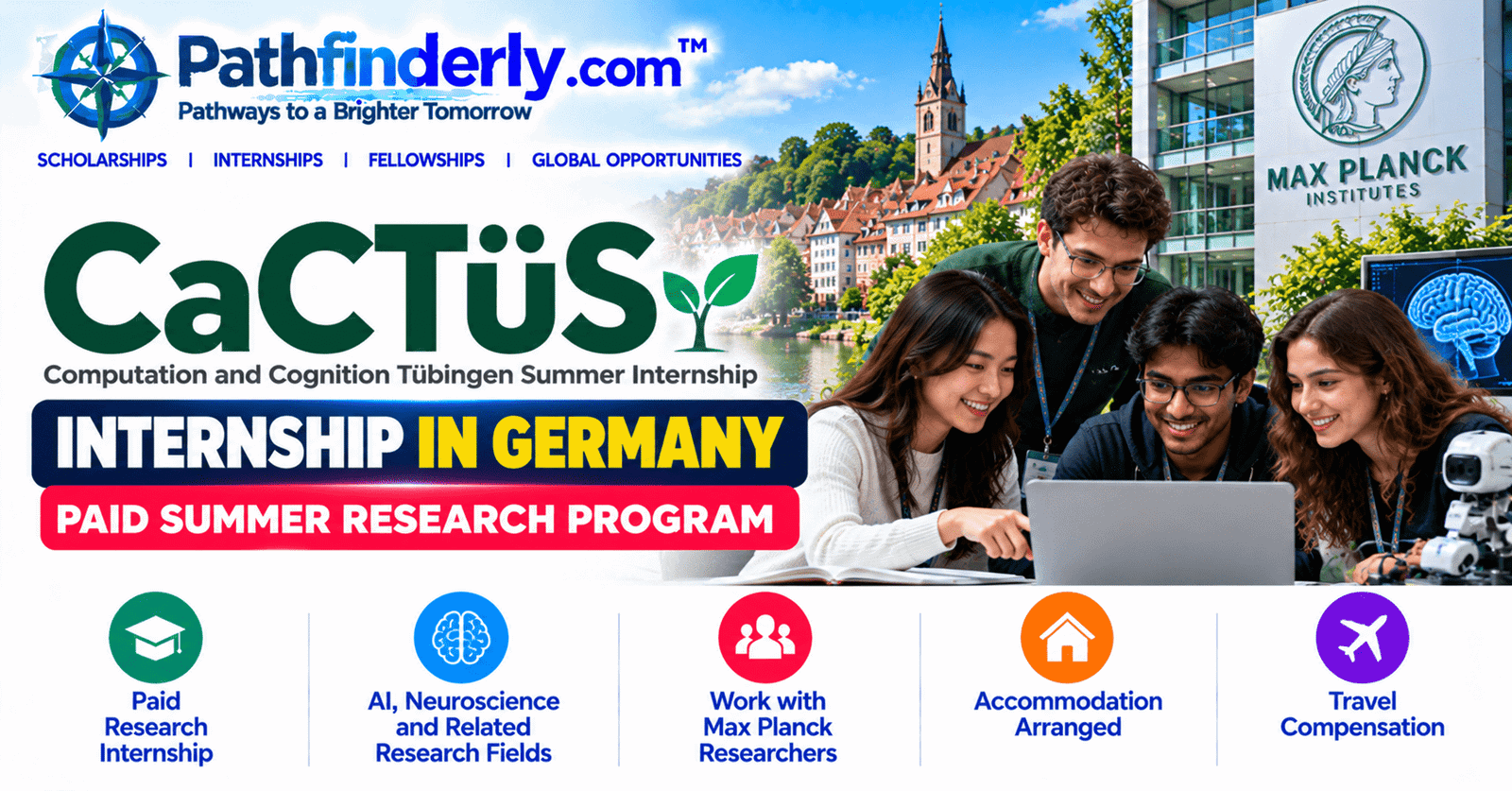
The CaCTüS Internship 2027 in Germany offers international bachelor’s and master’s students an opportunity to gain research experience in artificial intelligence, neuroscience and related scientific fields. This paid summer programme provides approximately €1,350 per month, travel compensation, arranged accommodation and the chance to work with experienced researchers at leading German research institutions.
Applications are now open for the 2027 intake. The programme will take place in Tübingen, Germany, from 1 July to 30 September 2027, with a permitted internship stay of 90 days.
The application deadline is 16 November 2026.
The programme particularly encourages applications from students whose access to advanced research opportunities is limited by financial, personal, regional or social circumstances.
Students from low- and middle-income countries are especially encouraged to apply.
However, applicants from other countries may also be eligible if they meet the programme requirements.
The internship is organized through the Max Planck Institutes for Biological Cybernetics and Intelligent Systems, together with the Tübingen AI Center.
Interested students can submit their applications through the official CaCTüS application portal.
CaCTüS Internship 2027 Overview
| Details | Information |
|---|---|
| Programme | CaCTüS — Computation and Cognition Tübingen Summer Internship |
| Host Country | Germany |
| Main Location | Tübingen |
| Host Institutions | Max Planck Institutes and Tübingen AI Center |
| Programme Type | Paid summer research internship |
| Academic Level | Bachelor’s and master’s students or eligible graduates |
| Main Research Areas | Artificial intelligence, machine learning, neuroscience and related fields |
| Available Places | Up to 12 |
| Monthly Salary | Approximately €1,350 |
| Travel Support | Travel cost compensation |
| Accommodation | Affordable accommodation arranged |
| Health Insurance | Covered through the financial package |
| Internship Period | 1 July – 30 September 2027 |
| Permitted Stay | 90 days |
| Applications Opened | 21 October 2026 |
| Application Deadline | 16 November 2026 |
| Interviews | January 2027 |
| Selection Notifications | February 2027 |
| Application Method | Online |
Important: Although the organizers describe the programme as fully funded, participants must pay their own visa application fees and related expenses.
What Is the CaCTüS Internship Program?
CaCTüS stands for Computation and Cognition Tübingen Summer Internship.
It is a research internship designed to help talented students gain experience in modern scientific research.
The programme focuses on subjects connected with artificial intelligence and biological intelligence.
These fields examine how intelligent systems learn, process information, make decisions and respond to their environments.
For example, researchers may study machine learning algorithms, brain activity, perception, human behavior or computational models.
Selected interns work directly with scientists on research projects.
They also become part of a research community where they can develop technical skills, exchange ideas and explore future academic opportunities.
A major objective of CaCTüS is to improve access to high-quality scientific research.
Therefore, the programme particularly supports students who face barriers to educational and professional development.
Host Institutions
The CaCTüS programme brings together several important research institutions.
Max Planck Institute for Biological Cybernetics
The Max Planck Institute for Biological Cybernetics studies how humans and other biological systems perceive, process and respond to information.
Its research connects neuroscience, perception, cognition and computational methods.
Students interested in understanding the brain and human behavior may find relevant research projects through this institute.
Max Planck Institute for Intelligent Systems
The Max Planck Institute for Intelligent Systems conducts research on intelligent systems, including artificial intelligence and technologies inspired by biological processes.
Its research combines several scientific and engineering disciplines.
The institute provides opportunities to explore advanced scientific questions through experimental and computational methods.
Tübingen AI Center
The Tübingen AI Center supports research and collaboration in artificial intelligence.
It brings together researchers working on machine learning and related scientific topics.
Through the CaCTüS programme, selected students may gain exposure to research in these rapidly developing fields.
Research Areas Available
The programme offers projects across different scientific disciplines.
However, the exact research opportunities depend on the projects advertised for the 2027 intake.
Artificial Intelligence
Artificial intelligence research involves developing systems capable of performing tasks that require learning, reasoning or decision-making.
Interns may work on projects involving computational models and intelligent systems.
Machine Learning
Machine learning focuses on algorithms that learn patterns from data.
Relevant research may include model development, evaluation and analysis.
Neuroscience
Neuroscience examines the structure and function of the nervous system.
Students may explore questions related to brain activity, perception, cognition and behavior.
Theoretical Neuroscience
Theoretical neuroscience uses mathematical and computational models to understand nervous-system processes.
It is particularly relevant to students with backgrounds in mathematics, physics or computer science.
Behavioral Science
Behavioral research examines how humans and other organisms respond to different situations.
Projects may involve experiments, data collection and statistical analysis.
Electrical Engineering
Some research projects involve technical systems, sensors, signal processing and related engineering methods.
Data Analysis
Research teams often use data analysis to identify patterns and interpret experimental results.
Students with statistical and programming skills may find relevant opportunities.
Note: Applicants should review the official list of available research projects before selecting their preferences.
Who Can Apply for the CaCTüS Internship?
The programme welcomes eligible students from different academic backgrounds.
However, applicants must satisfy the official requirements.
1. Bachelor’s Degree Students
Undergraduate students can apply if they have completed at least four semesters, equivalent to two years of study, before the internship begins.
2. Master’s Degree Students
Students pursuing master’s degrees in relevant fields may apply.
3. Graduates
Applicants who have completed a bachelor’s or master’s degree may also be eligible.
The official FAQ confirms that a master’s graduate does not necessarily need to be a recent graduate.
4. PhD Restriction
Applicants must not have started a PhD programme by the time the internship begins.
Therefore, students who have already begun doctoral studies are not eligible.
5. Strong Academic Background
Applicants should have a good academic record.
6. Relevant Field of Study
Suitable academic backgrounds may include:
- Computer science
- Artificial intelligence
- Mathematics
- Physics
- Electrical engineering
- Mechanical or related engineering fields
- Psychology
- Cognitive science
- Neuroscience
- Data science
- Other relevant scientific disciplines
The organizers do not impose one strict list of accepted degree programmes.
Instead, applicants should demonstrate that their knowledge and skills match their selected research projects.
7. English Language Skills
Applicants must have sufficient English proficiency to communicate with supervisors and colleagues.
They should also be able to understand scientific presentations and read research literature.
8. Motivation for Research
Candidates must explain their scientific interests and reasons for applying.
9. Educational Barriers
The programme prioritizes students who face significant obstacles to accessing advanced education or research.
These obstacles may involve financial, social, personal or regional circumstances.
10. Full Availability
Applicants must be available for the full internship period.
The programme requires a voluntary internship and cannot accommodate students who need the placement to fulfill compulsory university course-credit requirements.
Can International Students Apply?
Yes.
The CaCTüS Internship is open to eligible students worldwide.
The organizers particularly encourage applications from students who are both from and currently living in low- and middle-income countries.
However, students from other countries may also apply.
The programme’s official FAQ explains that candidates without significant educational barriers are not automatically excluded.
Nevertheless, applicants who demonstrate such barriers receive preferential consideration when their qualifications are comparable.
International applicants must also satisfy Germany’s immigration requirements.
The programme provides assistance with visa-related procedures after selection, but a visa is not guaranteed.
Is the CaCTüS Internship Fully Funded?
The organizers describe CaCTüS as a fully funded research internship.
However, students should understand exactly what the financial package includes.
Monthly Salary
Selected interns receive approximately €1,350 per month.
The salary is intended to cover living expenses during the internship.
Accommodation
The programme coordination office arranges affordable accommodation.
This is particularly helpful because finding suitable short-term housing in Tübingen can be difficult.
However, accommodation should not be described as an additional free benefit.
Housing costs are covered through the financial package rather than through a separate universal free-housing award.
Health Insurance
The programme states that the salary covers health insurance costs.
Travel Compensation
Selected participants receive compensation for travel expenses.
Applicants should confirm the reimbursement process and any applicable limits with the organizers.
Visa Assistance
The programme provides guidance to selected participants who need a visa.
However, it does not reimburse visa application fees or related expenses.
Research Experience
Participants gain access to research facilities and work with experienced scientists.
Mentorship
Interns receive guidance and support during their research placements.
Research Community
The programme provides opportunities to interact with researchers and other interns.
CaCTüS Internship Funding Breakdown
| Benefit | Coverage |
|---|---|
| Monthly Salary | Approximately €1,350 |
| Three-Month Salary | Approximately €4,050 |
| Accommodation | Arranged; costs covered through financial package |
| Living Expenses | Intended to be covered by salary |
| Health Insurance | Intended to be covered by salary |
| Travel | Compensation provided |
| Research Mentorship | Included |
| Research Activities | Included |
| Visa Application Fee | Not reimbursed |
| Embassy Travel Expenses | Not reimbursed |
The approximate three-month salary of €4,050 is calculated from the advertised monthly amount.
Actual payment and deductions are governed by the internship agreement.
Internship Duration and Important Dates
The 2027 programme follows a defined recruitment schedule.
| Event | Date |
|---|---|
| Applications Open | 21 October 2026 |
| Application Deadline | 16 November 2026 |
| Interviews | January 2027 |
| Acceptance Notifications | February 2027 |
| Internship Begins | 1 July 2027 |
| Internship Ends | 30 September 2027 |
The organizers specify that participants must comply with the 90-day internship stay limit.
Applicants should follow the dates and immigration instructions in their official offer rather than independently extending their stay.
Required Documents
The CaCTüS application includes academic and personal information.
Applicants should prepare their documents before starting the online form.
Academic CV
Candidates should submit a concise academic CV.
The official application guide recommends a maximum of two pages and a font size of at least 11 points.
The CV should describe academic achievements, relevant experience, technical skills and extracurricular activities.
Applicants should not include a photograph.
Academic Transcripts
Students should provide transcripts for completed academic terms.
The organizers require transcripts to be understandable in English.
Applicants may translate them themselves for the application stage, although official translations may later be required for visa purposes.
Motivational Statement
The motivation section is particularly important.
Applicants should explain their research interests, relevant experience and reasons for selecting particular projects.
They must also describe any circumstances that have limited their access to educational or research opportunities.
Research Project Preferences
Candidates should select appropriate research projects and explain why they are suitable.
Recommendation Letter
A reference letter is optional.
Applicants may submit one if it strengthens their application.
The programme explains how to provide the referee with the appropriate upload link.
How to Write a Strong Motivational Statement
The motivation statement should be specific, clear and personal.
Explain Your Research Interests
Describe the scientific questions that interest you.
Connect Your Academic Background
Explain how your studies have prepared you for the selected research projects.
Highlight Relevant Skills
Mention programming, mathematics, laboratory work, research methods or other relevant abilities.
Discuss Previous Experience
Include academic projects, research assignments or practical experience.
Explain Your Educational Barriers
Describe genuine circumstances that have restricted your access to advanced education or research.
Describe Your Future Goals
Explain how the internship could support your academic or professional development.
Avoid Generic Statements
Focus on specific experiences rather than broad claims about being passionate or hardworking.
Follow the AI Usage Policy
The organizers permit AI tools to improve grammar, clarity and writing style.
However, applicants must not use AI to generate original ideas, scientific concepts or substantive application content.
All intellectual contributions must come from the applicant.
How to Apply for the CaCTüS Internship 2027
Applications must be submitted through the official online portal.
Step 1: Visit the Official Website
Open the CaCTüS Internship website.
Step 2: Review Eligibility
Read the programme requirements carefully.
Step 3: Explore Available Projects
Identify research projects that match your academic background and interests.
Step 4: Read the Application Guide
Review the official guidance for preparing your CV and motivation statement.
Step 5: Prepare Your Documents
Gather your academic CV, transcripts and other supporting materials.
Step 6: Open the Application Portal
Visit the official CaCTüS 2027 application portal.
Step 7: Register an Account
Enter the required information and complete the registration process.
Step 8: Complete the Application Form
Provide accurate academic and personal details.
Step 9: Select Research Projects
Choose the projects most relevant to your qualifications.
Step 10: Write Your Motivational Statement
Explain your research interests and educational circumstances.
Step 11: Upload Documents
Attach the required documents in the accepted format.
Step 12: Review Your Application
Check all information carefully.
Step 13: Submit Before the Deadline
Complete the application by 16 November 2026.
Step 14: Check for Confirmation
The programme sends an automatic confirmation email when an application has been successfully submitted.
If no confirmation arrives, applicants should check whether their application is complete.
Important: Applications submitted by email will not be assessed. The organizers also request that applicants do not contact individual supervisors to promote their applications.
CaCTüS Internship Selection Process
The selection process has three main stages.
Stage 1: Pre-Selection
The internship coordination office reviews applications.
Eligible applications are then made available to the relevant research laboratories.
Stage 2: Interviews
Shortlisted candidates attend virtual interviews.
These interviews may include personal and technical questions.
Applicants should be prepared to discuss their academic background, research interests and selected projects.
Stage 3: Acceptance
Successful candidates receive an official internship offer by email.
Acceptance notifications are expected in February 2027.
Selected participants then receive further instructions about travel, accommodation and visa arrangements.
Visa Requirements for Germany
International participants may need a visa to undertake the internship.
The requirements depend on nationality, residence and applicable immigration rules.
Visa Support
The organizers provide assistance to selected interns who need a visa.
Visa Approval
The programme cannot guarantee visa approval.
Processing Times
Visa processing times can vary significantly.
Therefore, successful applicants should begin the process as soon as they receive official instructions.
Visa Expenses
Applicants must cover their own visa application fees and related costs.
Internship Duration
The programme is structured around a 90-day stay.
Participants should not assume that they can extend their stay beyond the authorized period.
Is IELTS Required?
The official CaCTüS FAQ states that applicants need a good command of English.
However, IELTS or TOEFL certificates are not mandatory.
The organizers assess English proficiency through the application and interview process.
A TOEFL score of approximately 95 is mentioned as a useful reference, not as a compulsory minimum score.
Therefore, students who can communicate effectively in English may apply without submitting a formal language test certificate.
Is Previous Research Experience Necessary?
Previous research experience can strengthen an application.
However, the programme does not establish one universal requirement for published research papers or previous internships.
Applicants should demonstrate relevant academic preparation and the skills needed for their selected projects.
University assignments, independent projects, programming work and laboratory experience may all help demonstrate suitability.
Is the Internship Online or On-Site?
The CaCTüS Internship is an on-site programme in Germany.
The official FAQ states that virtual internships are not available.
Selected participants must be able to travel to Germany and attend the programme in person.
Tips to Improve Your Chances of Selection
Select Suitable Projects
Choose research projects that match your skills and academic interests.
Prepare a Focused CV
Highlight achievements relevant to the selected projects.
Demonstrate Technical Ability
Describe programming, mathematics, data analysis or laboratory skills where appropriate.
Explain Your Motivation
Show why the research area matters to you.
Discuss Genuine Challenges
Clearly explain any barriers that have affected your access to research opportunities.
Follow Application Instructions
Use the official format and submit all required information.
Prepare for Interviews
Review the scientific concepts relevant to your selected projects.
Demonstrate Independent Thinking
Explain your own ideas and research interests.
Submit Early
Avoid leaving your application until the final day.
Check Your Confirmation Email
Make sure the portal confirms successful submission.
Other Summer Research Internships to Explore
Students interested in research opportunities can also explore the ETH Summer Research Fellowship in Switzerland, which provides experience in computer science and related research fields.
Another option is the EPFL Summer Research Program, offering research exposure in life sciences and related disciplines.
Students interested in advanced research may also consider the KAUST Visiting Student Research Program (VSRP) in Saudi Arabia.
These programmes have different eligibility requirements, funding arrangements and recruitment schedules.
Applicants should compare the official guidelines before applying.
Frequently Asked Questions
What is the CaCTüS Internship?
It is a paid summer research internship in Germany focusing on artificial intelligence, neuroscience and related scientific fields.
Where does the programme take place?
At participating research institutions in Tübingen, Germany.
Who organizes the internship?
The Max Planck Institutes for Biological Cybernetics and Intelligent Systems, together with the Tübingen AI Center.
Is the CaCTüS Internship 2027 open?
Yes. Applications opened on 21 October 2026.
What is the application deadline?
16 November 2026.
When will the internship begin?
1 July 2027.
When will it end?
30 September 2027, subject to the programme’s 90-day stay limit.
How many students will be selected?
The programme advertises up to 12 positions.
Is the internship paid?
Yes.
What is the monthly salary?
Approximately €1,350.
Is accommodation provided?
The coordination office arranges affordable accommodation.
Is accommodation free?
The programme’s financial package is intended to cover housing costs, but accommodation is not advertised as a separate universal free benefit.
Are travel expenses covered?
The programme provides travel cost compensation.
Are visa fees covered?
No.
Can international students apply?
Yes. Eligible students from around the world may apply.
Are students from low-income countries preferred?
The programme particularly encourages applicants from low- and middle-income countries and students facing educational barriers.
Can bachelor’s students apply?
Yes, if they have completed at least four semesters before the internship begins.
Can master’s students apply?
Yes.
Can master’s graduates apply?
Yes, provided they have not started a PhD by the time of the internship.
Can PhD students apply?
No, if they have already started their doctoral programme.
Is IELTS required?
No formal IELTS or TOEFL certificate is required.
Can computer science students apply?
Yes, if their skills match the available research projects.
Can psychology students apply?
Yes, particularly for relevant cognition or behavioral research projects.
Can engineering students apply?
Yes, depending on the selected projects.
Is a recommendation letter required?
No. It is optional.
Can students apply without previous research publications?
Yes. Research publications are not listed as a universal requirement.
Is the internship remote?
No. It is an on-site programme.
Can students receive university credits?
The programme does not accept compulsory internships required for course credits.
Are interviews conducted online?
Yes. Shortlisted candidates attend virtual interviews.
When will results be announced?
Acceptance notifications are expected in February 2027.
Can applicants contact supervisors directly?
The organizers request that applicants use the central application portal rather than contacting supervisors to promote applications.
Can applicants use AI to write their motivation statement?
AI may be used for language improvement, but original ideas and substantive content must come from the applicant.
Where can students apply?
Through the official CaCTüS 2027 application portal.
Final Thoughts
The CaCTüS Internship 2027 offers an excellent opportunity for eligible international students interested in artificial intelligence, neuroscience, machine learning and scientific research.
The programme provides approximately €1,350 per month, travel compensation, arranged accommodation and access to leading research institutions in Germany.
It particularly supports students who face financial, regional, social or personal barriers to advanced education.
Applicants do not need to submit IELTS or TOEFL certificates, and recommendation letters are optional.
However, candidates must satisfy the academic requirements, demonstrate relevant research interests and be available for the full internship.
The programme is competitive, with up to 12 available places.
Students interested in applying should prepare their academic CV, transcripts and motivational statement carefully.
Applications close on 16 November 2026.
Official Programme: CaCTüS Internships
Eligibility and Funding: Programme Details
Application Guide: Official Application Instructions
Apply Online: CaCTüS Internships 2027 Application Portal
Last verified: 26 October 2026
Pathfinderly is an independent opportunities website and is not affiliated with the Max Planck Society or the CaCTüS Internship organizers. Applicants should verify all requirements, financial arrangements and deadlines through the official programme website.