
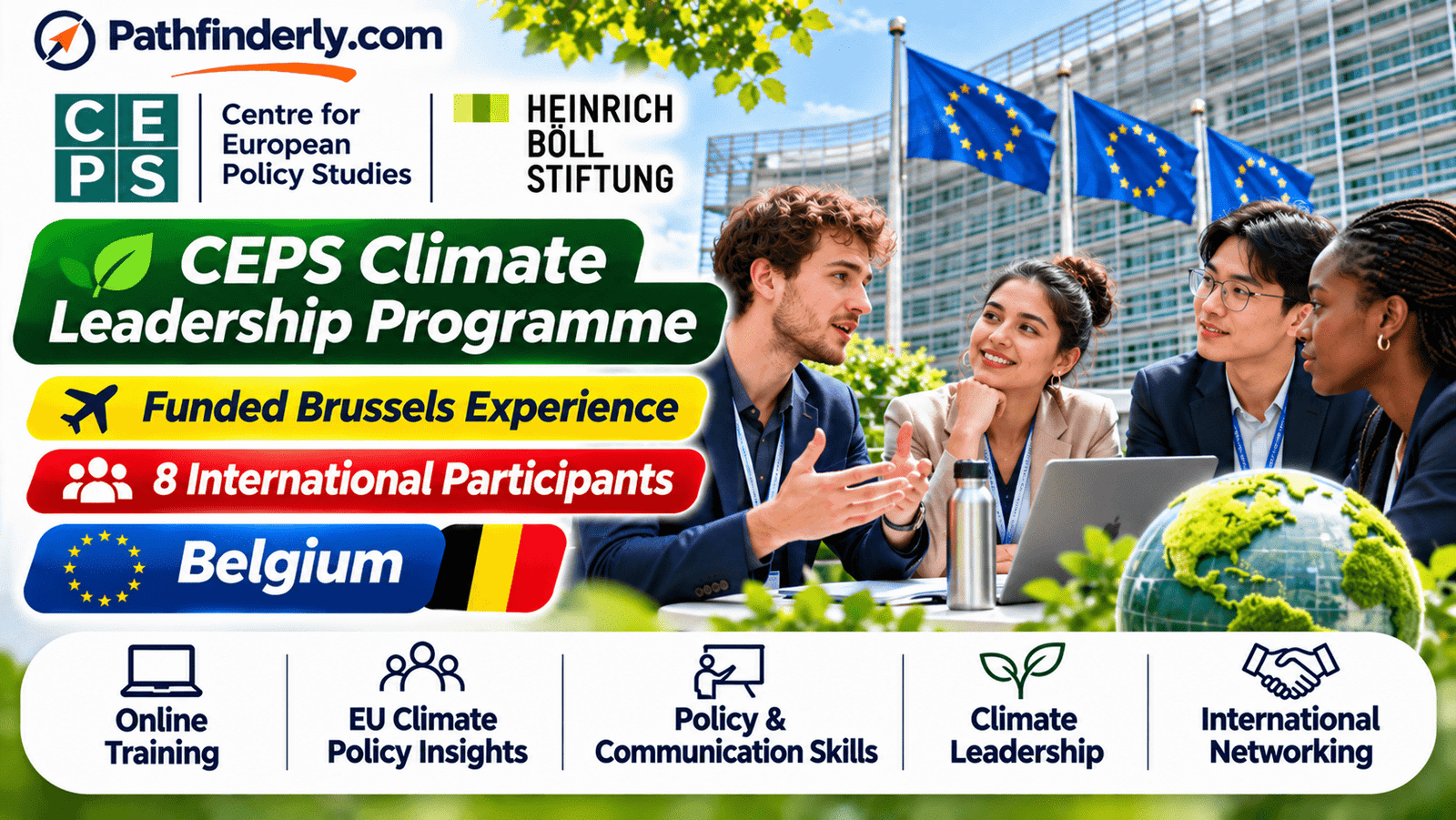
The CEPS Climate Leadership Programme 2027 offers young climate leaders an opportunity to develop policy skills and visit Brussels, Belgium. The programme combines online training, international networking, and direct engagement with European climate policymakers.
The Centre for European Policy Studies (CEPS) and Heinrich-Böll-Stiftung will select eight participants from around the world. Successful applicants will attend online masterclasses before joining a week-long programme in Brussels.
During their visit, participants will also attend CEPS Ideas Lab on 4–5 March 2027. The organisers will cover travel, visa and accommodation costs for the Brussels programme.
Applications are open to candidates aged 20–30 who already contribute to climate action, advocacy, policy or entrepreneurship.
Applications should be submitted by 10 November 2026 at 23:59 CET. The official announcement also lists 11 November in its key dates, so early submission is strongly recommended.
CEPS Climate Leadership Programme 2027 Overview
| Details | Information |
|---|---|
| Programme | Climate Leadership Programme |
| Organisers | CEPS and Heinrich-Böll-Stiftung |
| Destination | Brussels, Belgium |
| Programme type | Climate leadership and policy training |
| Number of participants | 8 |
| Eligible nationalities | Worldwide |
| Age requirement | 20–30 years |
| Online training | December 2026 – February 2027 |
| Brussels programme | 28 February – 6 March 2027 |
| CEPS Ideas Lab | 4–5 March 2027 |
| Funding | Travel, visa and accommodation for Brussels |
| Application opens | 29 October 2026 |
| Recommended submission deadline | 10 November 2026, 23:59 CET |
| Selection notification | By the end of November 2026 |
| Application method | Online questionnaire and emailed documents |
| Official website | https://www.ceps.eu/ceps-news/call-for-applications-climate-leadership-programme/ |
What Is the CEPS Climate Leadership Programme?
The Climate Leadership Programme is an international training initiative for young people working on climate challenges.
It aims to strengthen their understanding of European climate policymaking.
The programme also helps participants improve practical leadership, communication and policy skills.
Unlike a traditional academic scholarship, this opportunity focuses on people who already contribute to climate-related initiatives.
Applicants may work in advocacy, environmental organisations, policymaking, community projects or climate entrepreneurship.
The programme has two main phases.
First, participants attend online masterclasses between December 2026 and February 2027.
After completing this training, they travel to Brussels for an intensive policy experience.
The Brussels programme includes participation in CEPS Ideas Lab, a major European policy forum.
About the Organisers
Centre for European Policy Studies (CEPS)
The Centre for European Policy Studies is an independent European policy think tank based in Brussels.
CEPS conducts research and supports public discussion on European and international policy challenges.
Its work covers climate change, energy, economics, technology, governance and other important issues.
The organisation also brings researchers, policymakers, businesses and civil society representatives together.
Through this programme, CEPS aims to help emerging climate leaders understand and engage with European policy discussions.
Heinrich-Böll-Stiftung
Heinrich-Böll-Stiftung is a German political foundation.
It supports projects involving democracy, sustainability, environmental protection, human rights and international dialogue.
The foundation works with partners in different regions of the world.
For this programme, its European Union | Global Dialogue office supports CEPS in organising the leadership experience.
The foundation will also arrange a complementary programme in Brussels.
Programme Structure
The training takes place in two phases.
Phase 1: Online Climate Leadership Training
Period: December 2026 – February 2027
Selected participants begin with online masterclasses and practical training sessions.
The sessions cover important areas of climate policymaking and leadership.
Topics include:
- European Union climate governance
- Climate diplomacy
- Policy writing
- Strategic communication
- Climate advocacy
- Engagement with policy institutions
Participants will learn how climate decisions develop within European policy institutions.
They will also explore ways to communicate climate proposals more effectively.
Moreover, the training will help them connect their existing initiatives with broader policy discussions.
Attendance is mandatory.
Only participants who complete the online phase can proceed to the Brussels programme.
Phase 2: Climate Leadership Programme in Brussels
Dates: 28 February – 6 March 2027
After completing the online training, participants travel to Brussels.
The week offers direct exposure to the European policy environment.
Participants can meet policy professionals, researchers and other climate leaders.
They will also learn more about the institutions and organisations involved in European climate policy.
In addition, Heinrich-Böll-Stiftung will organise a complementary side programme.
The organisers will share further details with selected participants.
CEPS Ideas Lab 2027
One of the main highlights is participation in CEPS Ideas Lab.
The 2027 event will take place on 4–5 March in Brussels.
Ideas Lab brings together people working in European and international policymaking.
Participants include:
- Policymakers
- Researchers
- Business leaders
- Civil society representatives
- Policy experts
- International stakeholders
The event explores major challenges facing Europe and the wider world.
For young climate leaders, it provides an opportunity to observe policy discussions and meet experienced professionals.
Participants can also develop a better understanding of how research, advocacy and policymaking connect.
However, attendance does not guarantee meetings with specific officials or future employment opportunities.
Funding and Benefits
The organisers provide financial support for the Brussels phase.
1. Travel Expenses
The programme covers travel costs for the Brussels visit.
Selected participants will receive instructions about the travel arrangements.
2. Visa Costs
The organisers cover visa costs related to the Brussels programme.
However, applicants must still satisfy the relevant immigration requirements.
Selection does not guarantee visa approval.
3. Accommodation
The programme covers accommodation during the Brussels visit.
The organisers will provide further information to successful candidates.
4. Online Training
Participants receive access to the programme’s online masterclasses and skills training.
These sessions help develop practical knowledge of European climate governance and policy communication.
5. CEPS Ideas Lab Participation
Selected participants who complete the online training will join the Brussels programme, including CEPS Ideas Lab.
This experience offers exposure to European policy discussions.
6. International Networking
Participants can connect with climate leaders from different countries.
They may also meet researchers, policy professionals and civil society representatives.
7. Leadership Development
The programme helps participants strengthen their communication, advocacy and policy skills.
These skills may support their existing climate initiatives.
Is the Programme Fully Funded?
CEPS confirms that the organisers will cover travel, visa and accommodation costs for the Brussels week.
However, the official announcement does not clearly promise:
- A monthly or weekly stipend
- A cash allowance
- Full coverage of meals
- Personal shopping expenses
- Unlimited local transportation
- Other private expenses
Therefore, applicants should not assume that every cost will be covered.
Successful candidates should confirm the complete funding arrangements before travelling.
Who Can Apply?
The programme welcomes young climate leaders from around the world.
However, applicants must meet several requirements.
1. Age Requirement
Applicants must be 20–30 years old.
Candidates outside this age range do not meet the published eligibility requirement.
2. Interest in Climate Action
Applicants must demonstrate a strong interest in climate issues.
This interest should connect with practical activities or initiatives.
3. Existing Climate Engagement
The organisers seek people already involved in climate policy, advocacy or entrepreneurship.
Relevant experience may include:
- Climate advocacy campaigns
- Environmental organisations
- Community climate projects
- Sustainability initiatives
- Climate-related policy work
- Youth environmental movements
- Climate entrepreneurship
- Public awareness campaigns
Applicants should describe their actual contributions.
4. A Specific Climate Initiative
Candidates must bring a concrete initiative to the programme.
This could be a policy proposal, advocacy campaign or climate-related venture.
For example, an applicant may work on community adaptation, environmental education or clean energy advocacy.
However, the initiative should reflect genuine work or a clearly developed proposal.
5. English Communication
Applicants need a good command of English.
They must communicate effectively during online training and activities in Brussels.
The official announcement does not specify a mandatory IELTS or TOEFL score.
6. Full Availability
Applicants must be available for both programme phases.
The online training runs from December 2026 to February 2027.
The Brussels visit takes place from 28 February to 6 March 2027.
Participants must complete the online training before attending the Brussels programme.
Are International Applicants Eligible?
Yes.
CEPS welcomes applications from candidates worldwide.
The organisers also encourage applications from certain countries and regions.
These include:
- Albania
- Bolivia
- Bosnia and Herzegovina
- Brazil
- Cambodia
- Central American countries
- Chile
- China
- Colombia
- Georgia
- India
- Iraq
- Israel
- Kenya
- Kosovo
- Lebanon
- Mexico
- Montenegro
- Morocco
- Nigeria
- North Macedonia
- Palestine
- Peru
- Senegal
- Serbia
- South Africa
- South Korea
- Syria
- Tanzania
- Thailand
- Tunisia
- Turkey
- Uganda
- Ukraine
However, this list identifies countries and regions that the organisers particularly encourage.
It does not mean that applicants from other countries are automatically ineligible.
The programme remains open worldwide.
Do Applicants Need a University Degree?
The official announcement does not list a particular university degree as a universal requirement.
Instead, CEPS focuses on climate engagement, leadership potential and a concrete initiative.
Therefore, applicants should assess their experience against the published selection criteria.
Students, young professionals, advocates and entrepreneurs may have relevant backgrounds.
However, meeting the basic requirements does not guarantee selection.
Documents Required
Applicants must prepare three main application components.
1. Curriculum Vitae (CV)
Prepare an updated CV in English.
Include relevant information such as:
- Education
- Professional experience
- Climate-related projects
- Leadership activities
- Volunteer work
- Policy or advocacy experience
- Relevant achievements
- Communication and research skills
Keep the information accurate and relevant.
2. Reference Letter
Applicants must submit a reference letter in English.
Choose someone who can explain your climate work, leadership qualities or professional contributions.
A suitable referee might be a supervisor, project coordinator, academic mentor or organisational leader.
The official announcement does not specify a universal letter template.
Therefore, applicants should follow any additional instructions in the application materials.
3. Written Application Questionnaire
Candidates must complete the official online questionnaire.
The questionnaire forms an important part of the application.
Applicants should explain their climate interests, existing initiatives and reasons for joining the programme.
Use clear examples rather than general statements.
How to Prepare a Strong Application
Explain Your Climate Work
Describe the climate challenges you are addressing.
Then explain what you have done to respond to them.
For example, you might discuss an advocacy campaign, community project or environmental initiative.
Describe a Concrete Initiative
CEPS specifically asks applicants to bring an initiative.
Therefore, identify the problem, your proposed solution and the progress you have made.
Show Your Leadership Role
Explain your responsibilities.
Describe how you organised activities, worked with others or contributed to decisions.
Connect Your Work to Climate Policy
The programme focuses on European climate governance and policy engagement.
Explain how stronger policy knowledge could improve your initiative.
Highlight Communication Skills
Mention relevant experience in public speaking, advocacy, policy writing or community engagement.
Explain Your Future Goals
Describe what you hope to achieve after completing the programme.
For example, you may want to improve a climate campaign, develop a policy proposal or expand a local initiative.
Be Specific and Honest
Avoid exaggerated claims.
The organisers are looking for meaningful climate engagement.
Clear examples of genuine work can make an application more convincing.
How to Apply for CEPS Climate Leadership Programme 2027
The application requires an online questionnaire and an email submission.
Step 1: Visit the Official CEPS Announcement
Open the official programme page:
Read the eligibility rules and application instructions.
Step 2: Open the Application Questionnaire
Find the application questionnaire link in the official announcement.
Complete the required questions carefully.
Step 3: Describe Your Climate Initiative
Explain the climate issue you are working on.
Include your role, activities, achievements and future plans.
Step 4: Prepare Your CV
Update your CV in English.
Highlight relevant climate, policy, advocacy and leadership experience.
Step 5: Obtain a Reference Letter
Ask a suitable referee to prepare a letter in English.
Allow enough time for the referee to complete it.
Step 6: Email the Required Documents
Send your CV and reference letter to the email address provided in the official CEPS announcement.
Use this subject line:
Climate Leadership Programme – [Full Name]
Replace the bracketed text with your own full name.
Step 7: Complete Both Application Parts
Make sure you have submitted the online questionnaire and emailed the required documents.
CEPS states that only complete applications will receive consideration.
Step 8: Submit Before the Deadline
The application instructions specify 10 November 2026 at 23:59 CET.
However, the key dates section lists 11 November 2026.
Because of this discrepancy, applicants should complete both steps by 10 November.
Step 9: Monitor Your Email
CEPS expects to notify successful applicants by the end of November 2026.
Check your email regularly for updates.
Application Deadline
The official announcement contains two different deadline dates.
| Official page section | Deadline |
|---|---|
| Application instructions | 10 November 2026, 23:59 CET |
| Key dates | 11 November 2026, 23:59 CET |
Recommended submission deadline: 10 November 2026 at 23:59 CET.
Applicants should use the earlier date to avoid missing the opportunity.
They may also contact CEPS for clarification.
Programme Timeline
| Activity | Date |
|---|---|
| Applications open | 29 October 2026 |
| Recommended application deadline | 10 November 2026 |
| Selection notifications | By the end of November 2026 |
| Online masterclasses | December 2026 – February 2027 |
| Brussels programme begins | 28 February 2027 |
| CEPS Ideas Lab | 4–5 March 2027 |
| Brussels programme ends | 6 March 2027 |
What Makes This Programme Different?
Focus on Existing Climate Leaders
The programme targets applicants who already contribute to climate action.
It does not focus only on academic achievements.
Practical Policy Training
Participants learn about EU climate governance, diplomacy, communication and policy writing.
Online and In-Person Experience
The programme combines several months of online learning with a week in Brussels.
Small International Cohort
Only eight participants will be selected.
This creates a focused learning environment.
Exposure to European Policymaking
The Brussels visit gives participants an opportunity to observe policy discussions and engage with the European policy community.
Participation in Ideas Lab
The programme includes attendance at CEPS Ideas Lab, where policymakers and experts discuss important European challenges.
Do Participants Need a Belgium Visa?
Visa requirements depend on nationality, residence status and travel circumstances.
Some participants may enter Belgium without a visa for a short visit.
Others may need a Schengen visa.
CEPS confirms that the programme covers visa costs for the Brussels phase.
However, applicants must still meet the relevant immigration requirements.
Selected participants should follow the organisers’ instructions before applying for a visa.
Official information about entering Belgium is available through the Belgian Immigration Office:
Selection Process
CEPS will select eight participants.
The announcement identifies several qualities that applicants should demonstrate.
Climate Engagement
Applicants should show meaningful involvement in climate action.
Leadership Potential
The organisers seek candidates who can contribute to their communities or professional fields.
A Concrete Initiative
Applicants must present a specific policy proposal, advocacy campaign or venture.
Communication Skills
Participants need sufficient English skills to contribute to the training and Brussels activities.
Availability
Candidates must attend both phases of the programme.
Diversity
The organisers aim to bring together participants with different backgrounds and lived experiences.
They also seek a gender-balanced cohort.
CEPS expects to notify successful applicants by the end of November 2026.
Tips to Improve Your Chances
Apply Early
The application period is short.
Prepare your documents and questionnaire before the recommended deadline.
Focus on Real Achievements
Describe specific activities and outcomes.
For example, explain how many people joined a project or what changes your initiative achieved, if you can verify those figures.
Present a Clear Initiative
Explain the problem, your approach and your future plans.
Connect Local Work With Global Challenges
Show how your initiative relates to broader climate issues.
Explain Why Policy Training Matters
Describe how knowledge of European climate governance could help your work.
Choose a Relevant Referee
Ask someone familiar with your leadership and climate contributions.
Check Your Documents
Make sure your CV and reference letter are in English.
Complete Both Application Steps
Submitting only the questionnaire or only the email may leave your application incomplete.
Confirm Your Availability
You must attend the online phase and the Brussels programme.
Frequently Asked Questions
Is CEPS Climate Leadership Programme 2027 open?
Yes. CEPS opened applications on 29 October 2026.
Is the programme funded?
Yes. The organisers cover travel, visa and accommodation costs for the Brussels phase.
Does the programme provide a stipend?
The official announcement does not advertise a cash stipend.
Can international applicants apply?
Yes. Applications are open worldwide.
What is the age requirement?
Applicants must be 20–30 years old.
How many participants will be selected?
The organisers will select eight participants.
Do applicants need climate experience?
Yes. The programme targets people already engaged in climate policy, advocacy or entrepreneurship.
Is a university degree required?
The official announcement does not specify a universal degree requirement.
Is IELTS required?
The announcement requires good English communication skills but does not specify an IELTS score.
Can students apply?
Students may apply if they meet the age, climate engagement and other requirements.
Can entrepreneurs apply?
Yes. The organisers explicitly welcome applicants involved in climate entrepreneurship.
Is online training mandatory?
Yes. Participants must complete the online phase before joining the Brussels programme.
How long is the Brussels visit?
The in-person programme runs from 28 February to 6 March 2027.
Where will the programme take place?
Online training takes place remotely. The in-person phase takes place in Brussels, Belgium.
What is CEPS Ideas Lab?
It is a policy forum that brings together researchers, policymakers, business leaders and civil society representatives.
Is a reference letter required?
Yes. Applicants must submit a reference letter in English.
What is the application deadline?
The instructions state 10 November 2026, while the key dates section states 11 November. Applicants should submit by 10 November at 23:59 CET.
When will results be announced?
Successful applicants should receive notification by the end of November 2026.
Explore More International Leadership Opportunities
Young professionals interested in international leadership development can also explore the Community Solutions Program. This programme focuses on community leadership, professional development and practical projects.
Meanwhile, the CrossCulture Programme offers another pathway for international professionals interested in collaboration and cultural exchange.
Applicants seeking a fellowship that combines leadership and professional learning may also review the Stanford Fisher Family Summer Fellows Program.
These programmes have different eligibility requirements, funding arrangements and deadlines. Therefore, applicants should review each official announcement before applying.
Final Thoughts
The CEPS Climate Leadership Programme 2027 offers an opportunity for young climate leaders to strengthen their policy skills and gain international experience.
The programme combines online masterclasses with a funded visit to Brussels, Belgium.
Selected participants will also attend CEPS Ideas Lab in March 2027.
Importantly, the organisers welcome candidates worldwide. However, applicants must be 20–30 years old and already involved in climate-related activities.
CEPS will select only eight participants.
The organisers cover travel, visa and accommodation costs for the Brussels programme.
Applicants must complete an online questionnaire and email their CV and reference letter.
To avoid the conflicting deadline dates, submit both parts by 10 November 2026 at 23:59 CET.
Interested candidates should review the official CEPS announcement and prepare their applications early.
Official Sources
CEPS – Official Climate Leadership Programme Announcement and Application:
Climate Leadership Programme Announcement and Application
Centre for European Policy Studies
Heinrich-Böll-Stiftung:
Belgian Immigration Office:
Disclaimer
Pathfinderly.com is an independent information website. It is not affiliated with CEPS, Heinrich-Böll-Stiftung or the Climate Leadership Programme. Eligibility, funding, travel arrangements, selection requirements, application deadlines and programme dates may change. Applicants should verify all details through the official organiser before applying. Pathfinderly.com does not process applications, collect recruitment fees or guarantee selection, funding or visa approval.