
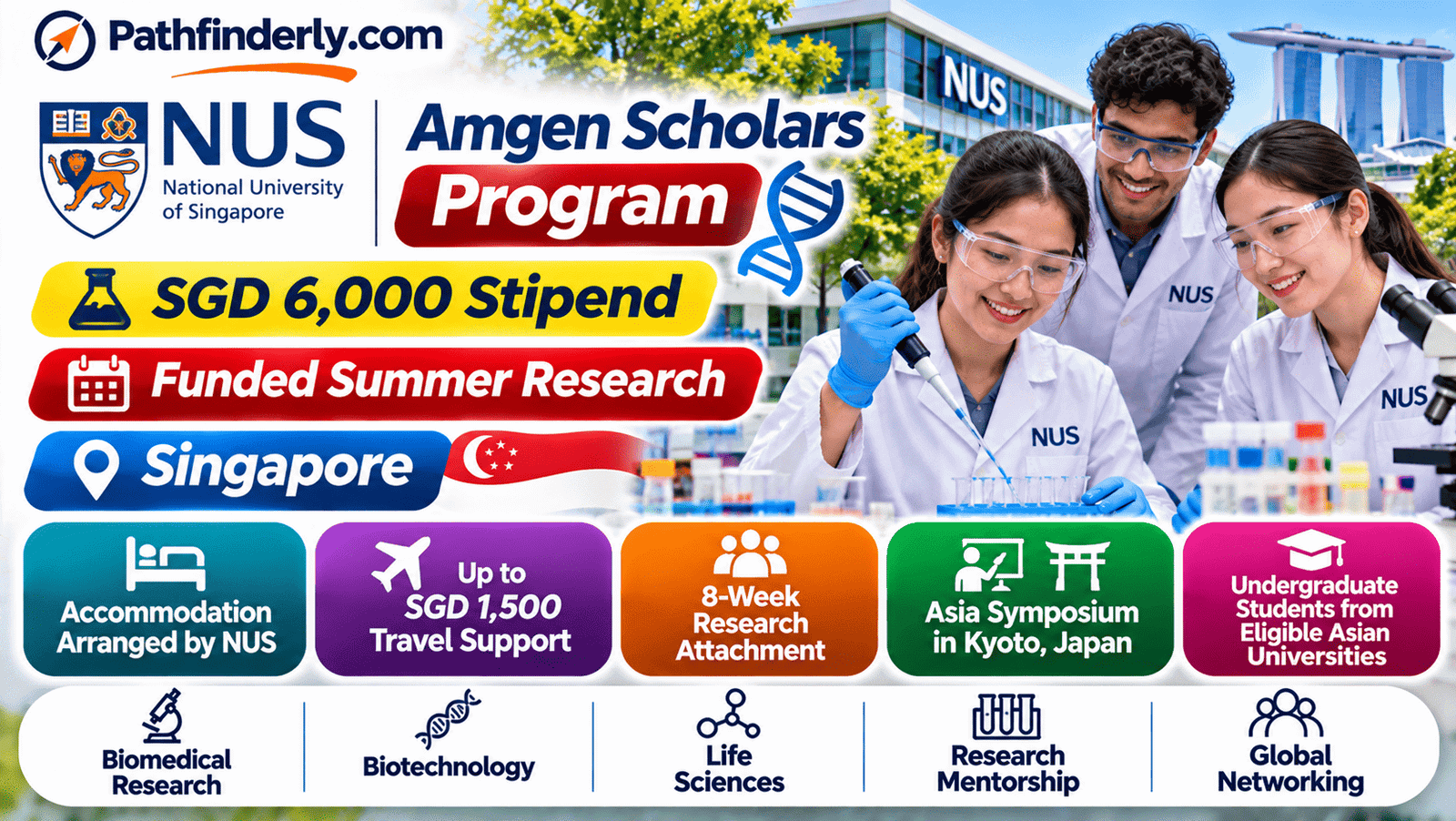
The NUS Amgen Scholars Program 2027 offers undergraduate students an opportunity to conduct funded biomedical research at the National University of Singapore. Selected scholars receive a SGD 6,000 stipend, accommodation, international travel support, and research mentorship from experienced scientists.
The program welcomes eligible undergraduate students attending universities across Asia. Participants spend approximately eight weeks working on research projects in biomedical sciences, biotechnology, and related fields.
In addition, scholars attend the Amgen Scholars Asia Symposium in Kyoto, Japan. This international event allows participants to present their research and connect with scientists and fellow students.
Applications opened on 1 November 2026. Interested students must submit their online applications by 1 February 2027 at 6:00 PM Singapore time (SGT).
NUS Amgen Scholars Program 2027 Overview
| Details | Information |
|---|---|
| Program | NUS Amgen Scholars Asia Program |
| Host university | National University of Singapore |
| Country | Singapore |
| Program type | Funded undergraduate summer research |
| Research fields | Biomedical sciences, biotechnology, and related disciplines |
| Research duration | Approximately 8 weeks |
| Full program period | 31 May – 5 August 2027 |
| Stipend | SGD 6,000 |
| Accommodation | Arranged by NUS |
| International travel grant | Up to SGD 1,500 |
| Visa support | Training Employment Pass processing and fees |
| Symposium | Amgen Scholars Asia Symposium |
| Symposium location | Kyoto, Japan |
| Eligible applicants | Undergraduates attending eligible Asian universities |
| Applications opened | 1 November 2026 |
| Application deadline | 1 February 2027 |
| Deadline time | 6:00 PM SGT (UTC+8) |
| Application method | Online |
| Official website | https://www.dbs.nus.edu.sg/outreach/amgen-program/ |
What Is the NUS Amgen Scholars Program?
The Amgen Scholars Program is an international undergraduate research initiative supported by the Amgen Foundation.
It gives students an opportunity to explore scientific research at leading universities and research institutions.
The National University of Singapore participates as a host institution for the Asia Program.
During the summer, selected scholars join research laboratories and work under the supervision of experienced researchers.
Participants learn research methods, develop laboratory skills, and contribute to ongoing scientific projects.
Moreover, they attend academic activities and present their research findings.
The experience can help students prepare for graduate education and future scientific careers.
About the National University of Singapore
The National University of Singapore is a major public research university.
Founded in 1905, NUS has a long history of higher education and scientific research.
The university offers academic programs in science, engineering, medicine, computing, business, and other disciplines.
Its research environment includes laboratories working on biomedical science, molecular biology, genetics, and biotechnology.
Through the Amgen Scholars Asia Program, NUS welcomes eligible undergraduate students from universities across Asia.
These students can explore research careers while working with university scientists and laboratory teams.
NUS Amgen Scholars Program 2027 Benefits
The program provides substantial financial and academic support.
1. SGD 6,000 Stipend
Each selected scholar receives a stipend of SGD 6,000 for the full program.
The stipend helps cover living expenses during the summer research attachment.
According to NUS, participants can use this support for meals, local transportation, social activities, and other daily expenses.
The university normally pays the stipend in two installments.
The first payment usually arrives during the second or third week.
The remaining payment generally follows around the sixth week.
However, administrative processing may affect the exact payment dates.
2. Accommodation in Singapore
NUS arranges accommodation for participating scholars.
Students must stay in the accommodation provided by the university during the program.
This arrangement helps participants live close to their research activities and other program events.
3. International Travel Grant
International scholars can receive a travel grant of up to SGD 1,500.
The grant supports eligible airfare expenses.
It covers travel from the scholar’s home country to Singapore and the return journey from Japan after the symposium, subject to the program’s rules.
However, the grant has a maximum amount and may not cover every travel expense.
4. Visa Application Support
NUS initiates the Training Employment Pass application for international participants.
The university also covers the related application fees.
However, selected students must cooperate with the immigration process and provide the required documents.
5. Research Mentorship
Scholars work under the guidance of NUS faculty members and laboratory researchers.
Mentors help participants understand research methods, laboratory procedures, and scientific investigation.
6. Scientific Training
Participants gain experience in an active research environment.
They may learn laboratory techniques, analyze experimental results, and discuss scientific questions with their research teams.
7. Amgen Scholars Asia Symposium
The program includes participation in the Amgen Scholars Asia Symposium in Japan.
Scholars share their research and meet participants from other host universities.
The symposium also offers opportunities to interact with researchers from academia and industry.
8. Academic Networking
Participants can connect with faculty members, graduate researchers, and undergraduate scholars.
These connections may help students explore future research and postgraduate opportunities.
Important Funding Conditions
Although the program offers strong financial support, applicants should understand several conditions.
- International students must initially purchase their own airfare to Singapore after confirming their itinerary with the program committee.
- Eligible airfare costs are reimbursed according to the program’s rules.
- Participants must arrange their own private health and travel insurance.
- Neither NUS nor the Amgen Foundation provides health insurance.
- The stipend covers everyday living costs rather than providing additional payments for every expense.
Therefore, applicants should prepare for any upfront travel or personal expenses.
Research Areas Available
The program focuses on biomedical sciences, biotechnology, and related life science disciplines.
NUS has research laboratories across several academic departments.
Students may explore projects in the following areas.
1. Molecular Biology and Genomics
Research in this field examines genes, molecular processes, and biological systems.
Students may gain experience with laboratory methods used to investigate cellular functions.
2. Cancer Biology
Cancer research explores how abnormal cells develop, grow, and respond to treatment.
Participants may work with research teams studying cancer-related biological processes.
3. Stem Cell Research
Stem cell research investigates cell development, regeneration, and related biological mechanisms.
This field can provide valuable experience for students interested in advanced biomedical research.
4. Infectious Diseases
Researchers investigate microorganisms, infections, and biological responses to disease.
Projects may involve microbiology, molecular biology, or related scientific methods.
5. Protein Structure and Drug Design
This field examines protein structures and their roles in biological processes.
Research may also contribute to understanding how new medicines interact with biological targets.
6. Cellular Development and Imaging
Researchers use scientific techniques to study how cells grow, develop, and function.
Students may learn about imaging methods and cellular analysis.
7. Ageing Research
Ageing research investigates biological changes that occur over time.
Projects may explore molecular, cellular, or physiological processes.
8. Pharmacology and Physiology
These disciplines examine how biological systems function and how substances affect the body.
They provide important foundations for biomedical research and drug development.
Important: These examples describe the research areas highlighted by Amgen Scholars at NUS. The exact projects available to selected scholars depend on the program’s project pool.
Who Can Apply for NUS Amgen Scholars Program 2027?
Applicants must meet the official academic and eligibility requirements.
1. Undergraduate Enrollment
Applicants must attend a college or university located in an eligible Asian country or area.
The institution must award a bachelor’s degree or an equivalent qualification.
2. Relevant Academic Discipline
NUS specifically welcomes students pursuing degrees in:
- Biology
- Biotechnology
- Biomedical Sciences
- Pharmaceutical Sciences
Students in related programs should review the official eligibility criteria before applying.
3. Minimum Academic Progress
Applicants must have completed at least their first year of undergraduate study when the summer program begins.
4. Continued Undergraduate Studies
Applicants must not graduate before the program begins.
After completing the summer program, they must return to undergraduate study for at least one semester or quarter.
Therefore, students who graduate before the summer and will not resume undergraduate studies are not eligible.
5. Strong Academic Performance
Applicants should demonstrate a strong academic record.
NUS considers academic preparation when evaluating candidates.
6. English Proficiency
Participants need a good working knowledge of English.
The program conducts its main research and academic activities in English.
7. Interest in PhD Research
Applicants should demonstrate an interest in pursuing a PhD.
The program aims to encourage undergraduate students to consider advanced research training.
8. Full-Time Availability
Scholars must participate throughout the program.
They cannot take additional courses or hold a job during the research attachment.
They must also attend the required symposium in Japan.
Which Countries Are Eligible?
The NUS program accepts undergraduate students attending universities in eligible Asian countries and areas.
These include countries across:
- Eastern Asia
- South-Eastern Asia
- Central Asia
- Southern Asia
- Western Asia
For example, the official eligibility list includes India, Bangladesh, Nepal, Sri Lanka, Japan, China, South Korea, Indonesia, Malaysia, Thailand, Singapore, Kazakhstan, Saudi Arabia, the United Arab Emirates, and other eligible locations.
However, the organizer uses a defined United Nations regional classification.
Applicants should check the complete country and area list on the official NUS website.
Does Citizenship Matter?
No.
The Amgen Scholars Asia Program does not require applicants to hold citizenship from an Asian country.
Instead, the location of the applicant’s university determines eligibility for the Asia Program.
For example, an international student attending an eligible university in Asia may qualify even if they hold citizenship from another region.
However, they must still meet the academic, language, and program requirements.
English Language Requirements
NUS accepts several ways to demonstrate English proficiency.
Applicants who need to provide a language test may use one of the following accepted qualifications.
| English test | Minimum requirement |
|---|---|
| TOEFL iBT | 72 |
| IELTS | Overall band 5.5 |
| Cambridge English | FCE |
| TOEIC | 1095 |
| TOEIC Listening & Reading | 785 |
| TOEIC Speaking & Writing | 310 |
Applicants should check the official website for any additional documentation rules.
Can Students Apply Without IELTS?
Yes, in some cases.
If the applicant’s current university teaches fully in English, NUS accepts an official university letter confirming the language of instruction.
This means eligible students may not need to submit IELTS or TOEFL results.
However, the university letter must clearly confirm that the institution uses English as its teaching medium.
NUS bases this requirement on the applicant’s current undergraduate education, not previous schooling.
Is Previous Research Experience Required?
Previous research experience is preferred but not compulsory.
NUS considers several factors when reviewing applicants.
These include:
- Academic preparation
- Research interests
- Curiosity about life science research
- Motivation
- Recommendation letters
- Interest in future PhD study
Therefore, students without formal laboratory experience may still apply.
However, they should explain their academic interests and relevant skills clearly.
Documents Required for NUS Amgen Scholars Program 2027
Applicants must prepare the documents listed in the official Amgen Application Checklist 2027.
The university provides this checklist through its program website.
1. Student Status Letter
Applicants should obtain an official letter from their university confirming their enrollment.
The letter should identify the student, degree program, and expected study period.
2. Academic Transcript
Applicants must provide their academic transcript.
NUS accepts unofficial transcripts printed on university or institutional letterhead.
If the transcript is not in English, applicants must also provide an English translation prepared by their university.
3. Curriculum Vitae
Prepare an updated academic CV.
Include relevant education, research experience, technical skills, and academic achievements.
4. Personal Statement
Applicants must explain their motivation for joining the program.
A strong statement should discuss academic interests, research goals, and what the applicant hopes to learn.
5. Recommendation Letters
Applicants must arrange academic references.
The application system sends instructions to referees after the online application is completed.
Referees generally receive two weeks to submit their letters.
However, applicants should follow the exact deadline provided in the referee email.
6. English Proficiency Evidence
Provide the relevant English test result if required.
Alternatively, eligible applicants may submit an official medium-of-instruction letter from their current university.
Important Document Preparation Advice
Download the 2027 checklist before applying.
Follow its required file names, formats, and instructions.
Applicants should not rely on checklists from previous years because document requirements may change.
How to Write a Strong Personal Statement
A personal statement gives applicants an opportunity to explain their motivation and research interests.
Explain Your Interest in Science
Describe what encouraged you to study your chosen subject.
You may discuss a course, laboratory activity, academic project, or scientific question.
Identify Your Research Interests
Explain which areas of biomedical science interest you.
For example, you may want to explore cancer biology, molecular genetics, infectious diseases, or biotechnology.
Discuss Relevant Experience
Mention academic projects, laboratory training, coursework, or independent research activities.
However, avoid exaggerating your experience.
Explain Why You Chose NUS
Describe how the university’s research environment connects with your goals.
You can also explain what you hope to learn from working with experienced researchers.
Describe Your Future Plans
The program values applicants interested in PhD study.
Therefore, explain how research experience may support your future academic development.
Use Your Own Voice
Write a clear and personal statement.
NUS has published guidance concerning the use of generative AI tools in applications.
Applicants should review that guidance and ensure their submissions accurately reflect their own experiences and ideas.
How to Apply for NUS Amgen Scholars Program 2027
The application process takes place through the official NUS system.
Step 1: Visit the Official Program Website
Open the Amgen Scholars Program page.
Read the eligibility requirements, funding information, and frequently asked questions.
Step 2: Download the 2027 Application Checklist
Find the official Amgen Application Checklist 2027.
Review all document requirements before starting the online form.
Step 3: Prepare Your Documents
Gather your student status letter, transcript, CV, personal statement, and English proficiency evidence if required.
Also identify suitable academic referees.
Step 4: Complete the Online Application
Use the application link provided on the official NUS program website.
Enter your personal, academic, and contact information carefully.
Step 5: Submit the Initial Application
Complete the online application before the official deadline.
After submission, the system sends instructions for uploading supporting documents.
Step 6: Upload the Required Documents
Follow the instructions sent to your email address.
NUS provides an additional three-day period for document uploads after the initial application deadline.
However, applicants should prepare all documents before submitting the application.
Step 7: Contact Your Referees
Make sure your referees receive their instructions.
Follow up with them to ensure they submit the required letters.
Step 8: Monitor Your Email
Check your inbox and spam folder for application updates.
Use a valid email address and monitor it regularly.
Step 9: Wait for Selection Results
NUS expects to notify shortlisted or successful candidates from mid-March 2027 onward.
Applicants should follow any additional instructions provided by the university.
NUS Amgen Scholars Program 2027 Deadline
The application deadline is:
1 February 2027 at 6:00 PM Singapore Standard Time (SGT, UTC+8).
The deadline applies to new online applications.
NUS provides an additional three-day period for uploading documents after the initial application submission.
However, this does not extend the deadline for starting a new application.
Applicants should submit early and avoid waiting until the final day.
NUS Amgen Scholars Program 2027 Timeline
| Event | Date |
|---|---|
| Applications open | 1 November 2026 |
| Online application deadline | 1 February 2027, 6:00 PM SGT |
| Admission notifications | Mid-March 2027 onward |
| Arrival in Singapore | 30 May 2027 |
| Orientation | 31 May 2027 |
| Research attachment begins | 31 May 2027 |
| Research attachment ends | 30 July 2027 |
| Departure for Japan | 2 August 2027 |
| Asia Symposium in Kyoto | 3–5 August 2027 |
| Participants return home | From 5 August 2027 |
The university may adjust the schedule if circumstances require changes.
What Happens During the Research Program?
Orientation
Scholars attend orientation at NUS.
The university introduces participants to the program, research environment, and required activities.
Laboratory Safety Training
Participants complete laboratory safety training and assessments before beginning laboratory work.
Research Project Assignment
NUS prepares a pool of research projects.
Selected scholars rank their project preferences.
The university then assigns projects based on the available opportunities.
However, participants may not receive their first-choice project.
Laboratory Research
Scholars join research groups and contribute to their assigned projects.
They participate in laboratory meetings, research discussions, and day-to-day scientific activities.
Research Presentations
Participants prepare poster and oral presentations describing their work.
These presentations help students develop scientific communication skills.
Final Research Report
Scholars must submit a written report after completing their research attachment.
Asia Symposium
The program concludes with the Amgen Scholars Asia Symposium in Japan.
Participants present their research and connect with scholars from other participating universities.
Amgen Scholars Asia Symposium 2027 in Japan
The 2027 symposium will take place in Kyoto, Japan, from 3 to 5 August.
This event brings together participants from Amgen Scholars host institutions across Asia.
Students can share their research findings and learn about scientific developments.
The symposium also includes opportunities to interact with researchers working in academia and industry.
According to the Amgen Scholars Asia Program, symposium travel and related program arrangements are supported.
However, participants must satisfy any applicable travel and immigration requirements for Japan.
Selection Process
NUS evaluates applicants based on academic preparation, research potential, and motivation.
Academic Performance
The university considers applicants’ academic records and relevant educational backgrounds.
Research Interest
Applicants should demonstrate genuine curiosity about biomedical research.
Recommendation Letters
Academic references help the selection committee understand an applicant’s abilities and potential.
Personal Statement
The personal statement explains why the applicant wants to participate and how the experience fits their goals.
Interest in Graduate Research
NUS values students who show an interest in pursuing PhD-level training.
Research Project Matching
Selected scholars rank their preferred research projects.
The university assigns projects according to available placements and suitability.
Important Rules for Selected Scholars
The program requires full-time participation.
Selected scholars must:
- Attend the full research program and symposium.
- Stay in accommodation arranged by NUS.
- Participate in laboratory activities and meetings.
- Complete laboratory safety training.
- Attend required conferences and program events.
- Prepare poster and oral research presentations.
- Submit a final written report.
- Avoid holding another job or taking additional courses during the program.
Applicants should check their university calendars before accepting an offer.
Tips for a Successful Application
Check Your University Location
Make sure your university is located in an eligible Asian country or area.
Confirm Your Graduation Date
You must return to undergraduate study for at least one semester or quarter after the program.
Prepare Your Documents Early
Request university letters and transcripts well before the deadline.
Choose Suitable Referees
Ask professors who understand your academic abilities and research potential.
Show Genuine Research Interest
Explain which scientific questions interest you and why.
Discuss Your Future Goals
Describe how the program could support your plans for graduate study or research.
Review English Requirements
If your university teaches in English, request an official medium-of-instruction letter.
Follow the Application Checklist
Use the official 2027 checklist for document formats and file names.
Plan for Initial Expenses
International participants may need to purchase airfare before receiving reimbursement.
They must also arrange their own insurance.
Submit Before the Deadline
Avoid waiting until the last day to complete the online application.
Frequently Asked Questions
Is NUS Amgen Scholars Program 2027 open?
Yes. Applications opened on 1 November 2026.
Is the program funded?
Yes. It provides a SGD 6,000 stipend, accommodation, and travel support under the program’s conditions.
How much is the stipend?
Each selected scholar receives SGD 6,000 for the full program.
Is accommodation provided?
Yes. NUS arranges accommodation, and participants must stay in the assigned housing.
Is airfare covered?
International scholars can receive a travel grant of up to SGD 1,500. Reimbursement conditions apply.
Can international students apply?
Yes, if they attend a university in an eligible Asian country or area and meet the remaining requirements.
Must applicants be citizens of Asian countries?
No. The program does not impose an Asian citizenship requirement.
Can students from non-Asian universities apply?
Not through the NUS Amgen Scholars Asia Program. They should explore Amgen Scholars opportunities in other eligible regions.
Is previous research experience compulsory?
No. Previous experience is preferred but not required.
Do I need IELTS?
Not necessarily. Applicants whose current university teaches fully in English may submit an official medium-of-instruction letter.
What is the minimum IELTS score?
The listed minimum is an overall band score of 5.5 for applicants who need to demonstrate English proficiency through IELTS.
Can master’s students apply?
The program targets undergraduate students.
Can final-year undergraduate students apply?
Only if they meet the requirement to continue undergraduate study for at least one semester or quarter after the program.
Can I choose my research project?
Selected scholars rank their preferences from the available project pool. However, their first choice is not guaranteed.
Do I need to contact a supervisor before applying?
No. NUS provides a project selection and assignment process after selection.
Can I apply to other Amgen Scholars host universities?
Yes. Applicants may apply to multiple eligible host institutions, but each university has its own application process.
Is health insurance provided?
No. Participants must arrange their own private health and travel insurance.
When is the application deadline?
1 February 2027 at 6:00 PM Singapore time.
When will applicants receive results?
NUS expects to announce admission decisions from mid-March 2027 onward.
Where will the symposium take place?
Kyoto, Japan.
Explore More International Research Opportunities
Students interested in biomedical research can also explore the Max Planck Institute for Infection Biology Internship, which introduces students to scientific research opportunities in Germany.
Meanwhile, the EPFL Summer Research Program offers another opportunity for students interested in life sciences and laboratory research in Switzerland.
Students who want to compare summer research experiences in the United States may also read our MIT Summer Research Program guide.
Each program has different academic requirements, eligibility rules, funding arrangements, and deadlines. Therefore, applicants should review the official information before applying.
Final Thoughts
The NUS Amgen Scholars Program 2027 offers undergraduate students attending eligible Asian universities an opportunity to gain valuable biomedical research experience in Singapore.
Selected participants receive a SGD 6,000 stipend, university-arranged accommodation, international travel assistance, and research mentorship.
They also attend the Amgen Scholars Asia Symposium in Kyoto, Japan.
Importantly, applicants do not need Asian citizenship or previous formal research experience. However, they must meet the academic, enrollment, English proficiency, and full-time participation requirements.
The application deadline is 1 February 2027 at 6:00 PM Singapore time.
Interested students should review the official 2027 checklist, prepare their documents, and complete the application before the deadline.
Official Sources
National University of Singapore – Official Amgen Scholars Program:
https://www.dbs.nus.edu.sg/outreach/amgen-program/
NUS Amgen Scholars – National University of Singapore:
https://amgenscholars.com/university/national-university-of-singapore/
Amgen Scholars Asia Program – Eligibility and Host Institutions:
https://amgenscholars.com/asia-program/
Amgen Scholars – Official Global Website:
https://amgenscholars.com/
Disclaimer
Pathfinderly.com is an independent information website and is not affiliated with the National University of Singapore, the Amgen Foundation, or the Amgen Scholars Program. Program eligibility, funding, travel grants, accommodation, visa requirements, research projects, deadlines, and schedules may change. Applicants should verify all details through the official university and program websites before applying. Pathfinderly.com does not process applications, collect application fees, or guarantee selection.