
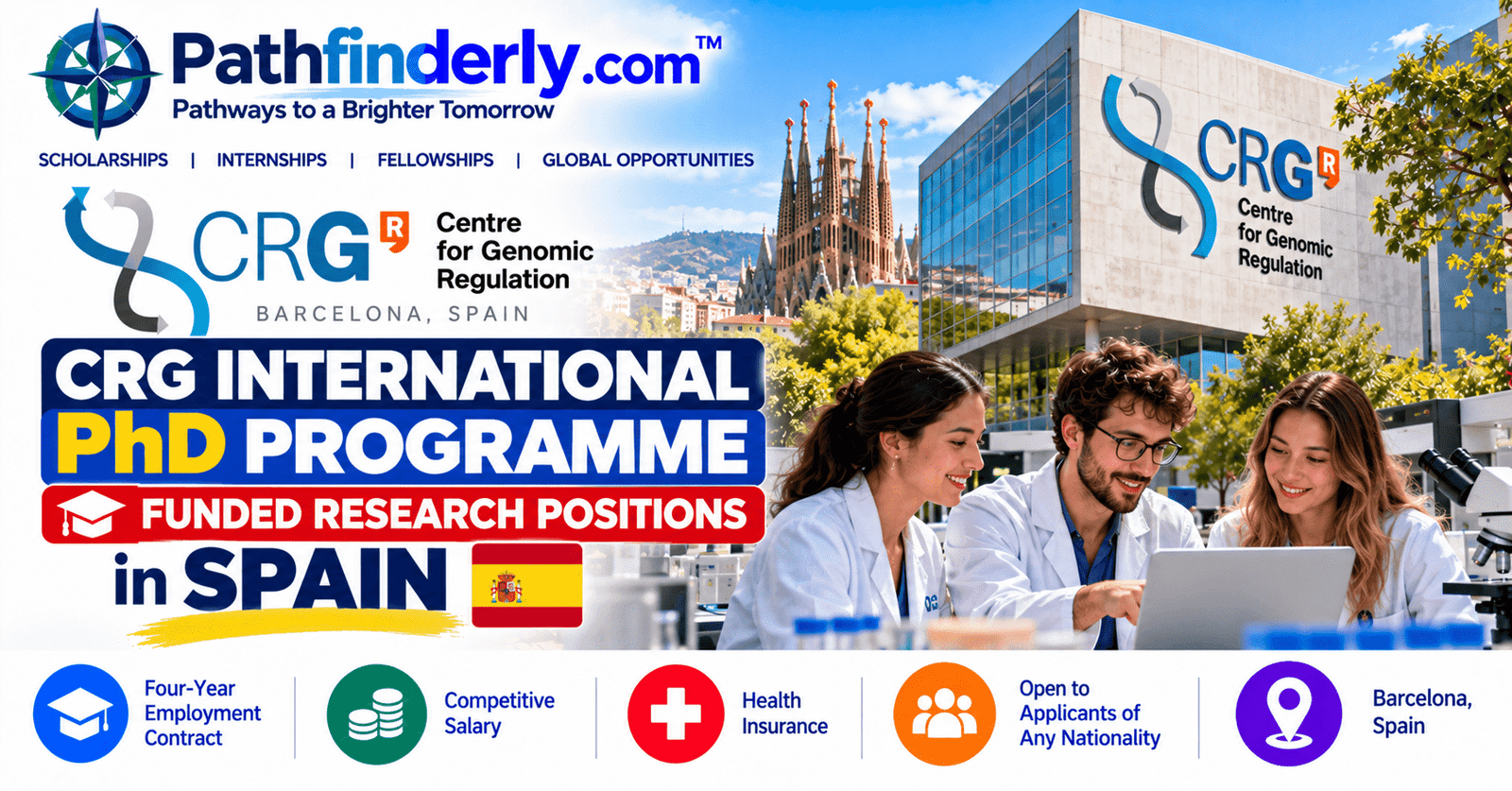
The CRG International PhD Programme 2027 offers an excellent opportunity for talented graduates who want to pursue doctoral research in Spain. The Centre for Genomic Regulation (CRG), located in Barcelona, is inviting applications from candidates worldwide for its funded PhD positions in life sciences and related research fields.
Selected candidates will receive a four-year employment contract with a competitive salary, health insurance and Spanish social security benefits. They will also gain access to advanced research facilities, international scientific teams and professional development activities.
The programme welcomes applicants of any nationality who meet the academic and research requirements. Candidates can choose up to two participating laboratories based on their interests and qualifications.
Research opportunities include genomics, molecular biology, computational biology, genetics, cancer biology, RNA research and other areas of biomedical science.
The application deadline is November 22, 2026.
Interested applicants should review the available research projects and submit their applications through the official CRG International PhD Programme 2027 announcement.
CRG International PhD Programme 2027 Overview
| Details | Information |
|---|---|
| Programme | CRG International PhD Programme 2027 |
| Host Institution | Centre for Genomic Regulation |
| Country | Spain |
| City | Barcelona |
| Programme Type | Funded doctoral research |
| Duration | Four years |
| Funding | Employment contract and competitive salary |
| Insurance | Health and occupational insurance |
| Social Security | Included |
| Eligible Nationalities | All nationalities |
| Education | Qualifying university degree for PhD admission |
| Language | High working proficiency in English |
| Research Areas | Genomics, molecular biology, computational biology and related fields |
| Laboratory Choices | Maximum two |
| Application Method | Online |
| Deadline | November 22, 2026 |
| Expected Start | No later than October 2027 |
What Is the CRG International PhD Programme?
The CRG International PhD Programme is a structured doctoral research initiative offered by the Centre for Genomic Regulation in Barcelona.
Its main purpose is to train talented researchers who want to build careers in biological and biomedical sciences.
Unlike a short-term research internship, this programme involves several years of advanced scientific research leading toward a doctoral qualification.
Participants work under the supervision of experienced researchers while developing independent research skills.
They also receive training in scientific methods, data analysis, communication and other professional skills.
The programme combines laboratory research with mentoring, scientific seminars and career development.
As a result, participants can prepare for future careers in universities, research institutions, biotechnology companies and other scientific organizations.
About the Centre for Genomic Regulation
The Centre for Genomic Regulation is an international biomedical research institute based in Barcelona, Spain.
CRG conducts research into fundamental biological processes and their connections with human health and disease.
Its researchers investigate how genes function, how cells develop and how molecular processes influence living organisms.
The institute brings together scientists from different countries and academic backgrounds.
It also provides access to advanced technologies, including genomics, proteomics, imaging and bioinformatics facilities.
These resources support interdisciplinary research and help doctoral students gain experience with modern scientific methods.
CRG is part of Barcelona’s wider biomedical research environment.
You can learn more through the official Centre for Genomic Regulation website.
Is the CRG PhD Programme Fully Funded?
Yes. CRG describes its doctoral positions as fully funded research opportunities.
However, the funding is provided through an employment arrangement rather than a conventional scholarship that simply pays a fixed stipend.
Selected researchers receive a paid contract for four years, subject to the applicable employment regulations.
They also receive health and occupational insurance coverage and participate in the Spanish Social Security System.
This provides financial support while allowing participants to develop their scientific careers.
Nevertheless, applicants should not assume that every personal expense is covered separately.
For example, the official announcement does not promise free accommodation or international relocation flights for every selected PhD student.
The institute specifically confirms flight and accommodation support for candidates invited to the final in-person interviews.
Financial Benefits
1. Four-Year Employment Contract
Successful applicants receive an employment contract covering the four-year doctoral research period.
CRG describes the arrangement as an annual work contract provided over four years.
The contract follows the relevant Spanish employment regulations.
This means doctoral researchers receive employment-based financial support while conducting their research.
2. Competitive Salary
Selected PhD students receive a competitive salary.
However, CRG does not specify one universal monthly salary in the main call announcement.
The exact amount may depend on the applicable funding arrangement and employment conditions.
Applicants should confirm the salary details when receiving an official offer.
3. Health Insurance
The programme includes full health insurance coverage for selected doctoral researchers.
This is an important benefit for international applicants who plan to live and work in Spain.
4. Occupational Insurance
Participants also receive occupational insurance coverage under the programme’s employment arrangements.
5. Spanish Social Security
Selected researchers become part of the Spanish Social Security System.
Their employment and associated benefits follow the applicable national regulations.
6. Research Facilities
PhD students gain access to CRG’s scientific facilities and technologies.
Depending on the laboratory, these may include genomic sequencing, microscopy, computational analysis and other advanced research methods.
7. Training and Career Development
CRG provides professional development opportunities alongside doctoral research.
Students may participate in scientific courses, seminars, workshops and career-development activities.
8. Travel and Accommodation for Final Interviews
Applicants invited to the final in-person selection stage in Barcelona receive flight tickets and accommodation for the interview visit.
This benefit applies to the relevant interview stage, not automatically to relocation after admission.
Available Research Fields
The 2027 call includes research opportunities across several areas of biological and biomedical science.
Applicants should choose laboratories that match their academic background and research interests.
Genomics and Genome Regulation
Genomics research investigates the structure, function and regulation of genetic material.
Projects may explore how genes influence cellular processes, development and disease.
Computational Biology
Computational biology combines biological research with mathematics, statistics and computer science.
Researchers use computational tools to analyze large biological datasets and investigate complex biological systems.
Single-Cell Biology
Single-cell research studies individual cells to understand how they differ and how their functions change.
This field is important for understanding development, ageing and disease.
Molecular Biology
Molecular biology focuses on the biological processes involving DNA, RNA and proteins.
Projects may investigate how cells control gene expression and respond to changing conditions.
Cancer Biology
Cancer research examines the molecular and cellular processes involved in tumor development and progression.
Projects may investigate gene regulation, epigenetics, cellular identity and potential therapeutic approaches.
RNA Biology
RNA research explores how RNA molecules are produced, processed, regulated and degraded.
These processes play important roles in gene expression and cellular function.
Epigenetics and Chromatin Biology
Researchers in these fields investigate how cells regulate access to genetic information.
Projects may examine chromatin organization, histone modifications and their effects on development or disease.
Bioinformatics and Data Science
Bioinformatics uses computational methods to analyze biological information.
Relevant skills may include programming, statistics, machine learning and biological data interpretation.
Participating Research Laboratories
The 2027 call includes several research groups with different scientific interests.
Examples include:
| Research Laboratory | Main Research Interests |
|---|---|
| Sebé-Pedrós Lab | Evolutionary genomics, genome regulation and single-cell biology |
| Velten Lab | Computational biology, ageing and blood stem cells |
| Gebauer Lab | RNA-binding proteins, translation and cancer |
| Baud Lab | Quantitative genetics and microbiome interactions |
| Irimia Lab | Single-cell genomics, RNA biology and evolution |
| Martí-Renom Lab | 3D genomics, epigenetics and genome organization |
| Höpfler Lab | Protein synthesis and RNA decay |
| Di Croce Lab | Epigenetics, chromatin and cancer |
| Surrey Lab | Biophysics, cytoskeleton and cellular organization |
| Valcárcel Lab | RNA splicing and gene regulation |
| Beekman Lab | Immune cells, epigenetics and lymphoma |
| Ferrer Lab | Regulatory genomics and diabetes |
| Lin Lab | Stem cells, single-cell analysis and predictive modelling |
Additional research groups and project descriptions are available in the official call.
Some laboratories advertise more than one PhD project.
Therefore, applicants should read the individual descriptions carefully rather than choosing a laboratory only by its name.
The complete list appears on the CRG PhD recruitment page.
Who Can Apply?
The programme is open to applicants from any country.
However, candidates must satisfy the academic, research and other eligibility requirements.
1. Nationality
Applicants of all nationalities may apply.
There is no general restriction limiting the call to Spanish or European Union citizens.
2. Educational Qualification
Candidates must hold a Bachelor’s degree and a Master’s degree in biomedical sciences within the European Higher Education System, representing at least 300 ECTS credits in total.
Alternatively, applicants may hold an equivalent university qualification that permits admission to doctoral research in Spain.
Candidates expecting to obtain the required qualification by September 2027 are also eligible to apply.
3. Academic Performance
Applicants should have an excellent academic record.
The selection committee considers academic qualifications when evaluating candidates.
4. Research Experience
Previous research experience is required.
Relevant experience may include a Master’s research project, laboratory work, scientific research assistance or other appropriate research activities.
The type of experience should match the chosen laboratory.
5. English Language Proficiency
Candidates must have a high working knowledge of English.
English is widely used in CRG’s international research environment.
Applicants should be able to understand scientific material, communicate research ideas and participate in professional discussions.
6. Commitment to Scientific Research
Applicants must demonstrate strong motivation for research.
They should explain their scientific interests and reasons for choosing the programme.
7. Previous CRG Interview Restriction
Candidates who were invited to interviews in previous CRG PhD calls are not eligible for this call.
8. Current CRG Master’s Students
Applicants who are completing their Master’s studies at CRG are not eligible under the published conditions.
9. Previous Employment at CRG
Candidates must not have worked at CRG for more than three months before the application deadline.
Applicants should review these restrictions before preparing an application.
Can International Students Apply?
Yes.
The CRG International PhD Programme welcomes candidates of any nationality.
Applicants from Asia, Africa, Europe, North America, South America and other regions may apply if they meet the eligibility criteria.
However, applicants with qualifications obtained outside the European Higher Education System must ensure that their degrees are equivalent to the qualifications required for doctoral admission in Spain.
International candidates should also consider visa and residence requirements if selected.
The official programme does not guarantee that every immigration-related expense will be reimbursed.
Can Final-Year Master’s Students Apply?
Yes, under specific conditions.
Candidates who expect to obtain the required qualification by September 2027 may apply.
They must still satisfy the other eligibility criteria.
Applicants should provide accurate information about their expected graduation date.
If selected, they will need to meet the academic requirements before beginning doctoral studies.
Can Bachelor’s Degree Holders Apply?
A Bachelor’s degree alone does not automatically satisfy the standard eligibility requirement.
CRG requires the relevant Bachelor’s and Master’s qualifications or an equivalent university degree that allows the candidate to begin doctoral research in Spain.
Therefore, applicants with only a Bachelor’s degree should confirm whether their qualification meets the Spanish doctoral admission requirements.
They should not assume that every four-year Bachelor’s degree is accepted.
Is IELTS Required?
The main CRG announcement requires a high working knowledge of English.
However, it does not specify a universal IELTS or TOEFL score for all applicants.
This does not mean that language ability is unimportant.
Candidates must be able to communicate effectively in an international scientific environment.
Applicants should review the application portal and any laboratory-specific requirements for additional instructions.
Is Previous Research Experience Necessary?
Yes.
CRG explicitly identifies previous research experience as an eligibility requirement.
Applicants should explain the research activities they have completed and the skills they developed.
For example, relevant experience might involve:
- Laboratory experiments
- Master’s thesis research
- Scientific data analysis
- Computational modelling
- Bioinformatics projects
- Research internships
- Academic research assistance
The selection committee will also consider how well the applicant’s experience matches the selected laboratories.
Required Documents and Information
The online application requests information about the candidate’s academic and research background.
Applicants should prepare the following:
- Personal and contact information
- Educational qualifications
- Academic transcripts
- Research experience
- Scientific interests
- Scholarships, prizes and awards, where applicable
- Motivation and laboratory preferences
- Contact details for two academic or professional referees
- Any additional documents requested by the application system
Academic Transcript Language
Transcripts must be in Catalan, Spanish or English.
If a transcript is issued in another language, the applicant must attach a translation into one of these languages.
Two Reference Letters
The application system automatically requests two reference letters from the referees nominated by the applicant.
Applicants should contact their referees early.
Importantly, the reference letters must be received before the application deadline.
Incomplete applications will not be considered.
How Many Laboratories Can You Choose?
Applicants may select a maximum of two CRG laboratories.
This is an important part of the application process.
Candidates should review the research projects and identify laboratories that match their qualifications and interests.
For example, a candidate with strong programming and statistical skills may be interested in computational biology laboratories.
Meanwhile, someone with extensive molecular laboratory experience may prefer experimental biology projects.
Applicants should explain why they are interested in the selected laboratories.
A well-matched application is more useful than choosing laboratories without understanding their research.
How to Apply for the CRG International PhD Programme 2027
The application process is entirely online.
CRG does not accept applications by email.
Step 1: Visit the Official Programme Website
Open the CRG International PhD Programme 2027 announcement.
Read the eligibility criteria and application instructions.
Step 2: Review the Research Projects
Explore the participating laboratories.
Pay attention to their research areas, project descriptions and preferred candidate backgrounds.
Step 3: Select Up to Two Laboratories
Choose no more than two laboratories that match your research interests.
Consider your academic training and previous research experience.
Step 4: Open the Application Portal
Use the Start Your Application button on the official announcement.
This directs applicants to CRG’s recruitment system.
Step 5: Register an Account
Create an applicant account using accurate personal information.
Use an email address that you check regularly.
Step 6: Complete Your Academic Information
Enter your university qualifications, academic history and relevant achievements.
Provide the requested transcripts and other documents.
Step 7: Describe Your Research Experience
Explain your previous research activities.
Highlight relevant scientific methods, technical skills and research outcomes.
Step 8: Explain Your Scientific Interests
Describe the research questions that interest you and how they relate to the selected laboratories.
Avoid using a generic motivation statement.
Step 9: Provide Two Referees
Enter the contact details of two referees.
The application system will automatically request their recommendation letters.
Make sure both referees understand the deadline.
Step 10: Review Your Application
Check that all required information and documents are complete.
Confirm that your laboratory choices are correct.
Step 11: Submit Before the Deadline
Submit the application by November 22, 2026.
All required reference letters must also be received by the deadline.
Step 12: Check Your Email
After submission, CRG sends an automatic acknowledgment by email.
Keep this confirmation for your records.
Application Deadline
The official deadline is:
November 22, 2026.
Candidates should submit their applications early.
Waiting until the final day may leave insufficient time for referees to upload their letters or for applicants to resolve technical problems.
The official call should be treated as the authoritative source for the precise closing time.
Selection Process
CRG evaluates applicants based on their academic qualifications, research excellence, motivation and suitability for the selected laboratories.
The process involves several stages.
Stage 1: Application Review
The selection committee reviews applications and supporting information.
Academic records, previous research experience, scientific interests and reference letters are important considerations.
Stage 2: Online Panel Interview
Preselected candidates will be invited to an online panel interview scheduled for January 13, 2027.
The interview provides an opportunity to discuss the candidate’s academic background, research experience and motivation.
Stage 3: In-Person Interviews in Barcelona
Candidates who successfully complete the online stage may be invited to Barcelona.
The official CRG call schedules in-person interviews for February 23–26, 2027.
CRG provides accommodation and flight tickets for invited candidates.
The visit includes interviews and presentations.
Stage 4: Final Selection
Successful candidates receive offers after the final interview stage.
The selection committee considers research excellence and suitability for the available positions.
Stage 5: Programme Start
Selected candidates are expected to begin their PhD no later than October 2027.
CRG International PhD Programme 2027 Timeline
| Stage | Date |
|---|---|
| Application Period | Open |
| Application Deadline | November 22, 2026 |
| Online Panel Interviews | January 13, 2027 |
| In-Person Interviews | February 23–26, 2027 |
| Final Offers | Following the interviews |
| Expected PhD Start | By October 2027 |
Applicants should monitor the official website and their email for any changes.
Online Application Workshops
CRG also organizes online workshops to help prospective applicants understand the PhD application process.
These sessions discuss how to identify suitable laboratories, prepare an application and present research interests effectively.
The remaining announced workshop is:
November 12, 2026, at 11:00 AM Central European Time.
Registration is required.
Applicants can find the registration link on the official PhD call page.
Participating in a workshop may help candidates prepare, but it does not guarantee selection.
How to Prepare a Strong Application
Choose the Right Research Laboratory
Research fit is particularly important for doctoral positions.
Before applying, study the research interests of the laboratory and identify how your background connects with its projects.
Explain Your Research Experience Clearly
Describe the scientific questions you have investigated.
Include the methods you used and the skills you gained.
You do not need to exaggerate your achievements.
A clear explanation of genuine research experience is more valuable.
Show Strong Scientific Motivation
Explain why you want to pursue doctoral research.
Describe the topics that interest you and how they connect with your longer-term goals.
Highlight Relevant Technical Skills
Depending on the project, useful skills may include laboratory techniques, microscopy, sequencing, statistical analysis or programming.
For computational positions, experience with Python, R or other relevant tools may be particularly valuable.
Contact Your Referees Early
Two recommendation letters are required.
Choose referees who can comment meaningfully on your academic ability and research potential.
Give them enough time to prepare their letters.
Prepare for Scientific Interviews
If shortlisted, be ready to discuss your previous research and explain why you selected particular laboratories.
You should also understand the main research questions addressed by those groups.
What Training Will PhD Students Receive?
CRG offers structured scientific and professional development activities.
These include technical training, scientific seminars and workshops on transferable skills.
Students may develop abilities in areas such as:
- Genomics and molecular research methods
- Bioinformatics and computational analysis
- Scientific communication
- Research ethics
- Data management
- Project management
- Statistics and programming
- Innovation and entrepreneurship
The institute also supports career development and mentoring.
These activities help researchers prepare for careers both inside and outside academia.
Living and Studying in Barcelona
Barcelona is one of Spain’s major centers for higher education and biomedical research.
The city hosts universities, research institutes and biotechnology-related organizations.
For international doctoral students, living in Barcelona can provide opportunities for scientific collaboration and professional networking.
However, applicants should consider practical matters before relocating.
These may include accommodation, transportation, health coverage, immigration procedures and living expenses.
Although CRG provides a competitive salary, the official call does not promise free housing for the entire doctoral period.
Selected candidates should confirm their employment conditions and expected expenses before accepting an offer.
Why Consider the CRG International PhD Programme?
International Research Environment
CRG brings together researchers from different countries and scientific backgrounds.
This creates opportunities for collaboration and knowledge sharing.
Advanced Research Facilities
Participants can use modern scientific technologies relevant to their research projects.
Financial Support
The four-year employment arrangement provides paid research experience and associated employment benefits.
Professional Development
Students receive training and mentoring throughout their doctoral studies.
Research Specialization
The programme allows participants to develop expertise in specialized areas of modern biology.
Career Opportunities
Doctoral training may help graduates pursue future opportunities in academia, biotechnology, pharmaceuticals, computational biology and scientific research.
However, completing the programme does not guarantee employment in any particular organization.
Other International Research Fellowships and PhD Opportunities
Researchers interested in funded scientific opportunities can also explore the KAUST Global Fellowship, which supports eligible early-career researchers working on advanced research projects.
The Hong Kong PhD Fellowship Scheme offers financial support for outstanding students pursuing doctoral studies at participating universities in Hong Kong.
Applicants interested in research training at leading institutions may also explore the KAUST Visiting Student Research Program, which provides selected students with practical research experience in Saudi Arabia.
These opportunities have different academic requirements, durations and funding arrangements.
Therefore, applicants should compare the official eligibility conditions before applying.
Frequently Asked Questions
Is the CRG International PhD Programme 2027 open?
Yes. The 2027 call is accepting applications.
What is the application deadline?
November 22, 2026.
Where is the programme located?
At the Centre for Genomic Regulation in Barcelona, Spain.
Is the programme fully funded?
Yes. CRG describes the doctoral positions as fully funded and provides a four-year paid employment arrangement.
What is the duration?
Four years.
Is there a monthly salary?
Selected researchers receive a competitive salary. The main call does not publish one fixed monthly amount for all positions.
Can applicants from any country apply?
Yes. The programme is open to all nationalities.
Is a Master’s degree required?
Applicants must hold the specified Bachelor’s and Master’s qualifications or an equivalent degree that allows doctoral study in Spain.
Can final-year Master’s students apply?
Yes, if they expect to obtain the qualifying degree by September 2027.
Is research experience required?
Yes. Previous research experience is one of the eligibility criteria.
Is IELTS compulsory?
The main announcement requires high working proficiency in English but does not specify a universal IELTS score.
How many laboratories can I select?
A maximum of two.
How many recommendation letters are required?
Two.
Can I submit my application by email?
No. Applications must be submitted through the online recruitment system.
Are flights provided?
CRG covers flights for candidates invited to the final in-person interviews in Barcelona. This should not be confused with a general relocation benefit.
Is accommodation included?
Accommodation is provided for invited final-stage interview candidates. The call does not promise free housing throughout the PhD.
When are the online interviews?
January 13, 2027.
When are the interviews in Barcelona?
February 23–26, 2027.
When will selected candidates start?
No later than October 2027.
Can someone previously interviewed for a CRG PhD apply again?
Candidates invited to interviews in previous CRG PhD calls are not eligible for this call.
How can I contact CRG?
Applicants can contact the Training & Academic Office at training@crg.eu.
Final Thoughts
The CRG International PhD Programme 2027 in Spain is a valuable opportunity for graduates who want to pursue advanced research in life sciences.
The programme offers four-year funded doctoral positions at the Centre for Genomic Regulation in Barcelona.
Selected researchers receive a competitive salary, health and occupational insurance, and Spanish social security coverage.
Applicants from any nationality may apply if they meet the academic, research and language requirements.
Candidates can select up to two laboratories and must provide two recommendation letters.
The selection process includes online interviews followed by in-person interviews in Barcelona for successful shortlisted applicants.
The application deadline is November 22, 2026.
Interested candidates should review the available research projects and apply through the official CRG International PhD Programme 2027 website.
Last verified: October 21, 2026
Pathfinderly provides independent information about international scholarships, fellowships and research opportunities. We are not affiliated with the Centre for Genomic Regulation. Programme details, research positions and recruitment arrangements may change. Always consult the official CRG website before applying.