
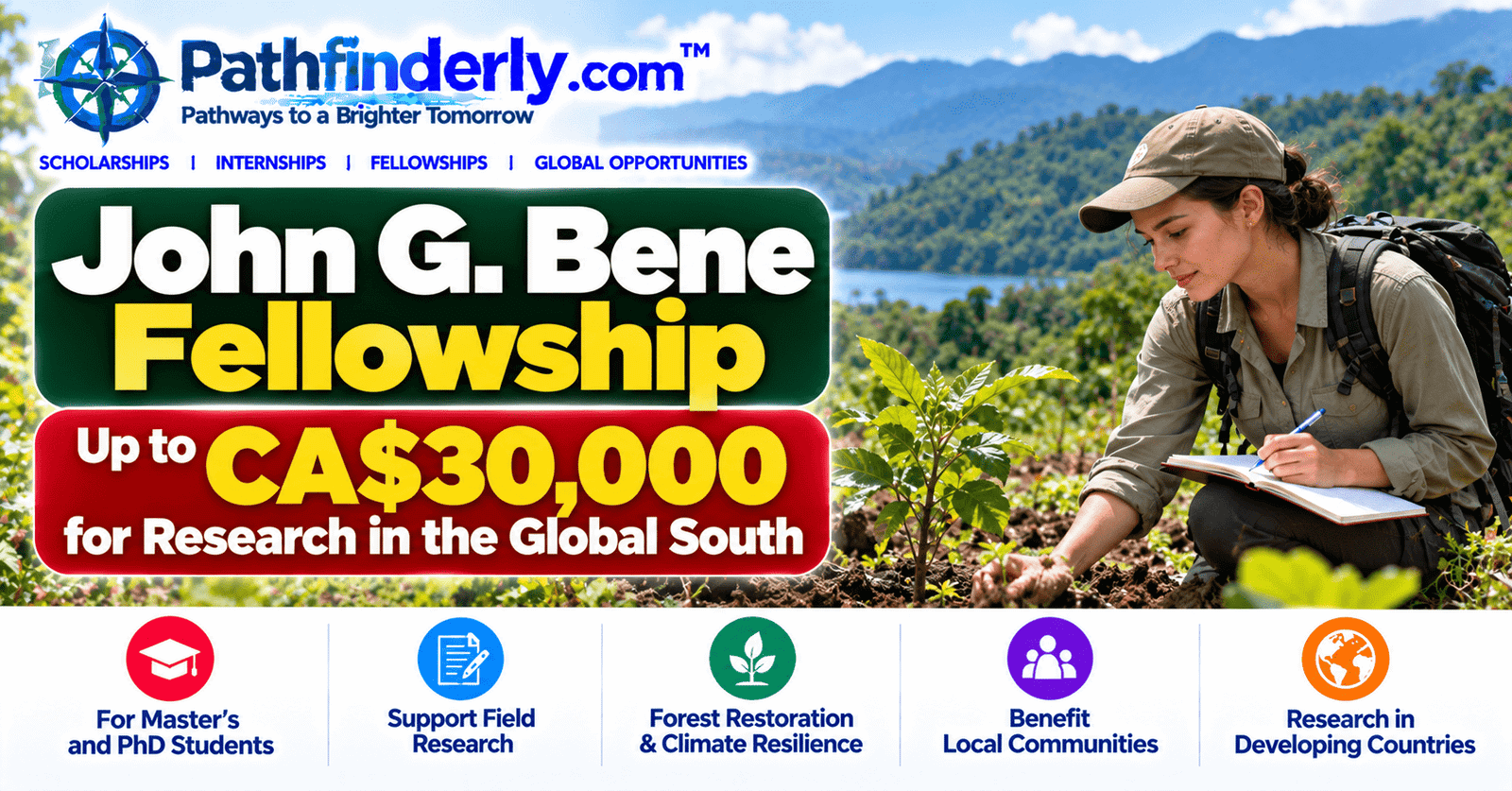
The John G. Bene Fellowship 2026 is accepting applications from eligible master’s and doctoral students at Canadian universities. Offered by Canada’s International Development Research Centre (IDRC), the fellowship provides up to CA$30,000 to support graduate field research in developing countries.
The 2026 programme focuses on community-led nature-based solutions, forest restoration, climate resilience and food system transformation. It encourages research that benefits vulnerable communities, including smallholder farmers, women, young people and Indigenous populations.
IDRC expects to offer up to ten fellowships, with research lasting between 10 weeks and 12 months.
Importantly, this opportunity is not open to all international students. Applicants must be Canadian citizens or permanent residents of Canada who are pursuing a master’s or doctoral degree at a Canadian university.
The research itself must take place in one or more eligible countries of the Global South.
Applications opened on 19 October 2026, and the official closing date is 30 November 2026.
IDRC’s main announcement specifies 11:59 p.m. Eastern Time, while its detailed checklist gives an earlier submission time of 4:00 p.m. Applicants should aim to complete their applications before the earlier time.
Interested researchers can review the official John G. Bene Fellowship announcement.
John G. Bene Fellowship 2026 Overview
| Details | Information |
|---|---|
| Fellowship | John G. Bene Fellowship 2026 |
| Organization | International Development Research Centre (IDRC) |
| Country of Organization | Canada |
| Funding | Up to CA$30,000 per award |
| Number of Awards | Up to 10 |
| Programme Type | Graduate field research fellowship |
| Academic Levels | Master’s and PhD |
| Eligible Nationality/Status | Canadian citizens and permanent residents |
| University Requirement | Enrollment at a Canadian university |
| Research Location | Eligible developing countries in the Global South |
| Research Duration | 10 weeks to 12 months |
| Main Fields | Forest restoration, climate resilience, ecology and food systems |
| Application Language | English or French |
| Applications Opened | 19 October 2026 |
| Application Deadline | 30 November 2026 |
| Recommended Submission Time | Before 4:00 p.m. Eastern Time |
| Application Platform | SurveyMonkey Apply |
What Is the John G. Bene Fellowship?
The John G. Bene Fellowship is a research funding programme designed to help graduate students conduct fieldwork related to international development.
It supports research that addresses environmental and social challenges in developing countries.
Unlike a conventional scholarship, the award is intended specifically for field research expenses.
Selected researchers may use the funding to collect data, conduct interviews, organize field activities and work with local institutions.
The fellowship encourages projects that connect environmental science with the needs and experiences of communities.
For example, a researcher might examine how community-led forest restoration improves food security among smallholder farmers.
Another project could investigate how women participate in managing forest resources and adapting to climate change.
The central goal is to produce practical knowledge that can support sustainable development.
About the International Development Research Centre
The International Development Research Centre, commonly known as IDRC, is a Canadian organization that supports research addressing challenges in developing regions.
Its work helps researchers and institutions develop evidence-based solutions to social, economic and environmental problems.
IDRC supports research in areas such as climate resilience, food security, global health, education and inclusive governance.
The organization also works with researchers and institutions in developing countries to strengthen local research capacity.
Through the John G. Bene Fellowship, IDRC supports graduate students who want to conduct meaningful international field research.
Applicants can learn more about the organization through the official IDRC website.
Who Was John G. Bene?
The fellowship is named after John G. Bene, whose estate provided funding to support research in international development.
The award continues his legacy by helping graduate students investigate relationships between environmental resources and community well-being.
Over time, the fellowship has supported research addressing forest management, natural resources and development challenges.
The 2026 call places particular emphasis on inclusive environmental restoration and sustainable food systems.
Research Theme for 2026
The official theme is:
Strengthening Inclusive Community-Led Nature-Based Solutions for Forest Restoration and Food System Transformation
This theme connects several important development challenges.
These include environmental degradation, climate change, food insecurity and unequal access to natural resources.
IDRC is particularly interested in research that combines environmental knowledge with social considerations.
Projects should examine how practical solutions can benefit communities facing difficult environmental or economic conditions.
Eligible Research Areas
1. Forest Restoration
Research may investigate methods for restoring degraded forests and improving long-term ecosystem health.
Projects can examine restoration practices, community participation and sustainable resource management.
2. Agroforestry
Agroforestry combines trees with agricultural production.
Researchers may explore how these systems improve soil health, biodiversity and household livelihoods.
3. Climate Resilience
Projects can investigate how communities respond to climate-related challenges.
Relevant issues include drought, wildfire, changing rainfall patterns and environmental degradation.
4. Food System Transformation
Research may examine how food production and distribution systems can become more sustainable and resilient.
Projects should consider practical benefits for local communities.
5. Biodiversity Conservation
Researchers can explore the relationship between biodiversity protection and community development.
6. Gender and Social Inclusion
IDRC encourages research that considers the roles and experiences of women and other underrepresented groups.
7. Indigenous Knowledge
Projects may investigate how Indigenous knowledge contributes to environmental restoration and resource management.
8. Natural Resource Governance
Research can examine how institutions, communities and governments make decisions about land, forests and other resources.
9. Post-Fire Restoration
Projects aligned with IDRC’s REVIVE Initiative on post-fire forest and food restoration are welcome.
10. Community-Led Environmental Solutions
Researchers may study locally developed approaches to restoring landscapes and improving livelihoods.
These research areas are interconnected.
A strong proposal may combine several themes while maintaining a clear research question.
Research That Is Not Eligible
IDRC explicitly excludes research focused on genomics or genetic modification.
Applicants should also avoid submitting projects that fall outside the fellowship’s environmental and development priorities.
Research proposals should demonstrate a meaningful connection between environmental issues and social or community outcomes.
John G. Bene Fellowship Funding and Benefits
The programme offers up to ten awards.
Each award may provide a maximum of CA$30,000.
However, the actual amount awarded depends on the proposed research and approved budget.
Field Research Expenses
Funding can support eligible costs directly connected to the approved field research.
Data Collection
Researchers may use approved funding for field data collection activities.
Interviews and Surveys
Projects involving local communities may require interviews, surveys and other research methods.
Focus Groups and Workshops
Eligible research activities may include meetings or workshops with participants and stakeholders.
Research-Related Travel
Applicants can propose eligible travel costs associated with fieldwork, subject to IDRC’s funding rules.
Local Research Activities
The award can support approved activities undertaken with local partners and institutions.
Professional Research Development
Participants gain practical experience conducting research in international settings.
Academic Progress
The fellowship supports fieldwork contributing to a master’s thesis or doctoral dissertation.
Is the John G. Bene Fellowship Fully Funded?
The programme offers substantial financial support, but it should not be described as a fully funded university scholarship.
IDRC provides up to CA$30,000 for approved field research expenses.
However, the award does not cover university tuition fees.
It also does not guarantee that every applicant will receive the maximum funding amount.
Students should prepare a realistic research budget and identify any additional funding they may need.
For Pathfinderly readers, the accurate description is:
A graduate field research fellowship offering up to CA$30,000.
Fellowship Duration
The programme supports field research lasting between 10 weeks and 12 months.
Selected applicants have up to 12 months from the start date in their award agreement to spend the funding.
If a research project continues beyond the funded period, the researcher must arrange additional financial support.
For projects involving more than one research region, applicants must plan to spend at least five consecutive weeks in the field in each region.
These requirements should be reflected in the research schedule.
Who Can Apply for the John G. Bene Fellowship?
Applicants must satisfy several conditions.
1. Canadian Citizenship or Permanent Residency
Candidates must be Canadian citizens or permanent residents of Canada.
International students who do not hold either status are not eligible under the 2026 call.
2. Enrollment at a Canadian University
Applicants must be pursuing a master’s or doctoral degree at a Canadian university.
3. Relevant Academic Background
Candidates should have academic interests related to forests, environmental science, ecology, climate resilience or food systems.
Interdisciplinary programmes may qualify if they include relevant subject areas.
4. Progress in Graduate Studies
Applicants must have completed several courses in their graduate programme.
They do not necessarily need to have completed all coursework when submitting the application.
5. Supervisor Approval
The proposed research must be approved by the applicant’s thesis supervisor.
Written confirmation is required.
6. Field Research in the Global South
The project must involve field research in one or more eligible developing countries.
7. Host Institution Affiliation
Applicants must demonstrate an affiliation with an institution or organization in the research country.
8. Doctoral Research Readiness
PhD students must complete the required coursework and comprehensive examinations before taking up the award.
9. No Overlapping IDRC Awards
Applicants cannot hold two or more active IDRC awards covering overlapping periods.
Other IDRC-funded activities must not duplicate the same funded objectives.
Can International Students Apply?
This is one of the most important eligibility questions.
The fellowship is not open to international students solely because they study at a Canadian university.
Applicants must also be Canadian citizens or permanent residents.
For example, a student from another country who is studying in Canada on a temporary study permit but does not hold Canadian permanent residency would not meet the citizenship or residency requirement.
However, a permanent resident of Canada enrolled in an eligible master’s or doctoral programme may qualify.
The research location is a separate condition.
The Global South refers to where the research will take place, not to the nationality of the applicant.
Where Can Research Be Conducted?
IDRC generally supports research in developing countries recognized through the OECD Development Assistance Committee’s list of Official Development Assistance recipients.
However, not every developing country or region is automatically eligible.
Applicants must check Government of Canada travel advisories.
IDRC will reject research proposals involving locations subject to an official Avoid all travel advisory at the time of application.
Researchers must continue monitoring travel advisories after receiving an award.
If the security situation changes, they must follow the updated guidance.
Applicants should consult the Government of Canada Travel Advice and Advisories before finalizing their research location.
Research Proposal Requirements
A detailed research proposal is one of the most important application documents.
IDRC requires a proposal of 20–25 pages, excluding the bibliography.
The document must be double-spaced and use a 12-point font.
Applicants may write in English or French.
The proposal must follow the official section order.
Required Research Proposal Sections
- Abstract of research proposal, maximum 250 words.
- Literature review.
- Research questions.
- Research objective.
- Methodology.
- Tentative schedule of field activities.
- Ethical considerations.
- Gender implications.
- Expected results.
- Potential use of results.
- Possible beneficiaries of the research.
- Dissemination plan for results.
Applicants should not rearrange these headings.
Each section should contribute to a clear and practical research plan.
Letter of Affiliation
Applicants must provide a letter confirming their affiliation with an institution or organization in the research country.
The letter must appear on official letterhead and be signed.
The institution may be a university, research organization, government department or nonprofit organization.
The letter should explain how the institution will support the proposed research.
For example, the host institution may provide research guidance, access to facilities or introductions to local researchers.
If the project involves more than one country, applicants must provide a separate affiliation letter for each country.
Research Supervisor Approval Letter
Applicants must obtain an official letter from their university research supervisor.
The letter must confirm approval of the final research proposal.
It should also include information about the student’s academic progress.
For doctoral applicants, the letter must confirm that the required academic conditions for field research will be completed before the award begins.
In addition, the supervisor must explain relevant fieldwork safety and security risks and how the university plans to manage them.
IDRC provides an official template for this document.
Academic Transcripts
Applicants must submit official transcripts from:
- Their most recently completed degree.
- Their current graduate programme.
The transcripts must be original, certified or notarized copies in the required scanned format.
IDRC does not accept ordinary web transcripts or informal academic history records as substitutes.
Proof of Citizenship or Permanent Residency
Applicants must provide acceptable proof of their Canadian citizenship or permanent-resident status.
The official instructions identify documents such as:
- A current passport.
- A birth certificate.
- A Canadian permanent resident card.
Applicants should follow the exact documentation requirements provided in the application system.
Academic Recommendations
Two academic recommendations are required.
Both recommenders must be university professors.
At least one must be the applicant’s research supervisor.
Recommendations are submitted through the online application system.
Applicants must enter their professors’ contact information so that the system can send recommendation requests.
Importantly, the application cannot be submitted until both recommendations have been received.
Therefore, candidates should contact their professors well before the deadline.
Research Budget
Applicants must prepare a budget as part of the online application.
The budget should reflect the actual costs of the proposed research.
It should be consistent with the fieldwork schedule and methodology.
A clear budget may include eligible travel, data collection, local research activities and other approved expenses.
Applicants should avoid including unrelated personal or academic expenses.
They should also explain why the requested funding is necessary for the project.
Research Ethics and Safeguarding
The fellowship places importance on ethical research.
Selected applicants must obtain appropriate university ethics approval.
Local research ethics approval may also be necessary.
After receiving funding, fellows are required to prepare a safeguarding protocol.
This document addresses potential risks, protective measures and procedures for reporting concerns.
Researchers working with communities should consider informed consent, confidentiality, participant safety and responsible data management.
These considerations are especially important when working with vulnerable populations.
How to Apply for the John G. Bene Fellowship 2026
Applications must be submitted through IDRC’s official SurveyMonkey Apply platform.
Step 1: Visit the Official Fellowship Announcement
Open the John G. Bene Fellowship 2026 official page.
Step 2: Review Eligibility
Confirm Canadian citizenship or permanent residency, university enrollment and research suitability.
Step 3: Read the Detailed Guidelines
Review the full call document and FAQs.
Step 4: Confirm Your Research Country
Check the country’s eligibility and current travel advisories.
Step 5: Discuss the Project With Your Supervisor
Obtain approval for the research proposal.
Step 6: Arrange Host Institution Affiliation
Contact an institution or organization in the proposed research country.
Step 7: Prepare the Research Proposal
Follow the required 20–25-page format.
Step 8: Prepare Your Budget
Include realistic research expenses.
Step 9: Gather Academic Documents
Prepare official transcripts and proof of Canadian citizenship or permanent residency.
Step 10: Create a SurveyMonkey Apply Account
Open the official application portal.
Step 11: Complete the Eligibility Questionnaire
Answer the questions accurately.
Step 12: Complete the Application Form
Provide personal, academic and research information.
Step 13: Upload Supporting Documents
Attach the research proposal, affiliation letter, supervisor approval and other required materials.
Step 14: Request Recommendations
Enter the details of two university professors.
Step 15: Check Recommendation Status
Confirm that both recommendations have been submitted.
Step 16: Review the Entire Application
Check all documents, budget figures and research details.
Step 17: Submit Before the Deadline
The official closing date is 30 November 2026.
Because IDRC’s detailed checklist specifies an earlier time than its main announcement, applicants should aim to submit before 4:00 p.m. Eastern Time.
Official application: John G. Bene Fellowship SurveyMonkey Apply
Important Dates
| Event | Date |
|---|---|
| Applications Opened | 19 October 2026 |
| Application Deadline | 30 November 2026 |
| Recommended Submission | Before 4:00 p.m. Eastern Time |
| Main Portal Deadline | 11:59 p.m. Eastern Time |
| Expected Results | December 2026 or January 2027 |
| Research Start | According to individual award agreement |
Applicants should avoid waiting until the final hours to submit.
How Are Fellows Selected?
IDRC uses a competitive review process.
Applications are assessed by an IDRC committee, followed by further evaluation involving internal and external experts.
The selection process considers several factors.
Relevance to the Fellowship
The research must match the programme’s objectives.
Quality of the Proposal
A strong proposal should clearly explain the research problem, objectives and methodology.
Originality
IDRC considers whether the research offers new insights or approaches.
Practical Feasibility
The research schedule, fieldwork arrangements and budget must be realistic.
Community Benefits
The project should demonstrate potential benefits for people in developing countries.
Gender Considerations
Applicants should explain how gender and inclusion relate to the research.
Ethical Research
The proposal must address ethical and safeguarding issues.
Host Institution Suitability
The affiliated organization should be able to support the proposed fieldwork.
Researcher Qualifications
Applicants should demonstrate relevant academic preparation, research skills and knowledge of the study area.
Potential Use of Findings
IDRC considers how research results may contribute to practical decisions, policies or community initiatives.
When Will Results Be Announced?
IDRC expects to notify applicants recommended for an award in December 2026 or January 2027.
Candidates who are not selected will also receive notification through the online application system.
Applicants should monitor their email inbox and spam folder.
An award may be conditional on completing additional requirements.
Tips for a Strong Fellowship Application
Choose a Relevant Research Question
Focus on a problem that directly relates to forest restoration, food systems or climate resilience.
Demonstrate Community Benefits
Explain who will benefit from the research.
Include Social Dimensions
Address gender, inclusion or community participation where relevant.
Develop a Practical Methodology
Choose research methods that can realistically answer your questions.
Secure Local Partnerships Early
A strong affiliation with a host institution can improve research feasibility.
Prepare a Clear Budget
Ensure the requested funding matches the planned activities.
Address Safety and Ethics
Consider the risks of conducting fieldwork in the selected location.
Follow the Required Proposal Structure
Use all mandatory headings in the specified order.
Contact Your Recommenders Early
Both recommendations must be received before the application can be submitted.
Avoid Last-Minute Submission
Complete the application well before the official deadline.
Why This Fellowship Is Valuable
The John G. Bene Fellowship provides an opportunity to conduct research that connects academic study with practical development challenges.
For graduate students, international fieldwork can improve research skills and provide direct experience working with communities and institutions.
The award also encourages collaboration between Canadian universities and organizations in developing countries.
Research findings may contribute to better environmental management, stronger food systems and improved community resilience.
Moreover, the fellowship supports work that considers both environmental sustainability and social inclusion.
These combined objectives make the programme particularly relevant to interdisciplinary researchers.
Other Research Fellowships to Explore
Graduate students and researchers looking for additional opportunities can explore the British Academy International Fellowships, which support international research collaboration.
Another option is the KAUST Global Fellowship, which focuses on advanced research opportunities in Saudi Arabia.
Researchers interested in technology, science and interdisciplinary collaboration may also consider the Stanford Fisher Family Summer Fellows Program, although that programme is designed for experienced professionals rather than graduate field researchers.
Applicants should compare the eligibility requirements and funding structures of each programme.
Frequently Asked Questions
What is the John G. Bene Fellowship?
It is a graduate field research award offered by Canada’s International Development Research Centre.
Is the John G. Bene Fellowship 2026 open?
Yes. Applications opened on 19 October 2026.
How much funding is available?
Up to CA$30,000 per award.
How many fellowships are available?
Up to ten awards.
Is the fellowship fully funded?
It provides substantial field research funding but is not a comprehensive tuition and living-expense scholarship.
Does the award cover tuition fees?
No.
Who can apply?
Canadian citizens and permanent residents pursuing master’s or doctoral studies at Canadian universities.
Can international students apply?
Only if they hold Canadian permanent residency or citizenship and meet the other requirements.
Can students from developing countries apply directly?
Not solely because of their nationality or research interests. They must satisfy the Canadian citizenship or permanent-residency requirements.
Can master’s students apply?
Yes.
Can PhD students apply?
Yes.
Can undergraduate students apply?
No. The programme is for eligible graduate students.
Where must the research take place?
In one or more eligible developing countries in the Global South.
Can research take place in Canada?
The award is intended for field research in developing countries, not research conducted solely in Canada.
What research subjects are eligible?
Forest restoration, climate resilience, ecology, food systems and related interdisciplinary subjects.
Is genomics research eligible?
No.
How long can the research last?
Between 10 weeks and 12 months.
Is a research supervisor required?
Yes.
Is a host institution required?
Yes. Applicants must provide evidence of affiliation with an institution or organization in the research country.
How long must the research proposal be?
20–25 pages, excluding the bibliography.
Can applications be submitted in French?
Yes. English and French are accepted.
Are recommendation letters required?
Yes. Two academic recommendations are required.
Must one recommender be the research supervisor?
Yes.
When is the deadline?
30 November 2026.
What time should applicants submit?
Aim to submit before 4:00 p.m. Eastern Time because the detailed checklist gives this earlier time, despite the main announcement stating 11:59 p.m.
When will results be announced?
December 2026 or January 2027.
Where can applicants apply?
Through IDRC’s official SurveyMonkey Apply portal.
Final Thoughts
The John G. Bene Fellowship 2026 offers an important funding opportunity for eligible graduate students interested in environmental restoration and international development.
With awards of up to CA$30,000, the programme supports practical field research in developing countries.
The 2026 call focuses on community-led nature-based solutions, forest restoration, climate resilience and sustainable food systems.
However, eligibility is restricted to Canadian citizens and permanent residents pursuing master’s or doctoral studies at Canadian universities.
Applicants must also prepare a detailed research proposal, obtain supervisor approval and arrange affiliation with an institution in the research country.
Interested researchers should begin preparing their documents early, particularly the academic recommendations and host institution letter.
Application Deadline: 30 November 2026
Official Announcement: IDRC John G. Bene Fellowship 2026
Detailed Application Guidelines: IDRC Fellowship Requirements
Apply Online: Official SurveyMonkey Apply Portal
Contact: benefellowship@idrc.ca
Last verified: 28 October 2026
Pathfinderly is an independent educational opportunities website and is not affiliated with IDRC. Fellowship conditions, eligibility and deadlines may change. Applicants should verify the latest information through the official organization before applying.