
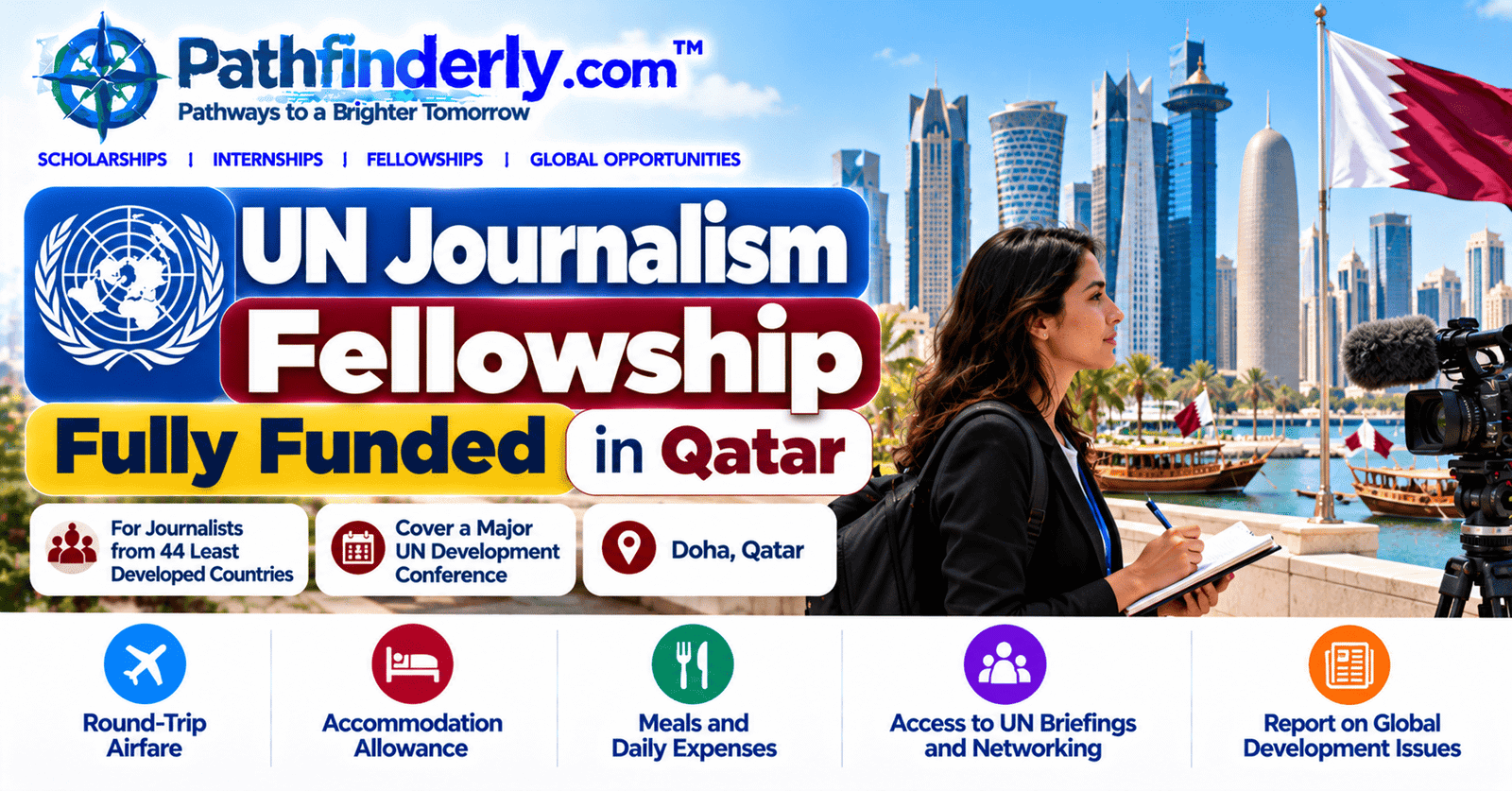
The UN Journalism Fellowship 2027 offers a fully funded opportunity for professional journalists from eligible Least Developed Countries to travel to Doha, Qatar. Organized by the United Nations Office of the High Representative for the Least Developed Countries, Landlocked Developing Countries and Small Island Developing States (UN-OHRLLS), the programme will support selected journalists covering a major international development conference.
The fellowship will take place during the High-level Midterm Review of the Doha Programme of Action, scheduled for 25–27 March 2027.
Ten journalists will receive round-trip economy-class travel to Qatar, a daily subsistence allowance for accommodation and meals, and access to fellowship briefings and networking opportunities.
The programme aims to strengthen reporting on sustainable development and highlight the challenges faced by the world’s Least Developed Countries.
However, this fellowship is not open to journalists from every country. Applicants must be nationals of one of the 44 eligible Least Developed Countries, have at least two years of professional journalism experience, and meet the other requirements.
Both staff journalists and freelancers may apply.
The application deadline is 30 November 2026.
Interested candidates can review the official UN Journalism Fellowship announcement.
UN Journalism Fellowship 2027 Overview
| Details | Information |
|---|---|
| Fellowship | DPoA MTR Journalism Fellowship |
| Common Name | UN Journalism Fellowship 2027 |
| Organizer | UN-OHRLLS |
| Host Country | Qatar |
| Location | Doha |
| Fellowship Dates | 25–27 March 2027 |
| Number of Fellowships | 10 |
| Funding | Fully funded |
| Airfare | Round-trip economy-class travel |
| Accommodation and Meals | Daily subsistence allowance |
| Eligible Nationalities | 44 Least Developed Countries |
| Minimum Age | 18 years |
| Experience | At least two years of professional journalism |
| Eligible Professionals | Staff and freelance journalists |
| Application Fee | None |
| Application Deadline | 30 November 2026 |
| Application Method | Official online application form |
What Is the UN Journalism Fellowship?
The UN Journalism Fellowship is an international reporting opportunity connected to the Midterm Review of the Doha Programme of Action.
It allows selected journalists to cover discussions about sustainable development, economic challenges and international cooperation affecting Least Developed Countries.
During the programme, fellows will have opportunities to attend relevant activities, participate in briefings and connect with development stakeholders.
They will also produce journalism that explains the significance of the conference to audiences in their home countries.
Rather than simply reporting conference speeches, participants are expected to connect international commitments with real development challenges.
For example, a journalist might investigate how international climate finance affects communities vulnerable to flooding or drought.
Another participant could report on barriers to education, healthcare, employment or digital technology in Least Developed Countries.
The fellowship encourages reporting that makes international development discussions understandable and relevant to the public.
About the United Nations Organizing Office
The programme is organized by the United Nations Office of the High Representative for the Least Developed Countries, Landlocked Developing Countries and Small Island Developing States.
The office is commonly known as UN-OHRLLS.
It supports international efforts to address development challenges faced by countries with particular structural and geographical vulnerabilities.
These include Least Developed Countries, Landlocked Developing Countries and Small Island Developing States.
Its work involves advocacy, coordination, partnerships and monitoring progress under international development frameworks.
The Journalism Fellowship is part of the effort to increase awareness of the Doha Programme of Action and its implementation.
For more information, visit the official UN-OHRLLS website.
What Is the Doha Programme of Action?
The Doha Programme of Action, or DPoA, is an international development framework for Least Developed Countries covering the decade 2022–2031.
It focuses on improving living conditions, building resilience and supporting sustainable economic progress.
The programme addresses challenges such as poverty, limited productive capacity, climate vulnerability and barriers to international trade.
It also emphasizes cooperation between governments, international organizations and development partners.
The Midterm Review provides an opportunity to examine progress, identify remaining challenges and discuss priorities for the years ahead.
Journalists attending the review will help communicate these discussions to the public.
Where Will the Fellowship Take Place?
The fellowship will take place in Doha, Qatar.
The High-level Midterm Review is scheduled for 25–27 March 2027.
Doha will host representatives and stakeholders involved in discussions about development priorities for Least Developed Countries.
Selected journalists will travel to Qatar to participate in the fellowship and cover the conference.
However, the exact travel arrangements and authorized dates will be communicated to selected fellows.
Applicants should not independently purchase tickets or make non-refundable arrangements before receiving official instructions.
UN Journalism Fellowship 2027 Benefits
The United Nations describes this programme as a fully funded fellowship.
Selected journalists will receive several forms of support.
1. Round-Trip Airfare
The fellowship provides round-trip economy-class travel to Doha, Qatar.
Travel arrangements are subject to the programme’s rules and the details provided in each fellow’s award letter.
2. Accommodation Allowance
Participants receive a daily subsistence allowance intended to cover accommodation expenses.
The amount is determined under applicable United Nations rules.
The official announcement does not provide a fixed accommodation allowance for every participant.
3. Meals and Daily Expenses
The daily subsistence allowance also supports meals during the authorized fellowship period.
Participants should follow the financial and travel instructions provided by the organizers.
4. Fellowship Briefings
Selected journalists will have access to briefings related to the Midterm Review and its development priorities.
These activities can help participants understand the issues discussed during the conference.
5. Pre-Conference Orientation
The programme may include orientation activities before the event.
These activities will help fellows prepare for their reporting responsibilities.
6. Networking Opportunities
Participants can connect with journalists, development professionals and other relevant stakeholders.
These interactions may help fellows develop informed reporting on international development issues.
7. International Reporting Experience
The fellowship provides experience covering a major United Nations development event.
This can be valuable for journalists specializing in public policy, economics, climate change and sustainable development.
Is the UN Journalism Fellowship Fully Funded?
Yes. The United Nations officially describes the DPoA MTR Journalism Fellowship as fully funded.
The principal financial benefits include round-trip economy-class travel and a daily subsistence allowance for accommodation and meals.
However, fully funded does not mean every possible personal expense is automatically covered.
The programme states that fellows remain responsible for passports, visas, accreditation and other personal requirements unless their individual award letter provides otherwise.
Furthermore, selection does not guarantee visa issuance, conference accreditation or travel clearance.
The exact support available to each fellow will be specified in the official award letter.
Applicants should review these conditions carefully before accepting an offer.
Who Can Apply for the UN Journalism Fellowship 2027?
Applicants must meet the official eligibility requirements.
1. Nationality Requirement
Candidates must be nationals of one of the 44 United Nations-designated Least Developed Countries.
This is a mandatory requirement.
2. Minimum Age
Applicants must be at least 18 years old.
3. Professional Journalism Experience
Candidates must have at least two years of professional journalism experience.
The fellowship is intended for working journalists rather than beginners without a professional reporting record.
4. Recognized Media Work
Applicants must demonstrate that their work is regularly published or broadcast by a recognized media outlet.
5. Staff and Freelance Journalists
Both employed journalists and independent freelancers are eligible.
Freelancers must still demonstrate a credible professional reporting record.
6. Interest in Sustainable Development
Applicants should demonstrate an interest in sustainable development, particularly issues relevant to the Doha Programme of Action.
7. Availability to Travel
Candidates must be willing and able to travel to Doha during the Midterm Review.
They must also participate in required briefings and other programme activities.
List of 44 Eligible Countries
The official fellowship announcement identifies the following countries.
| No. | Eligible Country |
|---|---|
| 1 | Afghanistan |
| 2 | Angola |
| 3 | Bangladesh |
| 4 | Benin |
| 5 | Burkina Faso |
| 6 | Burundi |
| 7 | Cambodia |
| 8 | Central African Republic |
| 9 | Chad |
| 10 | Comoros |
| 11 | Democratic Republic of the Congo |
| 12 | Djibouti |
| 13 | Eritrea |
| 14 | Ethiopia |
| 15 | Gambia |
| 16 | Guinea |
| 17 | Guinea-Bissau |
| 18 | Haiti |
| 19 | Kiribati |
| 20 | Lao People’s Democratic Republic |
| 21 | Lesotho |
| 22 | Liberia |
| 23 | Madagascar |
| 24 | Malawi |
| 25 | Mali |
| 26 | Mauritania |
| 27 | Mozambique |
| 28 | Myanmar |
| 29 | Nepal |
| 30 | Niger |
| 31 | Rwanda |
| 32 | Senegal |
| 33 | Sierra Leone |
| 34 | Solomon Islands |
| 35 | Somalia |
| 36 | South Sudan |
| 37 | Sudan |
| 38 | Timor-Leste |
| 39 | Togo |
| 40 | Tuvalu |
| 41 | Uganda |
| 42 | United Republic of Tanzania |
| 43 | Yemen |
| 44 | Zambia |
Applicants should verify their nationality against the official list before preparing an application.
Can Journalists From Pakistan, India or Nigeria Apply?
No.
Pakistan, India and Nigeria are not included in the 44 eligible Least Developed Countries listed in the official announcement.
Therefore, journalists who hold only the nationality of one of these countries do not meet the fellowship’s nationality requirement.
The programme is specifically designed to support journalists from countries classified as Least Developed Countries.
Applicants from other countries should explore alternative journalism fellowships that accept a broader range of nationalities.
Are Freelance Journalists Eligible?
Yes.
The United Nations explicitly allows applications from freelance journalists.
However, freelancers must demonstrate that their reporting is regularly published or broadcast by a recognized media outlet.
They must also have at least two years of professional journalism experience.
A freelance applicant may strengthen an application by providing clear publication links and explaining their professional reporting background.
Having a record of reporting on development issues can also help demonstrate relevance to the fellowship.
Is a University Degree Required?
The official fellowship announcement does not specify a mandatory university degree.
Instead, it focuses on professional journalism experience, recognized published or broadcast work, eligible nationality and the ability to participate in the programme.
Applicants should therefore concentrate on demonstrating their reporting experience and the quality of their journalism.
They should not assume that a journalism degree is compulsory when the official eligibility criteria do not state one.
What Topics Can Fellows Cover?
The fellowship focuses on the implementation of the Doha Programme of Action.
Relevant reporting themes may include the following.
Poverty Reduction
Journalists may explore progress and continuing challenges in reducing poverty.
Education and Skills
Reporting can examine access to education, training and opportunities for young people.
Healthcare
Fellows may investigate healthcare access, public health systems and development priorities.
Climate Change
Relevant stories could address climate adaptation, environmental vulnerability and resilience.
Food Security
Journalists may examine agricultural challenges, food systems and community livelihoods.
Economic Development
Reporting can explore investment, productive capacity, employment and economic transformation.
Science and Technology
Stories may focus on digital inclusion, innovation and access to new technologies.
International Trade
Journalists can investigate trade barriers, export opportunities and international partnerships.
Development Finance
Reporting may examine international assistance, financing gaps and the effectiveness of development commitments.
These examples are intended to help applicants identify relevant story ideas.
The strongest proposals will connect international policy discussions with specific challenges facing audiences in eligible countries.
Required Application Documents
Applicants must prepare three main components.
1. Short Professional Biography
The biography must not exceed 300 words.
It should include:
- Current professional position.
- Media organization or affiliations.
- Years of journalism experience.
- Main reporting areas.
- Languages spoken.
- Previous experience related to sustainable development or Doha Programme of Action priorities.
The biography should provide a clear summary of the applicant’s professional background.
2. Two Published Work Samples
Applicants must submit two published journalism samples.
Accepted formats include print, online, radio, television, multimedia and digital journalism projects.
At least one sample must address a development-related issue.
Candidates should choose work that demonstrates accuracy, clarity, originality and relevance.
3. Reporting Proposal
Applicants must submit a reporting proposal of no more than 400 words.
The proposal should explain:
- The story angles they intend to pursue.
- Why those issues matter to audiences in Least Developed Countries.
- How the reporting will improve public understanding of DPoA implementation.
- The reporting formats they plan to use.
- Their publication strategy.
- The media outlets where they intend to publish or broadcast their work.
The proposal should be realistic and specific.
A clear reporting plan is more useful than a general statement about wanting to attend an international conference.
How to Write a Strong Reporting Proposal
A strong proposal should show that the applicant understands the purpose of the fellowship.
Choose a Specific Issue
Select a topic connected to the Doha Programme of Action.
For example, a journalist could examine how climate adaptation commitments affect coastal communities.
Explain the National Connection
Show why the issue matters to people in your home country.
The programme is designed to connect international discussions with national realities.
Identify Relevant Sources
Consider which policymakers, researchers, civil society representatives or development specialists could contribute to the reporting.
Describe the Reporting Format
Explain whether you plan to produce news articles, interviews, radio features, video reports or multimedia stories.
Include a Publication Strategy
Identify the intended audience and likely publication outlets.
Keep the Proposal Within 400 Words
Use direct language and avoid unnecessary background information.
The proposal should demonstrate a clear story idea, a realistic reporting method and a meaningful public benefit.
What Will Selected Fellows Be Expected to Do?
The fellowship involves professional responsibilities.
Selected journalists must participate in required activities and produce substantive reporting connected to the Midterm Review.
Before the Conference
Fellows should prepare reporting that introduces relevant development challenges and the significance of the upcoming review.
During the Conference
Participants will report on discussions, announcements and issues emerging from the event in Doha.
After the Conference
Fellows should examine outcomes and explain what they may mean for Least Developed Countries.
Minimum Reporting Requirement
Each fellow must produce and publish at least three substantive journalism outputs related to the Midterm Review and DPoA implementation.
Submission of Publication Links
Fellows must share links to their published work by 30 April 2027.
Participants must also follow professional standards of accuracy, fairness, ethics and safety.
How to Apply for the UN Journalism Fellowship 2027
Applications must be submitted through the official online application form linked from the United Nations announcement.
Step 1: Visit the Official Website
Open the UN DPoA MTR Journalism Fellowship page.
Step 2: Confirm Your Nationality
Check whether your country appears in the official list of 44 eligible Least Developed Countries.
Step 3: Review Professional Eligibility
Confirm that you meet the minimum age and experience requirements.
Step 4: Prepare Your Biography
Write a professional biography of no more than 300 words.
Step 5: Select Two Journalism Samples
Choose two published or broadcast pieces.
Ensure that at least one addresses a development-related issue.
Step 6: Write Your Reporting Proposal
Prepare a proposal of no more than 400 words explaining your intended coverage.
Step 7: Open the Application Form
Use the application link provided on the official United Nations fellowship page.
Step 8: Complete the Required Information
Provide accurate personal and professional details.
Step 9: Submit Your Application Materials
Follow the form’s instructions for supplying your biography, work samples and proposal.
Step 10: Review and Submit
Check all information before submitting.
The application must be completed by 30 November 2026.
Late or incomplete applications will not be considered.
Official Application Page: Apply for the DPoA MTR Journalism Fellowship
Application Deadline and Important Dates
| Event | Date |
|---|---|
| Application Deadline | 30 November 2026 |
| Selection Process | Late 2026 |
| Expected Award Letters | Before 31 December 2026 |
| Online Orientation | February 2027 |
| Fellowship / Conference | 25–27 March 2027 |
| Publication Links Due | 30 April 2027 |
The official page contains an inconsistent indicative timeline for the open-call and review stages. However, the application instructions and terms explicitly identify 30 November 2026 as the closing date.
Applicants should submit well before that date.
How Are Fellows Selected?
The United Nations will review applications against the published eligibility and programme requirements.
Candidates should demonstrate professional credibility, relevant experience and the ability to produce meaningful reporting.
Several qualities may strengthen an application.
Professional Reporting Record
Applicants should provide evidence of regular published or broadcast journalism.
Relevant Experience
A background in development reporting may help demonstrate suitability.
Quality of Work Samples
Strong examples should demonstrate accurate reporting and clear communication.
Reporting Proposal
A focused proposal can show how the applicant plans to cover the conference.
Public Relevance
Proposed stories should explain why development commitments matter to audiences in eligible countries.
Ability to Participate
Candidates must be available for the required programme activities.
Meeting the minimum eligibility requirements does not guarantee selection.
The fellowship is competitive, with ten places announced.
Will Selected Fellows Receive a Visa?
Selection does not guarantee visa issuance.
The United Nations states that participants remain responsible for visas, passports, accreditation and personal requirements unless their award letters specify otherwise.
Selected journalists must complete all required administrative and travel procedures.
Therefore, applicants should not assume that a fellowship offer automatically provides permission to enter Qatar.
Is There an Application Fee?
No.
The United Nations confirms that applications are free.
Applicants should use the official UN website and avoid unofficial services requesting payment to secure a fellowship place.
Why Is This Fellowship Valuable?
The UN Journalism Fellowship provides an opportunity to report on development issues from an international perspective.
For journalists from Least Developed Countries, the programme offers access to discussions that may affect their home countries.
It can also help participants strengthen their reporting on policy, climate resilience, economic development and international cooperation.
Moreover, the fellowship encourages journalists to explain complex global commitments in language that local audiences can understand.
The experience may also help participants develop professional contacts and expand their knowledge of international development reporting.
However, the programme is a short professional reporting fellowship rather than an academic degree or long-term employment position.
Tips Before Submitting Your Application
- Confirm that your nationality is eligible.
- Select published journalism samples that demonstrate professional experience.
- Include at least one development-related work sample.
- Prepare a focused reporting proposal.
- Explain why your proposed stories matter to audiences in Least Developed Countries.
- Identify realistic publication outlets.
- Follow the biography and proposal word limits.
- Check all application details before submission.
- Apply before the deadline rather than waiting until the final day.
Other International Journalism and Fellowship Opportunities
Journalists interested in international reporting can also explore the EJN Reporting Fellowship, which focuses on environmental journalism and reporting opportunities.
Researchers and professionals looking for broader international development programmes may consider the World Bank Government Analytics Fellowship.
For readers interested in international leadership and professional development, the Yale World Fellows Program offers another type of fellowship opportunity.
Each programme has different eligibility requirements, funding arrangements and professional objectives.
Applicants should compare them carefully before applying.
Frequently Asked Questions
What is the UN Journalism Fellowship 2027?
It is a fully funded reporting fellowship organized by UN-OHRLLS for journalists from eligible Least Developed Countries.
Where will the fellowship take place?
Doha, Qatar.
When will the fellowship take place?
25–27 March 2027.
Is the fellowship fully funded?
Yes. It includes round-trip economy-class travel and a daily subsistence allowance for accommodation and meals.
How many fellows will be selected?
Ten journalists.
Who can apply?
Professional journalists aged 18 or older who are nationals of one of the 44 eligible Least Developed Countries and have at least two years of journalism experience.
Can freelance journalists apply?
Yes, provided they meet the professional experience and publication requirements.
Can students apply?
Only if they independently satisfy all the professional journalism requirements. Student status alone does not establish eligibility.
Can Pakistani journalists apply?
Not on the basis of Pakistani nationality alone, because Pakistan is not among the 44 eligible countries.
Can Indian journalists apply?
India is not included in the official eligibility list.
Can Nigerian journalists apply?
Nigeria is not included in the official eligibility list.
Is a university degree required?
The official announcement does not specify a mandatory degree.
Is there an age limit?
Applicants must be at least 18 years old. No upper age limit is specified in the published eligibility criteria.
Is an application fee required?
No.
What documents are needed?
A professional biography, two published work samples and a reporting proposal.
How long can the biography be?
Maximum 300 words.
How many work samples are required?
Two.
Must the work samples address development issues?
At least one must cover a development-related issue.
How long can the reporting proposal be?
Maximum 400 words.
What is the application deadline?
30 November 2026.
Are flights covered?
Yes. Round-trip economy-class travel is included.
Is accommodation covered?
The fellowship provides a daily subsistence allowance intended to cover accommodation and meals.
Are visa expenses covered?
Not automatically. The award letter will specify any exceptions to the participant’s responsibility for visas and other personal requirements.
How many stories must fellows publish?
At least three substantive journalism outputs.
When must publication links be submitted?
By 30 April 2027.
Where can I apply?
Through the official UN-OHRLLS fellowship announcement and its linked online application form.
Final Thoughts
The UN Journalism Fellowship 2027 in Qatar is an excellent opportunity for eligible professional journalists interested in sustainable development and international reporting.
The programme offers ten fully funded places to cover the High-level Midterm Review of the Doha Programme of Action in Doha.
Selected journalists will receive round-trip economy-class travel, a daily allowance for accommodation and meals, and access to fellowship briefings.
However, applicants must meet the nationality requirement, have at least two years of professional journalism experience and demonstrate a credible reporting record.
Candidates should also prepare a strong reporting proposal that connects international development discussions with issues affecting audiences in Least Developed Countries.
Application Deadline: 30 November 2026
Official Source: United Nations – DPoA MTR Journalism Fellowship
Conference Information: United Nations – Doha Programme of Action Midterm Review
Apply Online: Official Fellowship Application Page
Last verified: 28 October 2026
Pathfinderly.com is an independent information website and is not affiliated with the United Nations. Applicants should verify all conditions, deadlines and travel requirements through the official organizer before applying.