
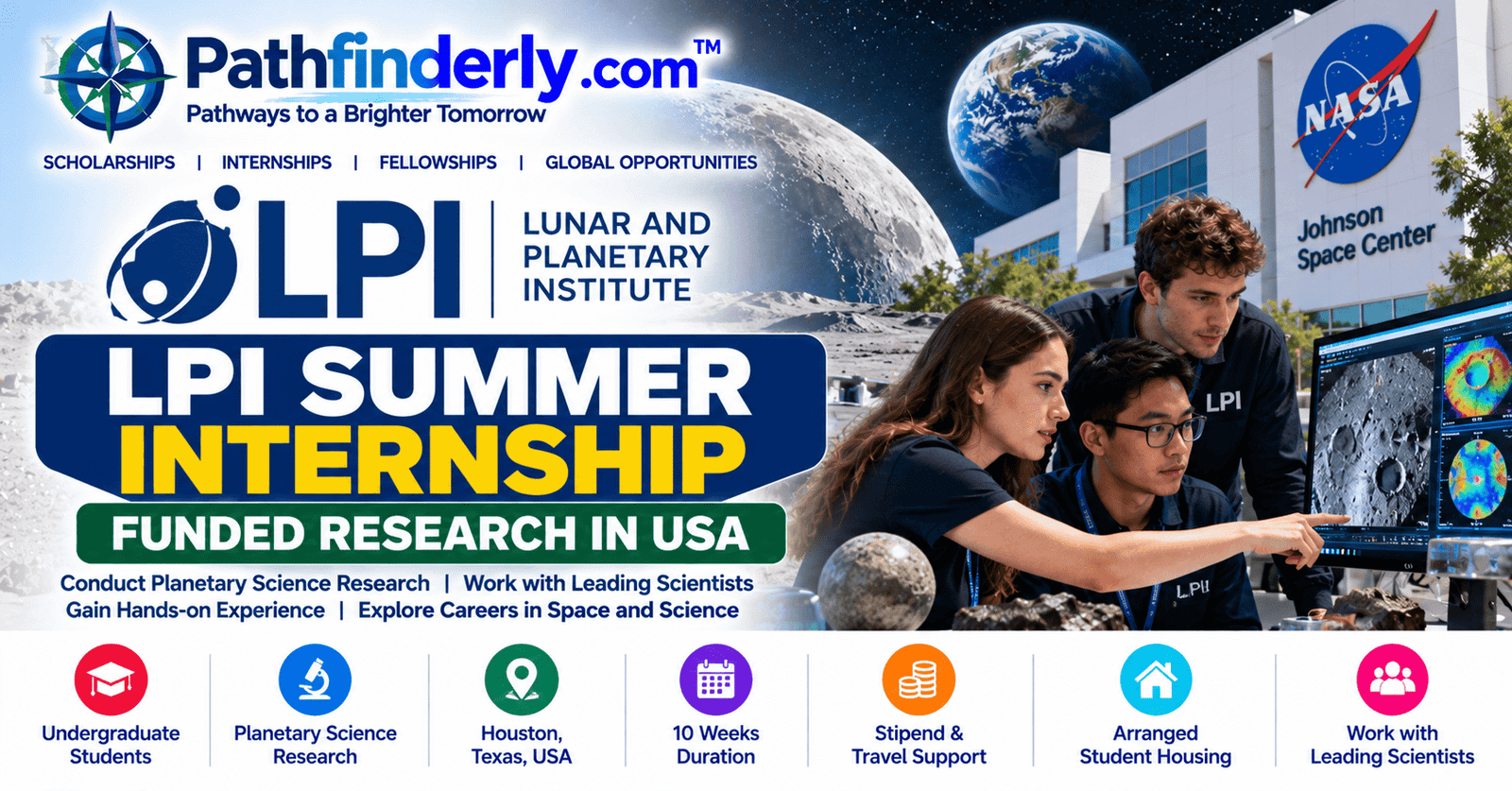
The LPI Summer Internship 2027 offers undergraduate students an opportunity to conduct planetary science research in the United States. The Lunar and Planetary Institute (LPI) is accepting applications for its 10-week summer research programme in Houston, Texas.
Selected students work alongside experienced planetary scientists on projects related to the Moon, planets, asteroids and other topics in solar system science.
The programme combines practical research with scientific lectures, professional development workshops and opportunities to interact with researchers.
Students studying physics, astronomy, geology, engineering, mathematics, computer science and related subjects are particularly encouraged to apply. However, applicants from other academic disciplines may also be considered if they meet the eligibility requirements.
The internship welcomes eligible international students, although important nationality restrictions apply.
Selected participants receive programme funding and arranged student housing. Applicants should confirm the current stipend and travel allowances before making financial commitments.
The application deadline is December 14, 2026.
Interested candidates can review the requirements and apply through the official LPI Summer Intern Program website.
LPI Summer Internship 2027 Overview
| Details | Information |
|---|---|
| Programme | LPI Summer Intern Program in Planetary Science |
| Organization | Lunar and Planetary Institute |
| Country | United States |
| Location | Houston, Texas |
| Programme Type | Funded undergraduate research internship |
| Duration | 10 weeks |
| Start Date | June 7, 2027 |
| End Date | August 13, 2027 |
| Main Research Locations | Lunar and Planetary Institute and NASA Johnson Space Center |
| Eligible Applicants | Undergraduate students meeting programme requirements |
| Minimum Academic Credits | 50 semester credit hours |
| Preferred Fields | Natural sciences, physical sciences, engineering, mathematics and computer science |
| International Applicants | Eligible, subject to nationality restrictions |
| Funding | Internship stipend and applicable travel support |
| Housing | Arranged student accommodation |
| Recommendations | Two required; maximum three |
| Application Opens | October 19, 2026 |
| Application Deadline | December 14, 2026 |
| Application Method | Online |
What Is the LPI Summer Internship?
The LPI Summer Intern Program in Planetary Science is a research training opportunity for undergraduate students interested in understanding the solar system.
Established in 1977, the programme has helped students develop scientific skills and explore careers in planetary research.
During the internship, participants work closely with experienced scientists on individual research projects.
These projects may involve scientific data, laboratory investigations, computer modelling or analysis of planetary observations.
Students also attend lectures, participate in career-development activities and present their research findings.
Unlike an ordinary office internship, this programme emphasizes scientific investigation and research training.
Participants are expected to work throughout the full 10-week period.
About the Lunar and Planetary Institute
The Lunar and Planetary Institute is a scientific research institute located in Houston, Texas.
It supports research into the Moon, planets and other objects in the solar system.
LPI also organizes scientific meetings, provides research resources and supports education and professional development in planetary science.
The institute is operated by the Universities Space Research Association.
Its location near NASA’s Johnson Space Center provides opportunities for collaboration with scientists working in space and planetary research.
The LPI Summer Intern Program is one of the institute’s established student research initiatives.
Learn more through the official Lunar and Planetary Institute website.
Where Will the Internship Take Place?
The programme takes place in Houston, Texas, United States.
Selected students conduct their research at one of two main locations.
Lunar and Planetary Institute
The Lunar and Planetary Institute provides research facilities and a professional scientific environment.
Students assigned to LPI work with researchers on projects related to planetary science.
NASA Johnson Space Center
Some participants conduct research at NASA’s Johnson Space Center in Houston.
These students work on projects under the supervision of scientists associated with the relevant research activities.
However, applicants should understand that selection for the LPI internship does not automatically mean they will work at NASA.
Research assignments depend on available projects, mentors and eligibility requirements.
The official internship location page explains the programme’s research locations and accommodation arrangements.
LPI Summer Internship 2027 Dates
The internship will run for 10 consecutive weeks.
| Activity | Date |
|---|---|
| Applications Open | October 19, 2026 |
| Application Deadline | December 14, 2026 |
| Selection Notifications | March 2027 |
| Orientation and Programme Start | June 7, 2027 |
| Midterm Presentations | July 7, 2027 |
| LPI Summer Intern Conference | August 11, 2027 |
| Programme Ends | August 13, 2027 |
| Departure | August 14, 2027 |
Students must be available for the complete programme.
The internship is conducted in person, and remote participation is not offered.
Is the LPI Summer Internship Fully Funded?
The LPI Summer Intern Program provides financial support to selected participants.
Published programme information describes a stipend and travel support. The institute also arranges student housing.
However, applicants should not assume that every personal expense will be covered.
For example, participants may need to budget for meals, local transportation, personal purchases and costs exceeding any applicable travel allowance.
International applicants may also face immigration-related expenses.
Therefore, it is more accurate to describe the programme as a funded summer research internship.
Applicants should confirm the exact 2027 financial arrangements directly with LPI before accepting an offer.
Financial Benefits
1. Internship Stipend
Published programme listings describe a stipend of approximately US$5,000 for the 10-week internship.
However, this figure should be treated as a previously published programme amount rather than a guaranteed 2027 award.
Candidates should confirm the current stipend through the official programme documents or offer letter.
2. Travel Support
Published programme information has described travel support of approximately:
- US$1,000 for eligible domestic travel
- Up to US$1,500 in travel reimbursement for eligible international interns
These figures may change between programme cycles.
The current award conditions determine the amount and eligibility.
3. Student Housing
LPI confirms that accommodation is arranged for selected interns at University Forest Student Village, near the University of Houston–Clear Lake campus.
This is an important benefit for participants traveling to Houston.
However, candidates should confirm whether any housing-related charges, deposits or other costs apply to their specific award.
4. Scientific Mentorship
Each intern works with an experienced researcher.
This provides an opportunity to learn scientific methods and receive guidance on a research project.
5. Research Facilities
Depending on the assignment, participants may gain experience using laboratory facilities, scientific datasets or computational research tools.
6. Professional Development
The programme includes lectures and workshops that help students understand research careers.
7. Research Presentations
Interns present their work during the programme.
These presentations help participants develop scientific communication skills.
Research Fields Available
LPI research projects cover different areas of lunar and planetary science.
The exact topics available depend on the participating scientists and research projects.
Lunar Science
Lunar science focuses on understanding the Moon’s surface, geology, history and physical processes.
Students may investigate lunar rocks, impact craters or observations from spacecraft.
Planetary Geology
Planetary geology examines the surfaces and geological histories of planets, moons and other solar system objects.
Research may involve analyzing images, surface features or geological materials.
Astronomy and Astrophysics
Some projects may involve astronomical observations, physical processes and the properties of planetary bodies.
Planetary Atmospheres
Planetary atmosphere research investigates the gases and physical processes surrounding planets and moons.
Meteorites and Planetary Materials
Meteorite research helps scientists understand the formation and evolution of the solar system.
Projects may involve laboratory analysis or interpretation of existing scientific data.
Impact Cratering
Scientists study how impacts shape planetary surfaces.
This research can help explain the geological histories of the Moon, Mars and other bodies.
Computational Planetary Science
Computational projects may involve numerical modelling, programming or analysis of large datasets.
Students with mathematics or computer science backgrounds may find these projects particularly relevant.
Remote Sensing
Remote sensing uses observations from spacecraft and scientific instruments to study planetary surfaces.
Projects may involve image analysis, mapping or interpretation of spectral data.
Applicants should consult the official LPI research topics page for the current programme’s research information.
Who Can Apply for the LPI Summer Internship 2027?
The programme is primarily designed for undergraduate students.
Applicants must satisfy the academic and nationality requirements.
Undergraduate Enrollment
The programme mainly targets students who are actively pursuing a Bachelor’s degree.
Applicants should normally be enrolled in a college or university during the semester before the internship begins.
Minimum Academic Credits
Applicants must have completed at least 50 semester credit hours.
Students studying outside the United States should consult their institution or LPI if they need clarification about equivalent academic credits.
Preferred Academic Fields
The programme particularly welcomes students studying:
- Physics
- Astronomy
- Geology
- Chemistry
- Natural sciences
- Engineering
- Computer science
- Mathematics
However, applicants from other academic backgrounds may also be considered.
Academic Performance
Selection considers academic achievement, coursework and relevant experience.
A strong academic background can improve an applicant’s competitiveness.
Scientific Interests
Applicants should demonstrate genuine interest in planetary science.
Their interests should also match available research projects.
English Language Skills
All application materials must be submitted in English.
Participants must be able to read, write and communicate effectively in English.
Additional evidence may be required from certain international applicants.
Can International Students Apply?
Yes.
The programme accepts applications from eligible foreign nationals.
However, citizens of countries included on the applicable U.S. designated-country list are not eligible.
This restriction is especially important because the programme may involve access to facilities at NASA’s Johnson Space Center.
Applicants should review the current NASA export-control information and LPI’s official eligibility requirements.
The restrictions can affect applicants even when they meet the academic requirements.
International students should confirm their eligibility before spending money on documents, tests or travel arrangements.
What About Dual Citizens and Permanent Residents?
LPI provides additional guidance for applicants with different citizenship or residency circumstances.
Eligible naturalized U.S. citizens may apply, but they must provide accurate citizenship information and documentation.
Dual citizens may also apply when they satisfy the designated-country restrictions.
U.S. permanent residents must declare their status and provide the required documentation.
Applicants should follow LPI’s official instructions rather than assuming that residence in an eligible country automatically establishes eligibility.
Can Final-Year Undergraduate Students Apply?
Yes, some final-year students may be eligible.
The programme primarily targets students who are still pursuing a Bachelor’s degree.
However, LPI may consider applicants who completed their Bachelor’s degree during the fall or spring semester immediately preceding the summer programme.
Applicants who graduated earlier should not assume they qualify.
The official FAQ explains these exceptions in more detail.
Can Master’s or PhD Students Apply?
The programme is designed primarily for undergraduate students.
Applicants who are already pursuing graduate studies are not its main target group.
Students seeking graduate-level research opportunities should consider programmes specifically designed for Master’s or PhD candidates.
Is Previous Research Experience Required?
The programme considers applicants’ academic background, experience, career objectives and scientific interests.
Previous research experience can strengthen an application.
However, students should not assume that they need an extensive publication record.
Relevant experience may include:
- University laboratory projects
- Scientific coursework
- Data analysis
- Programming projects
- Undergraduate research
- Academic fieldwork
- Research presentations
Applicants should explain what they learned and how their experience relates to planetary science.
Is IELTS Required?
International applicants whose primary language is not English must provide evidence of English proficiency.
LPI accepts one of the following forms of evidence:
- TOEFL score
- IELTS score
- A letter from a professor in the applicant’s college English department confirming sufficient spoken and written English skills
This means IELTS is not the only accepted option.
Applicants should review the current instructions before arranging a language test.
Required Documents
Applicants must complete the online application and provide the required supporting materials.
Online Application Form
The application includes personal, educational and other information.
Applicants must answer all required questions, including essay-style questions.
Official Academic Transcript
An official transcript is required.
LPI accepts official original transcripts and official electronic transcripts sent directly by the educational institution or its authorized transcript service.
Unofficial transcripts uploaded by applicants are not accepted as substitutes.
Letters of Recommendation
Applicants must submit at least two and no more than three recommendation letters.
LPI prefers recommendations from faculty members at the student’s current institution.
However, other suitable referees may be accepted.
These may include academic advisors, former professors or supervisors who can comment on the applicant’s qualifications and potential.
English Language Evidence
Certain international applicants must provide acceptable proof of English proficiency.
Additional Information
The online application may request information about academic interests, career goals and relevant experience.
Applicants should follow the instructions displayed in the current application system.
How to Apply for the LPI Summer Internship 2027
The application process is online.
Step 1: Visit the Official Programme Website
Open the LPI Summer Intern Program.
Read the current announcement and programme dates.
Step 2: Check Your Eligibility
Confirm that you meet the undergraduate credit requirement.
International applicants should also review the nationality restrictions.
Step 3: Review the Research Areas
Explore the programme’s research topics.
Identify areas that match your academic background and scientific interests.
Step 4: Open the Online Application
Use the Apply Now option on the official website.
Follow the instructions to access the application system.
Step 5: Complete Your Personal Information
Enter your name, contact details, university and other requested information.
Use an email address that you check regularly.
Step 6: Provide Academic Information
Enter your educational background and academic achievements.
International applicants may need to obtain guidance from their university about converting grades to the U.S. GPA scale.
Step 7: Answer the Essay Questions
Explain your interest in planetary science and your reasons for applying.
Describe relevant academic experiences and career objectives.
Avoid generic statements that do not connect with the programme.
Step 8: Arrange Recommendation Letters
Select two or three suitable referees.
The application system sends them instructions for submitting their recommendations electronically.
Contact your referees early so they have enough time.
Step 9: Arrange Your Official Transcript
Request an official transcript from your university.
Electronic transcripts must be sent directly from the institution or authorized transcript provider.
Follow the delivery instructions on LPI’s application requirements page.
Step 10: Prepare English Language Evidence
If required, provide an accepted language test result or the specified university letter.
Step 11: Submit the Application
Complete all required fields and submit the online form.
After submission, the system provides a confirmation email and application number.
Step 12: Monitor Recommendation Status
Use the application system to check whether your referees have submitted their letters.
All required materials must arrive before the deadline.
Application Deadline
The application deadline for the 2027 programme is:
December 14, 2026.
LPI does not accept late or incomplete applications.
Applicants should not wait until the final day because official transcripts and recommendation letters may require additional processing time.
The 2027 programme homepage confirms the deadline. Applicants should consult the current application portal for the precise closing time.
How Are Interns Selected?
LPI evaluates candidates using several criteria.
These include academic achievement, coursework, experience, career objectives and scientific interests.
The selection committee also considers how well an applicant’s interests match available research projects.
Therefore, students should explain their scientific interests clearly.
Strong grades are helpful, but research motivation and suitability for available projects also matter.
LPI expects to notify selected candidates in March 2027.
Successful applicants may need to respond quickly to their offers.
What Will Students Do During the Internship?
The programme combines individual research with scientific training and professional development.
Work With a Research Mentor
Interns work closely with scientists on assigned research projects.
Mentors provide guidance on research methods and scientific questions.
Conduct Research
Depending on the project, students may analyze scientific data, conduct laboratory work or use computational tools.
Attend Scientific Lectures
The programme includes lectures on planetary science and related subjects.
Participate in Workshops
Students attend activities designed to develop research and professional skills.
Prepare Research Presentations
Participants present their research progress during the programme.
The official schedule includes midterm presentations and an end-of-programme conference.
Learn About Scientific Careers
Interns can interact with researchers and explore possible career paths in science.
Internship Housing and Living Arrangements
LPI arranges student accommodation at University Forest Student Village in the Houston area.
The accommodation is located near the University of Houston–Clear Lake campus.
However, applicants should confirm the exact housing arrangements and any associated costs after selection.
Participants should also consider local transportation.
LPI advises that access to a car is useful in many cases.
Students assigned to off-site activities may need to arrange their own transportation.
Is the Internship Available Remotely?
No.
The programme is conducted in person.
Students must attend orientation on the first day and participate throughout the 10-week internship.
LPI generally expects interns to work Monday through Friday during regular working hours.
Limited absences may be permitted for valid reasons, but participants must coordinate them with their supervisors.
Do Applicants Need to Contact a Research Mentor?
No.
LPI states that applicants do not need to identify or contact potential mentors before applying.
Research assignments are handled through the programme’s selection and matching process.
Applicants should focus on submitting a complete application that explains their scientific interests.
Tips for a Strong Application
Explain Your Interest in Planetary Science
Describe the scientific questions that interest you.
For example, you might be interested in lunar geology, planetary atmospheres or computational analysis.
Connect Your Coursework to Research
Explain how your university studies have prepared you for research.
Mention relevant laboratory classes, programming projects or scientific assignments.
Describe Your Experience Accurately
Include genuine academic or research achievements.
You do not need to exaggerate your experience.
Choose Suitable Referees
Select people who know your academic abilities and can provide meaningful recommendations.
Prepare Your Transcript Early
Official transcripts may take time to process.
Request them well before the application deadline.
Check Nationality Requirements
International applicants should review the designated-country restrictions before applying.
Submit Before December 14
Allow enough time for recommendation letters and other documents to arrive.
Benefits of Participating in the LPI Summer Internship
Practical Research Experience
Students gain experience conducting scientific research under professional supervision.
Scientific Mentorship
Participants learn directly from experienced planetary scientists.
Research Communication
Students develop presentation and scientific writing skills.
Professional Networking
The programme provides opportunities to meet researchers and other students interested in planetary science.
Career Exploration
Interns can learn about careers in universities, research institutes and space science organizations.
Preparation for Graduate Study
The research experience may strengthen future applications for graduate programmes.
However, participation does not guarantee admission to any university or employment with NASA.
Other International Research Internships to Explore
Students interested in research opportunities can also explore the KAUST Visiting Student Research Program, which offers selected students practical research experience in Saudi Arabia.
The EPFL Summer Research Program in Switzerland provides research opportunities for eligible students interested in life sciences and related scientific fields.
Students planning to continue their education after graduation can also explore the ETH Zurich ESOP Scholarship, which provides financial support for outstanding students pursuing Master’s degrees in Switzerland.
Students interested in computer science research can also explore the ETH Summer Research Fellowship in Switzerland, which provides a CHF 4,000 stipend and covers eligible travel and visa expenses.
These programmes have different academic requirements, funding arrangements and application periods.
Applicants should compare the official eligibility conditions before applying.
Frequently Asked Questions
Is the LPI Summer Internship 2027 open?
Yes. Applications opened on October 19, 2026.
What is the application deadline?
December 14, 2026.
Where is the internship located?
Houston, Texas, United States.
How long is the programme?
Ten consecutive weeks.
When does the internship start?
June 7, 2027.
When does it end?
August 13, 2027.
Is the LPI Summer Internship funded?
Yes. The programme provides financial support and arranged student housing. Applicants should confirm the current stipend and travel terms.
How much is the stipend?
Previously published programme information describes a US$5,000 stipend. The exact 2027 amount should be confirmed with LPI.
Is travel support available?
Published programme information describes travel allowances or reimbursements. The applicable 2027 conditions should be confirmed.
Is accommodation provided?
LPI confirms arranged student housing at University Forest Student Village.
Can international students apply?
Yes, except applicants affected by the programme’s designated-country restrictions.
Are all nationalities eligible?
No. Citizens of countries on the applicable U.S. designated-country list are not eligible.
Can undergraduate students apply?
Yes. The programme is primarily designed for undergraduates.
How many academic credits are required?
At least 50 semester credit hours.
Can recent Bachelor’s graduates apply?
Some students who graduate during the fall or spring immediately before the internship may be considered.
Can Master’s students apply?
The programme primarily targets undergraduate students.
Is IELTS compulsory?
Not in every case. Certain international applicants may submit TOEFL, IELTS or an accepted letter from a university English professor.
How many recommendation letters are required?
At least two and no more than three.
Is an official transcript required?
Yes.
Can applicants upload unofficial transcripts?
No. LPI requires official transcripts sent through the approved methods.
Is remote participation available?
No. The internship is in person.
Do applicants need to contact research mentors?
No.
When will selected applicants be notified?
March 2027.
Does the internship guarantee a NASA job?
No.
Where can I apply?
Through the official LPI Summer Intern Program website.
Final Thoughts
The LPI Summer Internship 2027 is a valuable opportunity for undergraduate students interested in planetary science and space research.
The 10-week programme will take place in Houston, Texas, from June 7 to August 13, 2027.
Selected participants work with scientists at the Lunar and Planetary Institute or NASA’s Johnson Space Center.
The programme provides research experience, mentorship, scientific lectures, professional development activities and financial support.
Applicants must have completed at least 50 semester credit hours.
International students may apply, but nationality restrictions are important and should be reviewed carefully.
Candidates must also provide an official transcript and two or three recommendation letters.
The application deadline is December 14, 2026.
Interested students should review the official LPI Summer Intern Program and submit their applications through its authorized online system.
Last verified: October 22, 2026
Pathfinderly provides independent information about international scholarships, internships and research opportunities. We are not affiliated with the Lunar and Planetary Institute, NASA or the Universities Space Research Association. Programme conditions, funding amounts and eligibility requirements may change. Always consult the official programme website before applying.