
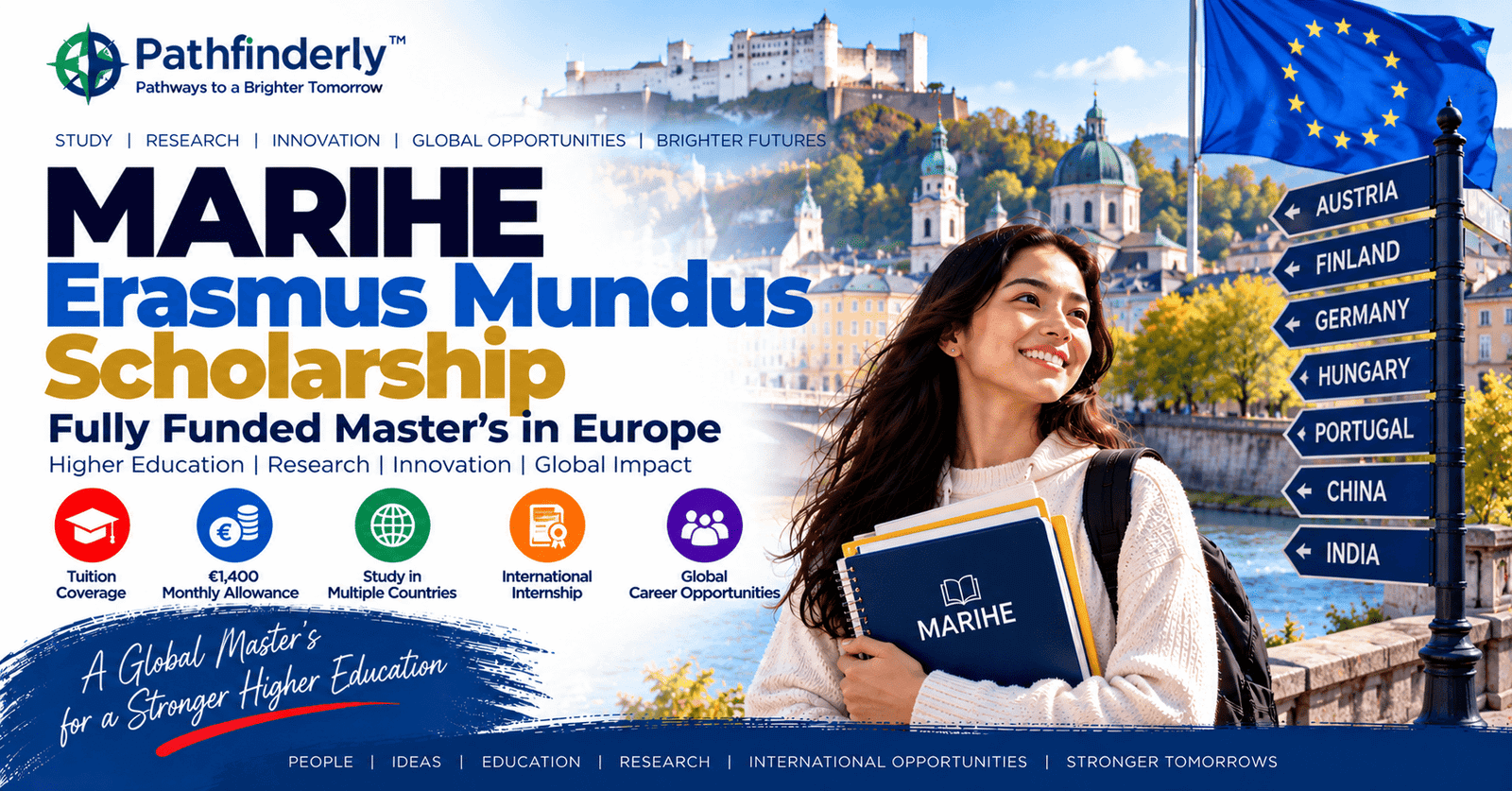
he MARIHE Erasmus Mundus Scholarship offers international students an opportunity to complete a highly international two-year Master’s program while studying across several countries.
MARIHE stands for Master in Research and Innovation in Higher Education.
The program focuses on higher education systems, research, innovation, management, policy, leadership, and institutional development.
Students begin their studies in Europe. Later, they follow specialized mobility routes that can take them to universities in Europe and Asia. A mandatory internship adds practical international experience.
Selected students can receive an Erasmus Mundus scholarship covering tuition and providing a monthly allowance.
MARIHE states that the next student intake with Erasmus Mundus scholarships will begin in September 2028.
Future applicants can use this guide to understand the program and prepare early.
MARIHE Scholarship Overview
| Details | Information |
|---|---|
| Program | MARIHE |
| Full Name | Master in Research and Innovation in Higher Education |
| Scholarship | Erasmus Mundus Scholarship |
| Study Level | Master’s |
| Duration | 2 years / 4 semesters |
| Credits | 120 ECTS |
| Language | English |
| Study Mode | Full-time, on-site |
| Tuition | Covered for selected MARIHE students |
| Erasmus Mundus Allowance | €1,400 per month |
| Maximum Scholarship Period | Up to 24 months |
| Internship | Mandatory |
| Internship Duration | Minimum 8 weeks |
| Mobility | Europe and Asia |
| Applicants | International students worldwide |
| 2027 Application | Closed |
| 2027 Deadline | 21 September 2026 |
| Next Scholarship Intake | September 2028 |
Future applicants should begin with the official MARIHE website and check the latest cycle before preparing an application.
What Is MARIHE?
MARIHE is an Erasmus Mundus Joint Master specializing in research, innovation, and higher education.
It was established in 2012.
Unlike a conventional Master’s degree completed at one university, MARIHE uses a structured international mobility model.
Students study in different countries and learn how higher education systems operate across national and institutional contexts.
The program is particularly relevant to people interested in careers connected with:
- Higher education management
- University administration
- Research management
- Education policy
- Institutional development
- International education
- Innovation management
- Higher education research
- Government agencies
- International organizations
- Consultancy
Applicants do not need a Bachelor’s degree in one particular subject.
MARIHE welcomes applicants from different academic disciplines.
Is the MARIHE Erasmus Mundus Scholarship Fully Funded?
For recipients of the Erasmus Mundus scholarship, fully funded is appropriate wording.
The scholarship provides substantial financial support throughout the program.
Tuition Coverage
MARIHE’s participation costs for the four-semester program are:
€18,000
Erasmus Mundus scholarship recipients do not pay these participation costs.
Importantly, MARIHE currently also waives the €18,000 participation costs for selected students without an Erasmus Mundus scholarship.
Therefore, selected non-EMJM students can also study tuition-free under the current MARIHE funding structure.
Applicants can review the official MARIHE costs and funding information.
€1,400 Monthly Allowance
Erasmus Mundus scholarship recipients receive:
€1,400 per month
The allowance contributes toward expenses such as:
- Living costs
- Travel
- Visa expenses
- Installation costs
- Other subsistence expenses
For a full 24-month scholarship period, the monthly component can reach:
€33,600
This figure is based on €1,400 × 24 months.
Students should remember that this is a combined monthly contribution rather than separate unlimited payments for every individual expense.
Health and Accident Insurance
MARIHE also provides health and accident insurance meeting the minimum requirements applicable to Erasmus Mundus Joint Master students.
The program states that this insurance is provided to students with and without an Erasmus Mundus scholarship.
Still, students should check what the insurance covers before purchasing any additional protection independently.
Tuition-Free Study Without Erasmus Mundus Scholarship
This is one of the most interesting features of the current MARIHE funding structure.
An applicant who receives admission but does not win the full Erasmus Mundus scholarship may still receive a:
Tuition Fee Scholarship
MARIHE currently waives the €18,000 participation costs for selected students.
However, there is an important difference.
A tuition-fee scholarship does not automatically provide the €1,400 monthly Erasmus Mundus allowance.
Students without the full scholarship may therefore need to finance:
- Accommodation
- Food
- Travel
- Visa costs
- Installation costs
- Local transportation
- Mobility between countries
- Personal expenses
- Books and other study expenses
Additional funding may be available, but applicants should not assume it is guaranteed.
Additional MARIHE Funding
MARIHE lists other possible funding opportunities for students who do not hold the full Erasmus Mundus scholarship.
These include:
- Erasmus+ Student Mobility funding
- Special MARIHE scholarships
- External funding sources
One special scheme supports students from deprived backgrounds and/or first-in-family students.
MARIHE currently offers up to two such scholarships per intake.
Each can contribute up to:
€6,000
toward eligible travel and visa expenses.
These scholarships are intended for selected students who do not already hold an Erasmus Mundus scholarship.
Availability is limited.
Where Will MARIHE Students Study?
International mobility is central to the program.
The first two semesters follow a common route.
Semester 1 — Austria
All students begin at:
University for Continuing Education Krems, Austria
Semester 2 — Finland
Students then continue at:
Tampere University, Finland
After these common semesters, students follow specialization and mobility pathways involving Europe and Asia.
The official MARIHE mobility information explains the current structure.
MARIHE Partner Universities
The current consortium includes seven universities:
- University for Continuing Education Krems — Austria
- Tampere University — Finland
- Osnabrück University of Applied Sciences — Germany
- Eötvös Loránd University — Hungary
- University of Aveiro — Portugal
- Beijing Normal University — China
- Thapar Institute of Engineering and Technology — India
Students therefore gain exposure to several higher education environments during the program.
Asian Specializations
MARIHE currently provides two specialization possibilities in Asia.
Beijing Normal University — China
The specialization focuses on:
Educational Planning and Development
Students explore educational planning, curriculum development, higher education reform, and comparative perspectives.
Thapar Institute of Engineering and Technology — India
This specialization focuses on:
Sustainable Education and Social Entrepreneurship
Students examine areas connected with entrepreneurship, sustainability, education, and institutional development.
European Specializations
Students also have access to five specialization options in Europe.
These currently include:
University for Continuing Education Krems — Austria
Institutional Research
Tampere University — Finland
Research Management and Digital Transformation
Osnabrück University of Applied Sciences — Germany
Leadership and Management
Eötvös Loránd University — Hungary
Learning and Teaching
University of Aveiro — Portugal
Policy Analysis
Students express specialization preferences, but the final allocation is determined by the MARIHE consortium.
Therefore, applicants should not assume that admission guarantees their first-choice specialization.
Mandatory International Mobility
MARIHE is not an online Master’s program.
Students must physically attend the participating institutions.
The Erasmus Mundus structure requires substantial international mobility.
MARIHE includes study periods in multiple countries, and students need to be prepared to relocate during the degree.
Remote participation is not available for the required study periods.
This is an important consideration for applicants with family, employment, visa, or other mobility constraints.
MARIHE Internship
A professional internship is a compulsory part of the degree.
The program includes an internship of at least:
8 weeks
It can be completed internationally.
Potential internship environments may include organizations connected with:
- Universities
- Research institutions
- Higher education organizations
- Government
- International organizations
- Education policy
- Consulting
- Innovation
- Research management
The internship provides an opportunity to connect academic knowledge with professional practice.
MARIHE Degree and Credits
The full program consists of:
120 ECTS
completed over four semesters.
The broad structure is:
Semester 1: Orientation — 30 ECTS
Semester 2: Foundation — 30 ECTS
Semester 3: Internship and Specializations — 35 ECTS
Semester 4: Master’s Thesis — 25 ECTS
The precise degree awarded depends on the student’s specialization route.
Depending on the pathway, graduates can receive a joint, double, or multiple degree from participating institutions.
Who Can Apply?
MARIHE is open to applicants from around the world.
The main academic requirement is straightforward.
Applicants need a first university degree representing at least:
Three years of full-time higher education
or:
180 ECTS
where the ECTS system applies.
In most cases, this means a Bachelor’s degree.
Does Your Bachelor’s Degree Need to Be in Education?
No.
This is an important advantage of MARIHE.
The program does not require the first university degree to be in a particular subject.
Applicants can come from different academic backgrounds.
However, they need to demonstrate strong motivation for studying and working in areas connected with higher education, research, and innovation.
Your application should explain why MARIHE logically fits your previous education and future plans.
Can a Two-Year Degree Qualify?
Applicants need a first university degree that independently represents at least three years of full-time higher education.
MARIHE does not allow applicants to combine several shorter qualifications merely to reach the equivalent duration.
For example, combining separate degrees to turn a shorter first degree into a three-year equivalent is not accepted under the current admission rules.
The qualifying first university degree must itself satisfy the requirement.
Is Work Experience Required?
No.
Professional experience is not a formal admission requirement.
A recent graduate can therefore apply if the other eligibility conditions are met.
However, relevant experience can strengthen an application.
Experience with:
- Universities
- Education institutions
- Research organizations
- Government education departments
- International organizations
- Education projects
- Research administration
can help demonstrate a genuine connection with the field.
English Language Requirements
MARIHE is taught in English.
Applicants must provide acceptable evidence of academic English proficiency unless they qualify for an official exemption.
Current accepted tests include:
| English Test | Minimum Requirement |
|---|---|
| IELTS Academic | 6.5 overall |
| IELTS Individual Components | Minimum 5.5 |
| PTE Academic | 62 |
| Cambridge C1 Advanced | Grade C |
| Cambridge C2 Proficiency | Grade C1 |
MARIHE also accepts TOEFL iBT, but its scoring system changed in January 2026.
For tests completed before 21 January 2026, the listed minimum is:
TOEFL iBT 92/120, with no section below 20
For tests completed on or after 21 January 2026, MARIHE currently lists:
TOEFL iBT 4.5/6, with no section below 4
Applicants should verify the current requirements on the official MARIHE admission requirements page before booking a test.
Is Duolingo Accepted?
No, according to the current requirements.
MARIHE specifically limits accepted language tests.
For example, it does not currently accept Duolingo as a substitute for one of the approved English tests.
A general letter stating that an applicant knows English is also insufficient unless the applicant qualifies under the official previous-study exemption rules.
This is an area where applicants should be particularly careful.
English Test Exemption
Some applicants can qualify for an exemption based on previous education completed entirely in English.
However, MARIHE has specific rules about:
- Type of qualification
- Country of study
- Location of the institution
- Language of instruction
Completing a degree “in English” somewhere in the world does not automatically provide an exemption.
The university awarding the qualifying degree must meet the current geographic and language conditions.
Applicants should check the official exemption list rather than relying on a general Medium of Instruction letter.
Application Documents
The latest application process uses two rounds.
Round 1
All applicants submit nine mandatory documents:
- MARIHE Application Form
- Passport or national ID
- Curriculum Vitae
- Letter of Motivation
- University degree certificate or diploma
- Official academic transcripts
- Proof of English proficiency
- Two letters of recommendation
- Essay
The CV currently needs to follow the Europass format, and MARIHE instructs applicants not to include a portrait photograph.
Applicants should check the official application documents page before preparing the next cycle’s documents.
Round 2 — Shortlisted Applicants
Not everyone proceeds to the second round.
Applicants who are shortlisted must submit an additional:
Video
The video becomes the tenth mandatory application document for shortlisted candidates.
This two-stage process allows the consortium to assess candidates more closely before making final selections.
Motivation Letter
The motivation letter is an important part of the application.
A strong letter should connect:
- Your academic background
- Your interest in higher education
- Relevant experience
- Career goals
- Interest in research and innovation
- Reasons for choosing MARIHE
Avoid writing a generic Erasmus Mundus motivation letter that could be sent to any Master’s program.
Your explanation should show why MARIHE specifically fits your goals.
Essay
MARIHE also requires an essay.
Applicants must follow the topic, format, and length specified for the relevant application cycle.
Do not reuse an old essay prompt simply because it appeared in a previous intake.
The program can update templates and requirements between cycles.
Letters of Recommendation
Two recommendation letters are currently required.
Applicants should choose referees who can meaningfully discuss their academic ability, professional potential, motivation, or relevant experience.
MARIHE also has formal requirements for recommendation letters, including requirements relating to signatures.
Therefore, give referees enough time to prepare the documents correctly.
How to Apply for the MARIHE Erasmus Mundus Scholarship
When the next scholarship application period opens, the process should begin with the official MARIHE instructions.
Step 1: Check the New Intake
Visit the official MARIHE application page and confirm that applications are open.
Step 2: Read the Current Guidelines
Do not rely solely on guidelines from the 2027 intake.
MARIHE may update:
- Dates
- Templates
- Essay topics
- Document requirements
- Selection procedures
- Funding arrangements
Use the guidelines issued specifically for your application cycle.
Step 3: Confirm Eligibility
Check your:
- Bachelor’s qualification
- Degree duration
- English proficiency
- Motivation and academic fit
Step 4: Prepare the Documents
Start early, particularly with:
- English test
- Recommendations
- Motivation letter
- Essay
- Academic records
Step 5: Submit Through the Official Portal
MARIHE accepts electronic applications during open application periods through its designated online application system.
Do not email a complete application directly to individual consortium universities.
Step 6: Wait for Shortlisting
Eligible applications proceed through the selection process.
Shortlisted candidates receive instructions for Round 2.
Step 7: Submit the Video
If shortlisted, prepare the required video according to the current guidelines and deadline.
Step 8: Wait for Final Selection
The consortium then completes the scholarship and admission selection process.
MARIHE 2027 Deadline — Applications Closed
This section is particularly important because the latest deadline has just passed.
For the 2027 intake, Round 1 closed on:
21 September 2026 at 10:00 a.m. CEST
The application period is now closed.
Applicants who successfully submitted by that deadline remain in the selection process.
Shortlisted candidates for that intake have a Round 2 video deadline of:
11 December 2026 at 10:00 a.m. CET
This second deadline applies to shortlisted 2027 applicants, not to new applicants.
Therefore, someone discovering MARIHE now cannot use the December date to submit a new 2027 application.
When Is the Next MARIHE Erasmus Mundus Scholarship?
MARIHE currently states:
The next student intake with Erasmus Mundus scholarships is September 2028.
The application period for that intake has not yet been announced.
Future applicants should monitor the official MARIHE website for the next application window.
This also gives prospective candidates useful preparation time.
They can work on:
- English proficiency
- Academic performance
- Relevant professional experience
- Understanding higher education issues
- CV development
- Scholarship documentation
Pathfinderly will update this guide when MARIHE publishes the next application schedule.
Does MARIHE Charge an Application Fee?
Applicants should follow the official portal instructions for the relevant intake.
The important financial distinction is that MARIHE currently provides tuition-fee scholarships to all selected students, while only a limited number receive the additional Erasmus Mundus monthly scholarship.
Therefore:
Admission with tuition waiver ≠ Erasmus Mundus scholarship.
Both are valuable, but their financial packages are different.
How Competitive Is the Scholarship?
MARIHE describes itself as highly selective.
The Erasmus Mundus scholarships are limited, so meeting the minimum admission requirements does not guarantee funding.
Applicants should focus on producing a strong overall application rather than merely satisfying the basic eligibility criteria.
Important areas include:
- Academic preparation
- Motivation
- Quality of written documents
- Relevance of previous experience
- Career direction
- Understanding of higher education
- Communication skills
How to Strengthen Your Application
Start by understanding what MARIHE actually studies.
This is not a general business or education Master’s.
The program focuses specifically on research, innovation, management, policy, and development in higher education.
Your application should therefore explain how your background connects with that field.
A strong candidate can demonstrate:
- Clear academic goals
- Interest in higher education systems
- International outlook
- Evidence of analytical ability
- Relevant experience where available
- Strong motivation
- Realistic career plans
Avoid vague statements about simply wanting to study in Europe.
Career Opportunities After MARIHE
The program can prepare graduates for careers in several sectors.
Potential areas include:
- Universities
- Research institutions
- Government agencies
- International organizations
- University alliances
- Education organizations
- Consultancy
- Research management
- Higher education policy
- Innovation management
- Start-ups
- Institutional development
The international mobility and internship can also help students develop cross-cultural professional experience.
MARIHE vs Other Erasmus Mundus Scholarships
MARIHE has a specialized academic focus.
Students looking for public-policy study can also explore the Erasmus Mundus MAPP Scholarship, which focuses on public policy and includes several European mobility tracks.
MARIHE, by contrast, concentrates on higher education, research, institutional management, innovation, and education systems.
Both programs use Erasmus Mundus structures, but their academic objectives are different.
Applicants should choose according to their intended field rather than simply applying because both offer substantial funding.
Other Fully Funded Master’s Scholarships
Students preparing for MARIHE may also consider other international Master’s opportunities.
The Commonwealth Scholarship supports eligible students from participating Commonwealth countries for postgraduate study in the UK.
For applicants interested in Japan, the Japanese Government MEXT Scholarship provides another major government-funded route for graduate study.
Students seeking a fully funded Master’s at a single European university can also explore the ETH Zurich ESOP Scholarship, which provides a living scholarship and tuition-fee waiver for outstanding Master’s students in Switzerland.
Furthermore, students interested in studying at a French university can also explore the Eiffel Excellence Scholarship, which provides monthly allowances and additional support for eligible Master’s and doctoral students in France.
These scholarships have different eligibility rules, application systems, academic fields, and funding arrangements.
Compare them based on your academic goals rather than funding alone.
Common MARIHE Application Mistakes
Applicants should avoid:
- Using outdated application guidelines
- Missing the English-language requirements
- Assuming a Medium of Instruction letter is always accepted
- Submitting an unapproved English test
- Treating work experience as a substitute for the required degree
- Writing a generic motivation letter
- Ignoring formal recommendation-letter requirements
- Missing the essay
- Uploading an incomplete application
- Assuming admission automatically means a €1,400 monthly scholarship
- Ignoring the compulsory mobility requirement
- Assuming they can choose any specialization without consortium approval
- Waiting until the deadline to arrange an English test
Careful preparation matters because formal errors can make an otherwise strong application ineligible.
Is the MARIHE Erasmus Mundus Scholarship Worth Considering?
MARIHE offers an unusual combination of academic study, international mobility, specialization, research, and practical experience.
Full Erasmus Mundus scholarship recipients receive tuition coverage plus a €1,400 monthly allowance for up to 24 months.
Even selected students without the full Erasmus Mundus award currently benefit from waived €18,000 participation costs.
The program is especially relevant to applicants who want careers connected with universities, higher education policy, research management, education innovation, or institutional leadership.
However, candidates must be comfortable with extensive international mobility.
This is a genuinely multi-country degree rather than a Master’s program based at one campus.
Final Thoughts
The MARIHE Erasmus Mundus Scholarship provides a strong opportunity for international students interested in higher education, research, innovation, leadership, and policy.
The two-year program carries 120 ECTS and combines study in Austria and Finland with additional specialization opportunities across Europe and Asia.
Erasmus Mundus scholarship recipients receive covered participation costs and a €1,400 monthly allowance. Health and accident insurance is also included under the program’s current arrangements.
However, new applications are not open at present.
The 2027 intake deadline passed on 21 September 2026, and the official MARIHE website states that the next intake with Erasmus Mundus scholarships will be September 2028.
Prospective applicants should use this period to strengthen their academic profile, prepare an accepted English test if necessary, understand the program, and monitor the official MARIHE application page for the next call.
Last verified: September 2026
Pathfinderly provides scholarship information for educational purposes. MARIHE can change application dates, funding, admission requirements, partner arrangements, specialization options, and document requirements. Always verify the latest information through the official MARIHE website before applying.