
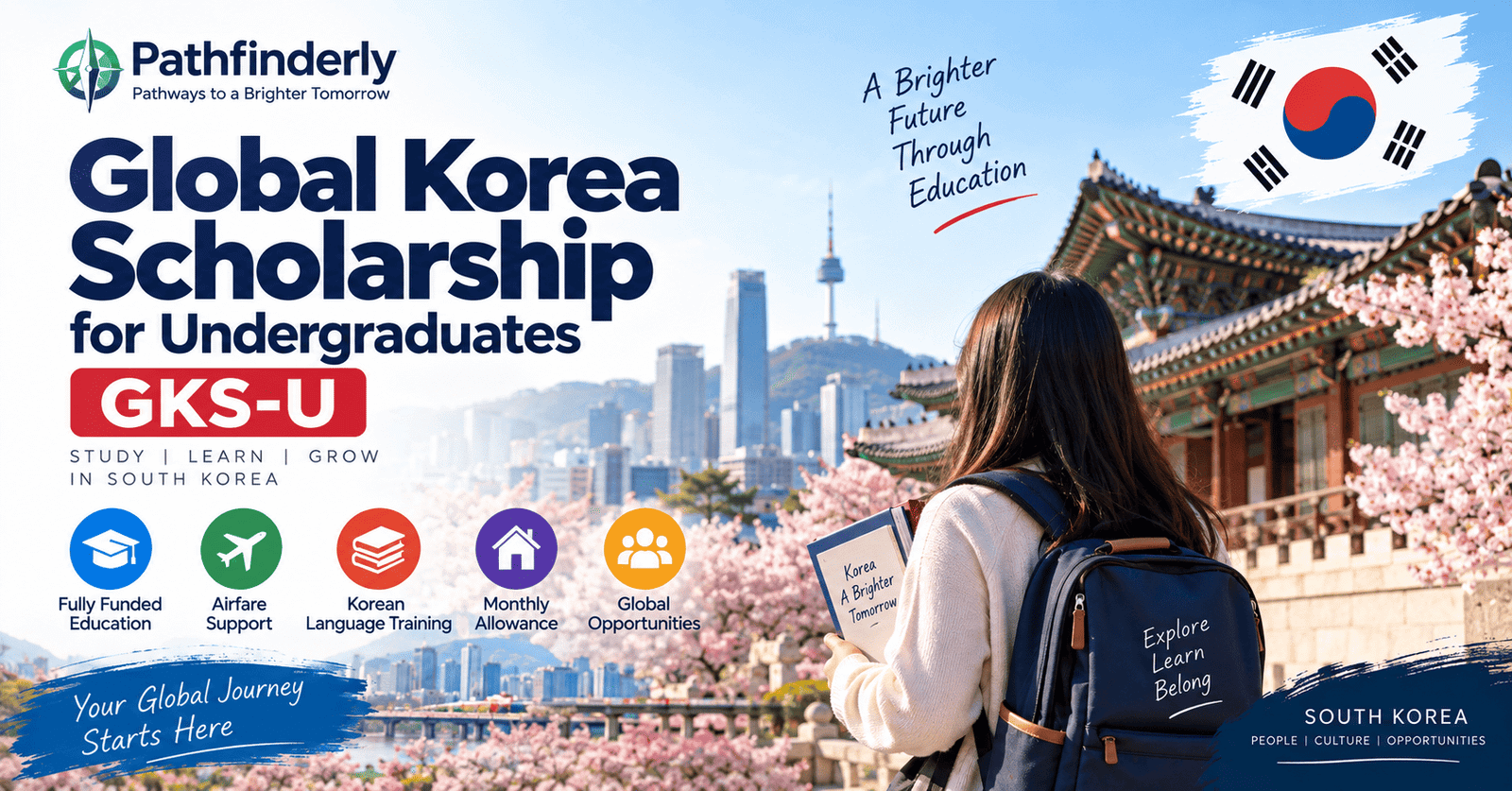
The Global Korea Scholarship for Undergraduates gives international students an opportunity to study in South Korea with financial support from the Korean government. The program is commonly known as GKS-U and supports eligible students pursuing undergraduate and associate degree programs at participating Korean universities.
The National Institute for International Education (NIIED) administers the scholarship. For the 2027 intake, the official application guidelines were released in September 2026 along with application forms and university information files.
Students can apply through different routes depending on their nationality, intended degree, and chosen university. Since requirements and available institutions vary by track, applicants should understand the process before preparing their documents.
GKS-U 2027 Overview
| Details | Information |
|---|---|
| Scholarship | Global Korea Scholarship (GKS) |
| Current Intake | 2027 |
| Host Country | South Korea |
| Funding | Korean Government |
| Administrator | NIIED |
| Study Level | Bachelor’s and Associate Degree |
| Eligible Applicants | International students meeting GKS requirements |
| Main Routes | Embassy Track and University Track |
| Korean Language Training | Generally included in the scholarship program |
| Application Period | Varies by track and first-round institution |
| Final Selection | NIIED |
| Category | Scholarships |
What Is the Global Korea Scholarship?
The Global Korea Scholarship is a Korean government initiative designed to bring talented international students to Korea for higher education.
It was previously widely known as the Korean Government Scholarship Program (KGSP). Today, Global Korea Scholarship or GKS is the official name.
The program supports different levels of higher education. GKS-U covers undergraduate-level opportunities, while a separate GKS Graduate program supports master’s and doctoral study.
Students selected for the undergraduate program can study at participating Korean universities while receiving financial support under the scholarship conditions.
What Is GKS-U?
GKS-U stands for Global Korea Scholarship for Undergraduate Degrees.
It covers opportunities for bachelor’s and associate degree study. However, the available degree type depends on the application track.
For example, the University Track includes designated options such as the University-Industry Cooperation (UIC) program and associate degree opportunities. Embassy Track applicants have different university-selection arrangements.
Applicants should therefore avoid treating every GKS-U route as identical.
GKS-U 2027 Application Tracks
There are two main routes:
Embassy Track
Under the Embassy Track, international students apply through the Korean embassy or consulate responsible for their country or eligible jurisdiction.
The official GKS structure includes:
- General
- R-GKS
- Overseas Koreans
R-GKS is designed for applicants from participating developing countries and focuses on degree opportunities at designated regional universities.
Embassy Track applicants generally have a broader range of academic fields and universities available according to the current guidelines.
University Track
Under the University Track, candidates apply directly to a participating GKS university.
For the undergraduate program, University Track options include:
- University-Industry Cooperation (UIC)
- Associate Degree programs
UIC focuses particularly on science and engineering departments offering curricula connected with industry-university cooperation and practical experience.
Students must follow the rules of their chosen route carefully.
How Many GKS-U Scholarships Are Available?
The current Study in Korea information shows a total selection quota of 286 undergraduate-level scholars across the listed tracks.
The published distribution is:
| Track | Category | Quota |
|---|---|---|
| Embassy Track | General | 88 |
| Embassy Track | Overseas Koreans | 7 |
| Embassy Track | R-GKS | 61 |
| University Track | UIC | 100 |
| University Track | Associate Degree | 30 |
| Total | 286 |
This gives the Embassy Track a subtotal of 156 places and the University Track 130 places.
Country-specific eligibility and quotas should still be checked in the official 2027 guidelines.
Who Can Apply?
Applicants must satisfy several conditions covering nationality, age, education, and academic performance.
The general official GKS criteria state that applicants and both parents must hold non-Korean citizenship.
Candidates must also meet the educational and academic requirements for the degree they intend to pursue.
Additional conditions can apply under individual tracks.
For that reason, meeting one requirement does not automatically make someone eligible for the scholarship.
Nationality Requirements
Applicants and their parents must generally hold citizenship other than Korean citizenship.
This is an important eligibility requirement.
Candidates with circumstances involving dual nationality, previous Korean citizenship, or changes in citizenship should read the detailed 2027 guidelines rather than relying on a general summary.
Country eligibility can also matter because Embassy Track quotas are allocated according to participating countries and categories.
Age Requirement
For the undergraduate program, applicants generally need to be under 25 years of age as of the applicable scholarship year.
The official Study in Korea eligibility information confirms the under-25 requirement for GKS undergraduate applicants.
Because the detailed guidelines define how age is calculated for a particular intake, candidates should verify their date of birth against the 2027 application guidelines.
Education Requirements
Academic eligibility depends partly on the degree being pursued.
For a bachelor’s degree, applicants generally need to have graduated or be expected to graduate from high school or an associate degree program.
Associate degree applicants generally need to have graduated or expect to graduate from high school.
Expected graduates must satisfy the documentation and graduation requirements stated in the current guidelines.
Applicants who already hold higher qualifications should also check the detailed restrictions before applying.
Academic Performance Requirements
GKS requires applicants to meet an academic-performance standard.
According to the official Study in Korea guidance, applicants generally need to satisfy an accepted criterion such as:
- A cumulative score of 80% or higher; or
- Ranking within the top 20% of their class; or
- Meeting an accepted CGPA threshold under the official conversion rules.
Applicants should not convert their grades informally if their university or school uses a different grading system.
Use the method and supporting documentation specified in the official guidelines.
What Can You Study?
The available academic fields depend on the universities and departments participating in the relevant track.
NIIED has released separate university information files for the 2027 Embassy Track and University Track. These files identify the universities and departments available to applicants.
This means students should not choose a Korean university simply because it offers their preferred degree on its normal admissions website.
The university and department must also be available under the relevant GKS track.
Participating Universities
A large number of Korean higher education institutions participate in GKS, but the available universities differ between tracks and scholarship cycles.
For 2027, NIIED has published separate information packages covering Embassy Track Type A, Type B, and University Track institutions.
Applicants should download the relevant university file before making their choices.
Pay close attention to:
- Available departments
- Degree level
- University type
- Track
- Admission requirements
- Language requirements
- Additional university conditions
Choosing an institution that is not available through your application route can make the application invalid.
Scholarship Benefits
GKS is designed to provide substantial financial support for selected international students.
Support traditionally covers major costs associated with studying in Korea, including areas such as:
- Airfare
- Tuition support
- Korean-language training
- Living allowance
- Settlement support
- Medical or health-related support under applicable rules
- Degree-completion support
The exact amounts and payment conditions can change between scholarship cycles.
Therefore, applicants should use the 2027 GKS-U Application Guidelines for the current benefit amounts rather than relying on older figures found on scholarship websites.
Korean Language Training
Korean-language study is an important part of the GKS degree pathway.
The scholarship has traditionally included a Korean-language training period before the degree program for scholars who are required to complete it.
Language proficiency can affect how an individual scholar progresses through the program.
Applicants with recognized Korean-language proficiency may be subject to different rules under the current guidelines.
Always check the current TOPIK-related provisions rather than assuming that every selected student follows exactly the same language-training path.
Do You Need TOPIK to Apply?
Applicants should not assume that they must already speak fluent Korean before applying.
GKS is designed for international students, and Korean-language training forms part of the broader scholarship structure for applicable scholars.
However, existing Korean proficiency can be valuable.
TOPIK results may influence evaluation or language-training arrangements according to current scholarship rules.
Students should report language qualifications accurately and provide the required evidence.
Is IELTS Required?
There is no reason to assume that one universal IELTS requirement applies to every GKS-U applicant.
Language requirements can depend on the scholarship rules, university, department, and program.
Some universities or departments may have their own expectations concerning English or Korean proficiency.
Applicants should therefore check both:
- The official GKS guidelines; and
- The requirements of their intended university and department.
Do not take an English-language test solely because an unofficial scholarship website says IELTS is compulsory.
Required Documents
The exact documentation should be taken from the 2027 application guidelines and the first-round selection institution.
Depending on the applicant and track, documents can include information or evidence relating to:
- Application form
- Personal statement
- Study plan
- Applicant agreement
- Personal medical assessment
- Citizenship
- Family relationship
- High school graduation
- Expected graduation
- Academic transcripts
- Academic performance
- Language qualifications
- Awards or other supporting achievements
Some documents may require authentication or other formal processing.
Start preparing early because official certificates can take time to obtain.
Personal Statement
The personal statement is an opportunity to explain your background, development, interests, and reasons for applying.
Avoid filling it with generic praise for Korea.
Instead, explain experiences that have shaped your academic interests and future plans.
Strong examples can include:
- Academic achievements
- Projects
- Leadership
- Community involvement
- Challenges you have overcome
- Extracurricular activities
- Relevant personal experiences
Keep the information truthful.
An impressive but invented story is far less useful than a genuine explanation of your development and goals.
Study Plan
Your study plan should show that you have thought seriously about studying in Korea.
Explain your academic interests and how the intended program connects with your future goals.
A good plan should also demonstrate realistic preparation for studying in another country and academic environment.
Avoid simply repeating your personal statement.
The two documents should support each other without saying exactly the same thing.
Embassy Track vs University Track
Choosing the correct route is one of the most important decisions in the application process.
Embassy Track applications begin through the relevant Korean diplomatic mission and can provide access to the universities and programs permitted under that route.
University Track applications go directly to a designated GKS university and are limited to the University Track programs available for the current cycle.
Neither route should automatically be described as “easier.”
Competition, quotas, academic fit, country allocation, and available programs differ.
Applicants should choose according to their eligibility and academic goals.
How to Apply Through Embassy Track
The official Study in Korea information currently states that Embassy Track applicants apply online through Study in Korea.
A general process is:
- Read the 2027 GKS-U guidelines.
- Check your country’s Embassy Track eligibility and quota.
- Review eligible universities and departments.
- Prepare the required documents.
- Complete the required application procedure.
- Submit within the deadline announced for your first-round selection.
- Follow any interview or additional instructions.
- Wait for subsequent screening stages.
The Korean embassy can provide country-specific instructions where applicable.
How to Apply Through University Track
University Track candidates apply directly to a participating GKS university.
The process generally involves:
- Checking the University Track eligibility rules.
- Reviewing the official list of participating universities.
- Selecting an eligible department.
- Preparing the application and supporting documents.
- Following the university’s submission instructions.
- Completing any university-level screening.
- Waiting for further NIIED evaluation.
University deadlines can differ, so do not rely on a single date copied from another institution.
Selection Process
GKS selection involves several stages.
The general official schedule shows:
Announcement: September
Application submission: September onward, depending on track
Screening and selection: October–December
Final results: December
The exact process differs between Embassy and University tracks.
Candidates who pass the first stage still need to complete the subsequent stages required by the scholarship.
Application Deadline for 2027
There is no single deadline that every applicant worldwide should follow.
NIIED released the 2027 GKS-U guidelines on September 9, 2026, but the official notice directs candidates to the detailed guidelines and relevant selection organizations for deadlines and submission procedures.
Embassies and universities may set their own first-round submission schedules within the overall GKS process.
Therefore, applicants should check the deadline for the specific embassy or university through which they are applying.
This is particularly important because missing the first-round deadline means you may not be able to participate in that route.
Can Pakistani Students Apply?
Pakistani applicants should check the 2027 country-specific quota and Embassy Track information in the official GKS-U guidelines before applying.
Eligibility should not be assumed merely because Pakistan participated in previous scholarship cycles.
Applicants from Pakistan should also follow any instructions issued by the Korean diplomatic mission responsible for the first stage of selection.
For University Track opportunities, check whether your intended program accepts applicants under the applicable 2027 route.
Tips for a Strong GKS Application
Start with the official guidelines rather than a third-party checklist.
Next, choose universities and departments that genuinely fit your academic background. A famous university is not automatically the best choice if your intended field or profile does not align with the program.
Give yourself enough time to obtain official academic and family documents.
Your personal statement should tell a coherent story, while the study plan should show clear academic direction.
Language ability can strengthen an application, but do not exaggerate your proficiency.
Finally, check every document before submission. Small administrative mistakes can cause serious problems in a competitive scholarship process.
Common Mistakes to Avoid
Several mistakes can weaken an otherwise good application.
Avoid:
- Using information from an older GKS cycle without checking 2027 rules
- Selecting an unavailable university or department
- Missing your embassy or university deadline
- Providing incomplete academic records
- Ignoring document authentication requirements
- Using an incorrect grade conversion
- Writing a generic personal statement
- Copying someone else’s study plan
- Assuming IELTS is universally mandatory
- Assuming TOPIK is universally mandatory at application stage
- Applying through a route for which you are not eligible
The official guidelines should resolve most uncertainties.
Why Study in South Korea?
South Korea has developed a large international education sector and hosts universities across a wide range of academic disciplines.
GKS gives selected students an opportunity to combine degree study with exposure to Korean language and culture.
However, applicants should choose the scholarship for academic reasons as well as the attraction of studying abroad.
Consider your intended major, university, language preparation, long-term career plans, and ability to adapt to a different academic environment.
Global Korea Scholarship for Undergraduates vs GKS Graduate
GKS-U and GKS-G are separate programs.
GKS-U targets eligible undergraduate and associate degree applicants.
GKS-G supports eligible students pursuing graduate-level education, including master’s and doctoral programs.
The programs have different application periods, eligibility rules, quotas, universities, and guidelines.
Students should therefore use information for their intended degree level rather than mixing requirements from the two programs.
Similarly, students planning to continue to Master’s or PhD study in South Korea can also explore the GIST University Scholarship, which provides extensive financial support to admitted international graduate students at the Gwangju Institute of Science and Technology.
Other International Scholarships to Explore
Students looking for fully funded opportunities outside Korea can also explore our latest international scholarships on Pathfinderly.
Students planning to study abroad can also explore our guide to the Swiss Government Excellence Scholarships. This program offers another government-funded route for eligible international scholars interested in studying or conducting research overseas.
Those who want to compare more opportunities in Asia can also read our Asia University Scholarship guide for information about another study option available to international students.
Graduate students and researchers planning doctoral study can also explore the Ellison Graduate Scholars Programme, which combines a fully funded University of Oxford DPhil with research connected to the Ellison Institute of Technology.
Students considering fully funded graduate study elsewhere in Asia can also explore the University of Tokyo ADB Scholarship, which supports eligible candidates pursuing selected Master’s programs in Japan.
Furthermore, students considering government-supported study opportunities outside South Korea can also explore the Open Doors Scholarship, which offers international applicants a competitive route to tuition-free Bachelor’s, Master’s, and PhD study at participating Russian universities.
Students seeking a fully funded undergraduate opportunity in the United States can also explore the University of Miami Stamps Scholarship, which covers the full cost of attendance and provides additional funding for approved educational experiences.
Comparing several programs can help students identify scholarships that best match their qualifications and future plans.
Official Application Information
The most important source is the Korean government’s Study in Korea portal.
2027 GKS-U official announcement and application files
The announcement provides the official English and Korean application guidelines, application forms, and separate university information files for the Embassy and University tracks.
Applicants can also review the government’s general scholarship information here:
Official Global Korea Scholarship information
Use these official sources to verify eligibility, documents, participating universities, deadlines, and application procedures before submitting an application.
Final Thoughts
The Global Korea Scholarship offers international students a valuable route to undergraduate study in South Korea with substantial government support.
For the 2027 intake, preparation should begin with the newly released official guidelines. Check your eligibility first, then identify the correct application track and available universities.
Pay particular attention to academic requirements, documentation, and your first-round deadline. Embassy and University Track procedures differ, so applicants should not rely on one general application checklist.
Most importantly, prepare an application that reflects your real academic record, interests, and future goals. A carefully researched university choice and a genuine personal statement can present your profile much more effectively than generic scholarship language.
Last verified: September 2026
Pathfinderly provides scholarship information for educational purposes. Eligibility, quotas, benefits, universities, deadlines, and application procedures may change. Always verify the current requirements through the official Study in Korea portal and the relevant embassy or university before applying.