
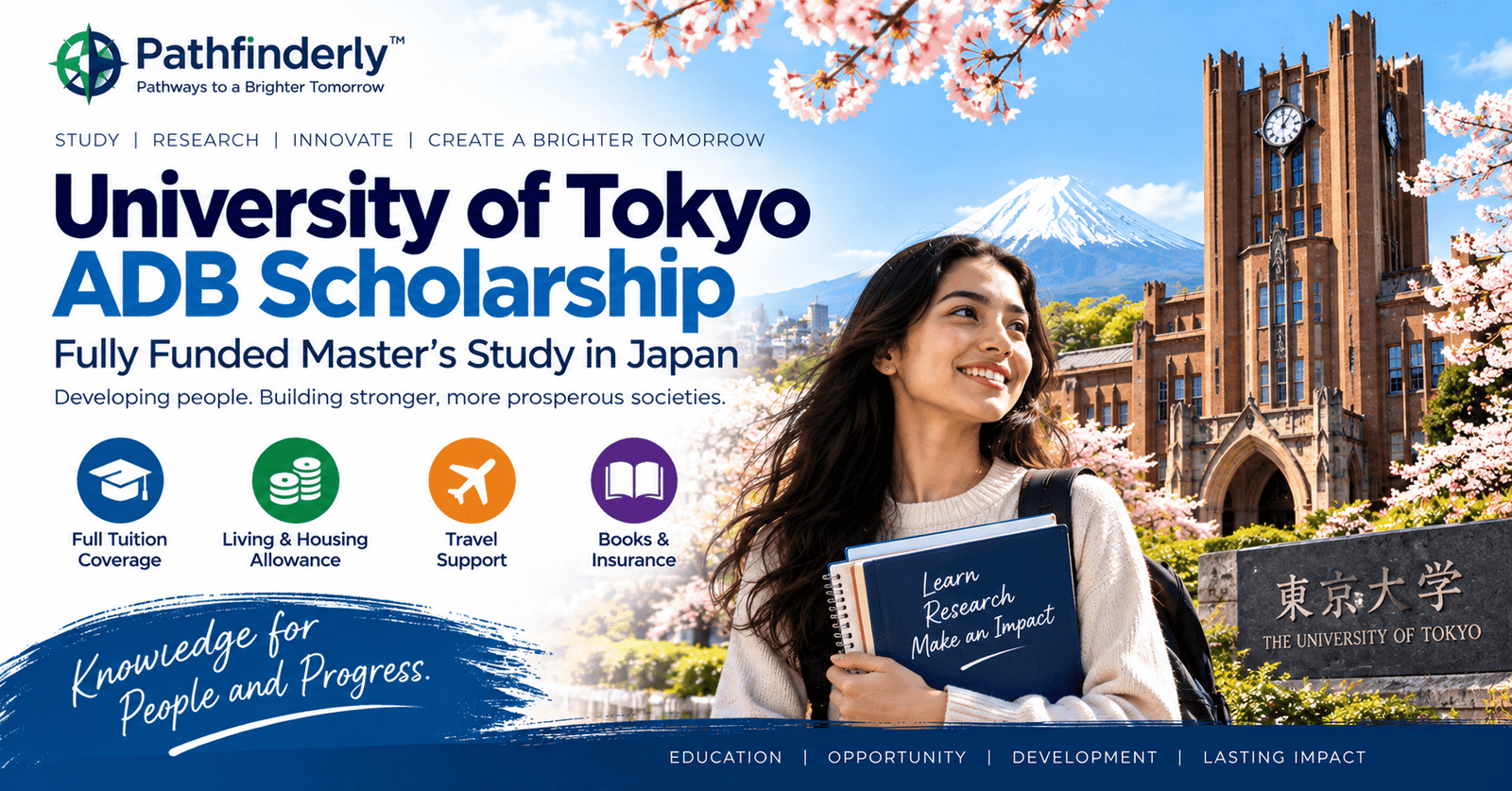
The University of Tokyo ADB Scholarship gives eligible students from developing member countries an opportunity to pursue fully funded Master’s study at one of Japan’s leading universities.
The funding comes through the Asian Development Bank–Japan Scholarship Program (ADB-JSP). The Government of Japan finances the program, while the Asian Development Bank administers it.
For the current 2027 Autumn intake, the University of Tokyo’s Graduate School of Frontier Sciences (GSFS) accepts ADB-JSP candidates across several Master’s departments and one graduate program.
The scholarship can cover full tuition, living expenses, books and instructional materials, medical insurance, and travel expenses. Successful students begin the Autumn Semester on 1 October 2027.
Students comparing funding options in different countries can also explore our latest international scholarships for more fully funded and partially funded opportunities worldwide.
University of Tokyo ADB Scholarship Overview
| Details | Information |
|---|---|
| Scholarship | ADB–Japan Scholarship Program |
| University | The University of Tokyo |
| Graduate School | Graduate School of Frontier Sciences |
| Country | Japan |
| Study Level | Master’s |
| Funding | Fully Funded |
| Intake | Autumn 2027 |
| Enrollment | 1 October 2027 |
| Eligible Areas | Science, energy, biosciences, environment, international studies, sustainability and related fields |
| Tuition | Covered |
| Living/Housing Allowance | Provided |
| Books | Allowance provided |
| Medical Insurance | Covered |
| Travel | Covered |
| General Age Limit | Not more than 35 |
| Main GSFS Deadline | 10 December 2026 for most participating departments/programs |
| Scholarship Administrator | Asian Development Bank |
| Funding Source | Government of Japan |
Applicants should begin by reading the official University of Tokyo ADB-JSP information because the application procedure differs slightly according to the selected department.
What Is the ADB-Japan Scholarship Program?
The ADB-JSP was established in 1988 with financial support from the Government of Japan.
Its purpose is to give well-qualified citizens from eligible developing member countries opportunities to undertake postgraduate education in development-related fields.
Around 130 graduate scholarships are offered each year across designated educational institutions in Asia and the Pacific.
The fields supported by ADB include areas such as science and technology, economics, business and management, development studies, health, engineering, environment, international cooperation, public policy, and other development-related subjects.
After completing their studies, scholars are expected to return home and use their knowledge and skills to support socioeconomic development.
Applicants can read the official ADB-Japan Scholarship Program information for the program-wide eligibility and funding rules.
University of Tokyo Graduate School of Frontier Sciences
The Graduate School of Frontier Sciences has expanded its participation in the ADB-JSP.
From the 2026 academic year, three additional GSFS departments received accreditation under the scholarship scheme.
The graduate school now accepts ADB-JSP scholars through nine departments and one graduate program.
This gives applicants a broader range of study options than a scholarship tied to only one Master’s course.
Eligible Master’s Departments and Programs
Current participating GSFS options include:
Department of Materials Science
Students completing this Master’s program receive a Master of Science degree.
The department can be relevant to candidates interested in advanced materials and related scientific research.
Department of Advanced Energy
Graduates also receive a Master of Science degree.
This area can appeal to students interested in energy systems, advanced technologies, sustainability, and related scientific challenges.
Department of Integrated Biosciences
Students completing this program receive a Master of Life Sciences degree.
This department follows a somewhat different ADB-JSP application route from most of the other participating GSFS departments, which I explain later in this article.
Department of Natural Environmental Studies
Students completing the program receive a Master of Environmental Studies degree.
Department of Ocean Technology, Policy, and Environment
This Master’s program also leads to a degree in Environmental Studies.
Department of Environment Systems
Successful Master’s students receive a degree in Environmental Studies.
Department of Human and Engineered Environmental Studies
The program combines environmental and human-centered perspectives and awards a Master of Environmental Studies.
Department of Socio-Cultural Environmental Studies
Students completing this route receive a Master of Environmental Studies degree.
Department of International Studies
Graduates receive a Master of International Studies degree.
This option may be particularly relevant to candidates whose academic and professional interests relate to international development and cooperation.
Graduate Program in Sustainability Science
Students completing this program receive a Master of Sustainability Science degree.
Applicants should not choose a department simply because it qualifies for the scholarship. Your proposed research and previous academic background should fit the department and the prospective supervisor.
What Does the Scholarship Cover?
The ADB-JSP provides a comprehensive financial package.
Full Tuition Fees
The scholarship covers approved tuition fees.
This removes one of the largest expenses associated with graduate study in Japan.
Monthly Subsistence and Housing Allowance
Scholars receive a monthly allowance intended to support living and housing expenses during the award.
The amount and payment arrangements are determined under the applicable ADB-JSP and university rules.
Books and Instructional Materials
An allowance is provided for approved books and instructional materials.
Medical Insurance
The scholarship provides medical insurance according to the program’s terms.
Travel Expenses
Approved travel expenses are covered.
This normally includes the relevant travel connected with beginning and completing the scholarship.
Research Support
For scholars involved in research, a special grant may also be available for thesis preparation.
Under special circumstances, support may additionally be available for preparatory language, computer literacy, or similar courses.
For the complete current package, applicants should review the official ADB-JSP scholarship benefits.
Is It a Fully Funded Scholarship?
Yes.
The ADB-JSP is reasonably described as a fully funded scholarship because its core package includes tuition, subsistence and housing support, books, medical insurance, and travel.
However, this does not mean every possible personal expense is covered.
For example, the scholarship does not cover expenses for a scholar’s family or dependants. It also does not automatically cover every additional trip, extracurricular course, workshop, field trip, internship expense, or personal equipment purchase.
Applicants should therefore distinguish between comprehensive scholarship funding and unlimited financial support.
Who Can Apply?
Candidates must satisfy both:
ADB-JSP eligibility requirements, and
University of Tokyo GSFS admission requirements.
The general ADB-JSP criteria include several important conditions.
Nationality Requirement
Applicants must be nationals of an eligible ADB borrowing member country that also qualifies for Japanese ODA scholarship support.
Candidates must not hold dual citizenship of a developed country.
The eligible-country list includes countries across Asia and the Pacific.
Examples include Bangladesh, Bhutan, Cambodia, India, Indonesia, Kazakhstan, Kyrgyz Republic, Malaysia, Maldives, Mongolia, Nepal, Pakistan, Philippines, Sri Lanka, Tajikistan, Thailand, Timor-Leste, Turkmenistan, Uzbekistan, Viet Nam, and several Pacific island countries.
Because the official country list can change, applicants should verify nationality eligibility through the ADB-JSP eligibility information before starting their university application.
Academic Requirements
Candidates need a Bachelor’s degree or its equivalent with a superior academic record.
In addition, applicants must satisfy the academic and research requirements of their selected University of Tokyo department.
The scholarship itself does not replace the university admission process.
A candidate can meet the general ADB criteria yet still fail to satisfy a particular department’s academic requirements.
Work Experience Requirement
Applicants need at least:
Two years of full-time professional work experience after completing their university degree.
This is a significant requirement.
Work undertaken before graduation does not normally satisfy it.
The University of Tokyo’s GSFS guidance specifically explains that paid research-assistant work completed while studying for an undergraduate degree does not count toward the required professional experience.
Your professional work should also be relevant to the field you studied at undergraduate level.
Age Limit
Candidates should generally be:
Not more than 35 years old at the time of application.
The GSFS specifically states that it is not authorized to recommend applicants over 35 to ADB under this scheme.
Therefore, candidates above that age should not assume an exception will apply to this University of Tokyo route.
English Language Ability
Applicants must have sufficient proficiency in written and spoken English to undertake graduate study.
Individual departments may have their own English-language requirements, test requirements, or admission procedures.
Check the selected department’s current admission guidelines rather than relying only on the general ADB condition.
Health Requirement
Candidates must be in good health.
This forms part of the ADB-JSP eligibility requirements.
Home-Country Requirement
Applicants should normally be living and working in their home country when applying.
Someone already living or working in another country generally does not satisfy the standard ADB-JSP requirements.
This condition is easy to overlook, particularly for applicants currently working abroad.
Return-Home Requirement
The scholarship has a development purpose.
Successful scholars agree to return to their home country after completing their studies.
ADB’s current general conditions require scholars to return and work in their home country for at least two years after completing the program.
Applicants should consider this requirement before applying.
Who Is Not Eligible?
Several groups are excluded.
These include certain ADB Executive Directors, Alternate Directors, management, staff, consultants, and their defined close relatives.
Staff of ADB-JSP designated institutions are also excluded under the general rules.
Candidates already enrolled in graduate degree programs do not meet the normal program requirements.
ADB-JSP is also not designed to provide repeated scholarships to someone who has already received an ADB-JSP award.
Can You Apply for a PhD?
No.
The University of Tokyo GSFS route is for Master’s study.
ADB-JSP does not provide this scholarship for doctoral enrollment through this route.
Candidates primarily interested in a PhD should investigate other funding programs, including relevant Japanese Government (MEXT) scholarship routes.
Can You Bring Dependants Under the Scholarship?
The scholarship is awarded to the scholar, not their family.
ADB-JSP does not provide scholarship funding for dependants.
Applicants planning to bring family members should therefore consider the additional financial requirements independently.
Finding a Prospective Supervisor
This is an important part of the University of Tokyo process.
Applicants should first determine whether the department or graduate program they want to join has a faculty member whose research matches their interests.
Your research plan should have a logical relationship with the expertise available in the selected department.
The University advises applicants to check for an appropriate prospective academic supervisor before proceeding through the relevant application process.
Do this early rather than waiting until the December deadline.
How the Selection Process Works
The scholarship is not awarded automatically with university admission.
The process involves multiple stages.
Stage 1: University Application
Applicants follow the relevant University of Tokyo GSFS application procedure.
Stage 2: Preliminary Screening
The University conducts its own screening.
Results of the preliminary process are expected around mid-February 2027.
Only applicants who pass this stage and meet ADB-JSP requirements receive instructions for the scholarship application process.
Stage 3: University Nomination
The University expects to nominate scholarship candidates to ADB around mid-March 2027.
Stage 4: ADB Selection
ADB then conducts its own scholarship screening.
The University expects ADB’s decision around May 2027.
Stage 5: Enrollment Procedure
Candidates confirmed for the scholarship proceed with the required enrollment arrangements.
Stage 6: Travel to Japan
Successful scholars obtain the necessary visa and enter Japan by the end of September.
The Autumn Semester begins:
1 October 2027
How to Apply
The application route depends on your selected GSFS department.
This distinction is important.
Route 1: Department of Integrated Biosciences
Candidates applying to the Department of Integrated Biosciences must take Entrance Examination Schedule B.
The application period for Schedule B is in November 2026.
Applicants who pass the examination and want to be nominated for ADB-JSP should contact the International Liaison Office promptly after receiving their admission notification, expected in early February.
This route therefore does not follow exactly the same December 10 procedure as most other participating departments.
Applicants should use the official University of Tokyo ADB-JSP application guidance to access the current Integrated Biosciences instructions.
Route 2: Other Participating Departments and Programs
Candidates applying to the other eligible GSFS departments or the Graduate Program in Sustainability Science should follow the published 2027 October Enrollment guidelines.
The current deadline is:
10 December 2026
The University provides designated forms including:
- Application form
- Study Field and Research Plan
- Recommendation letter form
Use the official GSFS ADB-JSP application page to obtain the current guidelines and designated documents.
Do not use forms downloaded from unofficial scholarship websites.
Do You Apply Directly to ADB?
No.
This is one of the most important application points.
Applicants should not send their scholarship application directly to the Asian Development Bank.
ADB-JSP accepts scholarship candidates through its designated academic institutions.
At the University of Tokyo, the University first evaluates applicants and then nominates eligible candidates to ADB.
The official ADB application procedure explains this institution-based selection process.
Is University Admission Enough to Receive the Scholarship?
No.
Passing the university process and receiving the scholarship are separate matters.
The University conducts preliminary screening and recommends selected candidates.
ADB then makes its scholarship decision.
Therefore, applicants should never resign from employment, make irreversible travel arrangements, or assume they have funding simply because they have progressed through the university stage.
Wait until the scholarship award is officially confirmed.
Important Application Deadline
For most participating GSFS departments and the Graduate Program in Sustainability Science, the current deadline for 2027 Autumn enrollment is:
10 December 2026
The Department of Integrated Biosciences follows its own Schedule B process, with the examination application period in November.
Always check the current department-specific instructions before submitting.
A Note About the School of International Health
You may find other websites advertising a University of Tokyo ADB Scholarship 2027 through the School of International Health.
That opportunity was genuine, but its application deadline was:
30 June 2026
It was for a two-year Master’s program beginning in April 2027.
Therefore, applicants reading this article now should not confuse that expired application round with the currently relevant GSFS Autumn 2027 route.
The current article focuses on the updated Graduate School of Frontier Sciences opportunity.
Tips for a Strong Application
Start by identifying the right department and supervisor, not by focusing only on the scholarship money.
Your previous degree, professional experience, proposed research, and future development goals should form a coherent story.
The research plan deserves particular attention.
Explain the problem you want to investigate, why it matters, what you hope to study at the University of Tokyo, and how the knowledge could contribute to your home country’s development.
Professional experience should also support your application.
Rather than merely listing job titles, show how your work connects with your proposed graduate study.
Finally, remember the development purpose of ADB-JSP. A strong candidate should be able to explain how advanced study in Japan could translate into meaningful contribution after returning home.
Common Mistakes to Avoid
Applicants should avoid:
- Applying without checking ADB nationality eligibility
- Ignoring the two-year post-degree professional experience requirement
- Assuming undergraduate work experience automatically counts
- Applying while living or working outside the home country without checking eligibility
- Choosing a department without identifying a suitable supervisor
- Confusing Master’s funding with PhD funding
- Sending an application directly to ADB
- Assuming university admission guarantees the scholarship
- Using the expired School of International Health deadline
- Missing the special procedure for Integrated Biosciences
- Assuming dependants are financially covered
- Leaving the research plan until the last minute
Carefully following the University and ADB instructions can prevent many avoidable application problems.
University of Tokyo ADB Scholarship vs Other International Scholarships
Students interested in international Master’s funding have several options, but their structures differ.
The Erasmus Mundus MAPP Scholarship is particularly relevant to applicants interested in public policy, governance, development, and international affairs. Its joint European structure requires students to study in two countries.
Applicants from eligible Commonwealth countries can also explore the Commonwealth Scholarship for fully funded Master’s study in the United Kingdom.
Students interested in other government-funded opportunities in Asia can compare this program with our guide to the Global Korea Scholarship, although GKS follows a different selection and funding structure.
Applicants comparing ADB-JSP study destinations can also explore the University of Hawaii ADB Scholarship, which supports approved Master’s study at the University of Hawaiʻi at Mānoa together with participation in the East-West Center community.
Furthermore, students seeking a broader Japanese Government funding route can also explore the Japanese Government MEXT Scholarship, which supports several categories of international students for study and research in Japan.
Similarly, students exploring other ADB-funded Master’s programs can also consider the Keio University ADB Scholarship, which provides tuition coverage, a monthly stipend and travel support for eligible students pursuing science and technology degrees in Japan.
Choose according to academic fit, eligibility, career goals, and study destination rather than funding alone.
Final Thoughts
The University of Tokyo’s ADB-JSP opportunity combines graduate education at a leading Japanese university with comprehensive financial support from the Asian Development Bank–Japan Scholarship Program.
For the current Autumn 2027 route, the Graduate School of Frontier Sciences provides options across science, energy, biosciences, environmental studies, international studies, and sustainability.
The scholarship can cover tuition, living and housing support, books, medical insurance, and approved travel.
However, applicants must meet strict eligibility conditions. The two-year professional experience requirement, age limit, nationality rules, home-country condition, and return-home commitment deserve particular attention.
For most participating GSFS departments and programs, the current application deadline is 10 December 2026.
Before applying, check the official University of Tokyo ADB-JSP page one final time for the latest forms and department-specific instructions.
Last verified: September 2026
Pathfinderly provides scholarship information for educational purposes. Eligibility, funding, deadlines, participating departments, admission procedures, and scholarship conditions can change. Always verify current information through the University of Tokyo and Asian Development Bank before applying.