
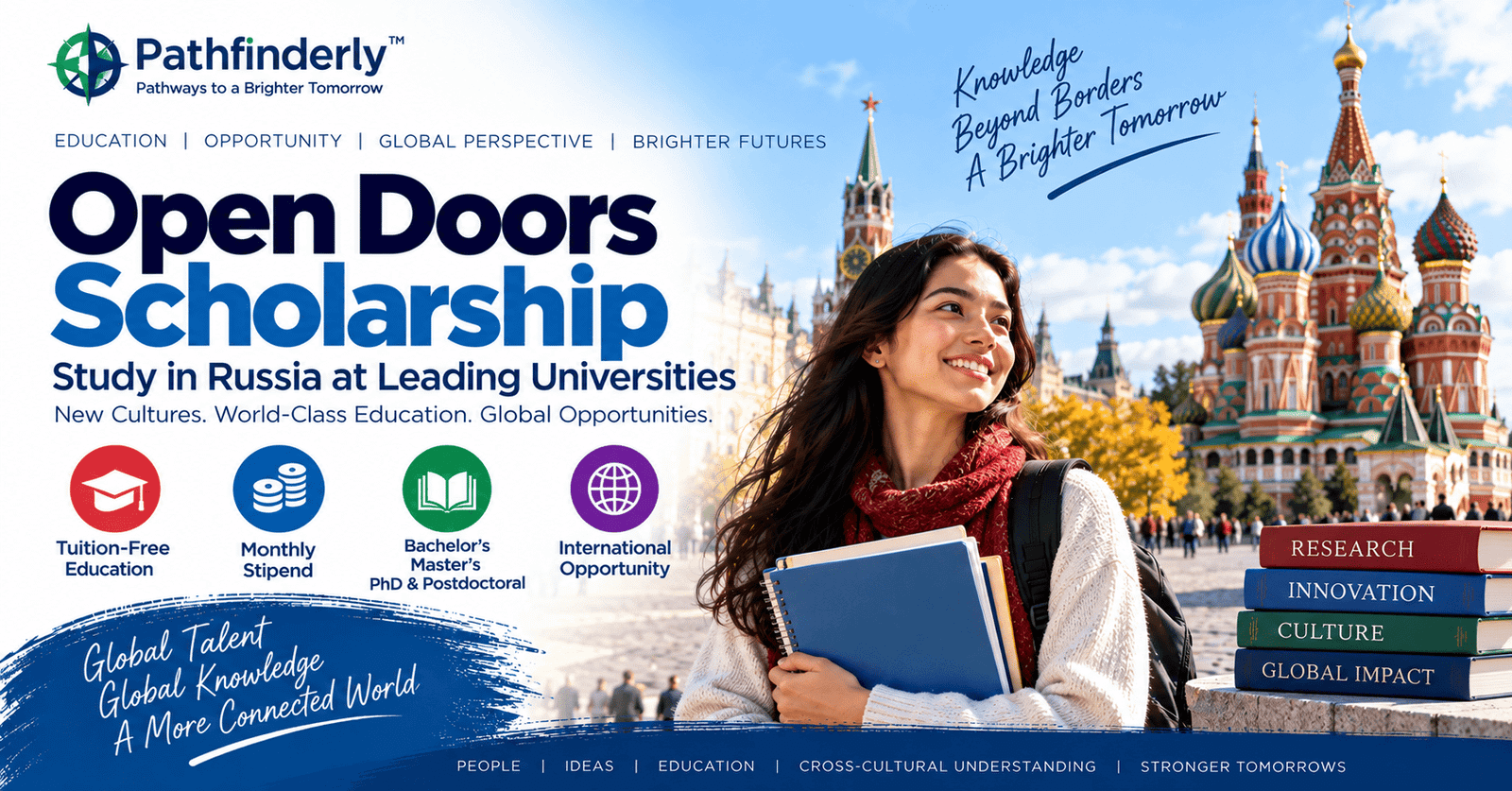
The Open Doors Scholarship gives international students and researchers an opportunity to study or pursue research at leading universities in Russia through an online international competition.
The current Open Doors Russian Scholarship Project is open to foreign citizens and stateless persons. Applicants can compete through Bachelor’s, Master’s, Doctoral (PhD), or Postdoctoral tracks, depending on their academic qualifications.
Registration opened on 20 August 2026 and closes on 1 November 2026.
One of the biggest advantages is that participation in the competition is completely free. Winners and eligible runners-up in the degree tracks can receive tuition-free admission at Russian universities under the Government of the Russian Federation quota.
However, applicants should understand the funding correctly. Tuition is covered and students receive a monthly stipend, but the standard scholarship does not automatically cover every living and travel expense.
Open Doors Scholarship Overview
| Details | Information |
|---|---|
| Scholarship | Open Doors Russian Scholarship Project |
| Country | Russia |
| Applicants | International students and researchers |
| Competition Format | Online |
| Participation Fee | None |
| Bachelor’s Track | Available |
| Master’s Track | Available |
| Doctoral / PhD Track | Available |
| Postdoctoral Track | Available |
| Subject Areas | 14 |
| Competition Languages | English or Russian |
| Tuition | Covered for scholarship recipients in degree tracks |
| Monthly Stipend | Available; amount varies by university |
| Registration Opens | 20 August 2026 |
| Registration Deadline | 1 November 2026 |
| First Stage | 20 August–13 November 2026 |
| Second Stage | 13 November–21 December 2026 |
| Final PhD/Postdoc Stage | 22 December 2026–26 February 2027 |
| Application | Online |
Applicants should begin with the official Open Doors Russian Scholarship Project and create their application only through the official platform.
What Is the Open Doors Scholarship?
Open Doors is an international academic competition for foreign students and researchers who want to study or develop their academic careers in Russia.
The project is organized by the Global Universities Association with support from Russia’s Ministry of Science and Higher Education.
Unlike a conventional scholarship where candidates mainly submit an application and wait for a selection decision, Open Doors uses an academic competition format.
Participants build a portfolio and complete assessments related to their chosen subject area.
The selection process differs according to academic track.
For Bachelor’s and Master’s candidates, there are two main stages. Doctoral and Postdoctoral applicants go through three stages.
Who Can Apply?
The competition is intended for:
- Foreign citizens
- Stateless persons
- Compatriots living outside Russia who meet the requirements
Applicants must have completed the educational level required for their chosen track or be completing it during the competition year where permitted.
This means eligibility depends primarily on the academic track you choose.
Four Open Doors Tracks
One of the most important features of the current competition is that it is no longer limited to postgraduate students.
There are now four routes.
1. Bachelor’s Track
This track is for applicants seeking undergraduate education in Russia.
Candidates should have completed general secondary education or be completing the required level during the relevant competition period.
Successful applicants can pursue an eligible undergraduate program connected with their chosen subject area.
This route makes Open Doors relevant to international students who have finished or are finishing school and want to begin university study.
2. Master’s Track
The Master’s track is intended for applicants who already have at least a Bachelor’s degree or will complete the required higher-education qualification within the permitted period.
This has traditionally been one of the most popular Open Doors routes.
Students compete in their selected academic subject and, if successful, can pursue an eligible Master’s program at a participating Russian university.
3. Doctoral Track
The Doctoral track is for candidates seeking PhD-level study and research.
Applicants need at least a Master’s or Specialist degree, or must complete the appropriate qualification as permitted by the current rules.
The selection process is more research-oriented than the Bachelor’s or Master’s route.
After completing the earlier stages, successful candidates move to interviews with prospective research supervisors.
4. Postdoctoral Track
The Postdoctoral track works differently.
Applicants must already hold a PhD, Candidate of Sciences, Doctor of Sciences, or qualifying equivalent degree when submitting their portfolio for evaluation.
This route is aimed at early-career international researchers rather than students seeking another academic degree.
Successful candidates can receive offers for research positions at participating Russian universities.
Is Open Doors Fully Funded?
This needs careful explanation.
For Bachelor’s, Master’s, and Doctoral scholarship recipients, the central benefit is:
Tuition-free education.
The Government of the Russian Federation covers tuition fees for eligible winners and runners-up admitted through the program.
Students also receive a:
Monthly stipend.
The exact stipend is not a single fixed Open Doors amount. According to the official project, the amount varies depending on the university.
However, the standard scholarship does not automatically cover all other expenses.
Students should normally budget for:
- Accommodation
- Food
- Transportation
- Medical insurance
- Communication expenses
- Personal expenses
- International travel
Therefore, describing every Open Doors award simply as an “all-expenses-paid scholarship” would be misleading.
Additional Government Grant Support
Some successful participants may qualify for broader government support.
The current official information states that students enrolling in Russian-language degree programs may also receive additional grant support from the Government of the Russian Federation.
Depending on eligibility, this additional package can include:
- Reimbursement of travel expenses for arrival in Russia and departure after study
- Monthly stipend
- Medical insurance
- Reimbursement of accommodation expenses
Applicants should not assume that this additional package applies automatically to every winner.
Check the conditions associated with your university, study program, language of instruction, and government support arrangements.
Is There an Application Fee?
No.
Participation in Open Doors is free.
The official rules state that no fee is charged for participation.
Applicants should therefore be cautious if an unofficial person or website asks for money simply to enter the Open Doors competition.
Use the official platform for registration.
14 Subject Areas
The current competition covers a broad range of academic fields.
Applicants can choose from:
- Applied Mathematics and Artificial Intelligence
- Biology and Biotechnology
- Business and Management
- Chemistry and Materials Science
- Clinical Medicine and Public Health
- Computer and Data Science
- Earth and Environmental Sciences for Sustainability
- Economics and Econometrics
- Education and Psychology
- Engineering and Technology
- Physical Sciences and Technology
- Politics and International Studies
- Russian Language and Culture
- Urbanism and Civil Engineering
Each subject area can contain several related university programs and specializations.
Therefore, applicants should not judge eligibility only from the broad subject title.
Explore the detailed program options before choosing your field.
The current subject areas and preparation materials are available on the official Open Doors website.
Can You Apply for More Than One Subject Area?
Yes.
The official FAQ states that there is no fixed limit on the number of subject areas in which a participant can compete.
However, you need to prepare a separate motivation letter for each chosen subject area.
There is also a practical issue.
Second-stage examinations for different subjects may take place on the same day.
If you eventually become a winner or runner-up in more than one subject area, you will need to select one subject area and one degree program for the scholarship.
For most applicants, choosing a few closely related fields carefully may be more manageable than applying everywhere without a clear academic direction.
Participating Universities
Open Doors works with leading Russian universities.
The current project includes 24 universities, such as:
- HSE University
- ITMO University
- Moscow Institute of Physics and Technology
- Bauman Moscow State Technical University
- National Research Nuclear University MEPhI
- National University of Science and Technology MISIS
- Novosibirsk State University
- Tomsk State University
- Tomsk Polytechnic University
- Kazan Federal University
- Far Eastern Federal University
- Ural Federal University
- University of Tyumen
- Peter the Great St. Petersburg Polytechnic University
- RUDN University
- Samara National Research University
- Siberian Federal University
- Southern Federal University
- Plekhanov Russian University of Economics
- Sechenov University
- MGIMO University
- Lobachevsky University
- Moscow Polytechnic University
- Moscow State University of Civil Engineering
Not every university necessarily offers every degree program within every subject area.
Applicants should compare the available programs before establishing their university preferences.
How Many Universities Can You Select?
Participants can select up to six universities.
This is useful because your first-choice university may not offer the exact degree program you eventually select.
Applicants can arrange their choices according to priority.
If the first institution cannot offer the required program, the application can move to the next university on the priority list.
Therefore, do not choose six universities randomly.
Compare:
- Available degree programs
- Language of instruction
- Research areas
- Faculty
- City
- Accommodation
- Living costs
- International student support
before setting your priorities.
Language of the Competition
Participants can take part in Open Doors in:
English
or
Russian.
You select the competition language during registration.
Importantly, applicants do not need to submit an English or Russian language certificate simply to participate in the competition.
A language certificate can still strengthen the portfolio where relevant.
Do You Need IELTS or TOEFL?
Open Doors does not require every applicant to submit IELTS or TOEFL as a mandatory condition for participating in the scholarship competition.
The official FAQ states that documentary proof of Russian or English ability is not required for participation.
However, language requirements for the actual university program can depend on the chosen institution and degree.
Students should therefore distinguish between:
competition requirements
and
university enrollment requirements.
They are not necessarily identical.
Can You Study in English?
Yes, participating universities offer programs in Russian and English.
Availability depends on the institution and degree.
If your selected program is offered only in Russian and you need additional language preparation, the official Open Doors information states that you may begin with a one-year preparatory Russian language course.
Your place in the degree program can then be secured for the following academic year after completing the preparatory course.
Documents Required for the First Stage
The initial application is relatively straightforward.
The mandatory items include:
- Passport
- Proof of your current education level
- Motivation letter
Applicants who have not yet received their final degree certificate may be able to submit another document confirming their current educational status.
Examples can include:
- Academic transcript
- Current transcript
- Previous year’s transcript
- Grade sheet
- Other official evidence of education
You will need to provide final qualification documents later if you win and proceed to admission.
Are Certificates and Achievements Required?
Additional achievements are generally optional at the portfolio stage, but they can improve your score.
Depending on your subject area, useful supporting evidence might include:
- Academic awards
- Research experience
- Publications
- Conference participation
- Competitions
- Relevant courses
- Professional achievements
- Projects
- Internships
- Language certificates
- Subject-related accomplishments
Upload only genuine achievements that are relevant to your chosen academic area.
Quality and relevance matter more than filling the portfolio with unrelated certificates.
Document Language
Supporting documents should be provided in English or Russian.
Documents originally issued in another language need an appropriate translation according to the competition requirements.
At the first portfolio stage, certified translations are not necessarily required.
However, winners and runners-up may later need properly notarized translations for university admission.
Applicants should therefore read the current official Open Doors rules carefully.
How the Selection Process Works
The competition has several stages.
The exact process depends on your track.
Stage One: Portfolio Competition
The first stage runs from:
20 August to 13 November 2026
During this period, applicants:
- Register online
- Select their track
- Choose subject areas
- Complete an entry test
- Prepare a motivation letter
- Enter relevant achievements
- Upload supporting documents
- Submit their portfolio
However, the important registration and portfolio editing deadline is 1 November 2026.
After that deadline, applicants can no longer add or edit their account information and portfolio.
First-stage results are scheduled for:
13 November 2026
Successful candidates then advance to Stage Two.
Stage Two: Online Academic Assessment
The second stage runs from:
13 November to 21 December 2026
For Bachelor’s, Master’s, and Doctoral applicants, this involves online academic tasks in the selected subject area.
The assessment is conducted using online proctoring.
Candidates receive:
180 minutes
to complete the second-stage tasks.
Participants must have:
- A suitable computer
- Webcam
- Stable internet connection
- Required proctoring software
- A quiet examination environment
The system monitors candidates during the examination.
Applicants should test their equipment in advance rather than waiting until examination day.
Stage Two Registration Deadline
Candidates who qualify for Stage Two must register for their assessment and choose an available time slot.
The current deadline for this is:
16 November 2026
Missing this step can prevent a candidate from taking the examination even after passing Stage One.
Postdoctoral Stage Two
Postdoctoral applicants follow a different process.
Instead of the same proctored academic test, their second stage involves a video presentation of research achievements.
The current deadline for submitting the Postdoctoral video presentation is:
6 December 2026
Researchers should follow the specific video requirements published for their chosen subject area.
Bachelor’s and Master’s Results
The announcement of winners and runners-up for the Bachelor’s and Master’s tracks is scheduled for:
21 December 2026
This means these applicants do not proceed to the same third-stage interview process used for Doctoral and Postdoctoral candidates.
Stage Three: Doctoral and Postdoctoral Interviews
The third stage runs from:
22 December 2026 to 26 February 2027
Doctoral candidates participate in online interviews involving prospective research supervisors.
Postdoctoral candidates interview with research project leaders.
The third stage allows both the candidate and academic team to determine whether the proposed research interests are a suitable match.
Final Doctoral and Postdoctoral results are scheduled for:
26 February 2027
How to Write the Motivation Letter
The motivation letter is an important part of Stage One.
The official guidance recommends addressing areas such as:
- Academic goals
- Career goals
- Professional achievements
- Why you selected the subject area
- Why you want to study in Russia
Doctoral candidates should also consider explaining their previous research and proposed future research.
Avoid generic statements such as:
“Russia has excellent universities and I want a good education.”
Instead, explain the connection between your previous education, your chosen subject, the program you want to pursue, and your future plans.
A focused motivation letter is usually more convincing than exaggerated praise.
How to Strengthen Your Portfolio
Start with relevance.
If you apply for Computer and Data Science, computer-related projects or competitions are more useful than unrelated certificates.
Similarly, a Business and Management applicant should prioritize relevant academic, professional, entrepreneurial, or research experience.
Use evidence wherever possible.
Your portfolio should help evaluators understand what you have achieved and how those achievements relate to your chosen field.
How to Prepare for Stage Two
Each subject area provides its own preparation information.
Applicants should review:
- Subject-area program
- Required competencies
- Sample tasks
- Assessment structure
- Technical requirements
Do not wait until Stage One results are released before beginning academic preparation.
The time between stages is relatively short.
Use the official Open Doors subject-area pages to access the relevant program and preparation materials.
Can You Appeal the Results?
The rules differ by stage.
There is no standard appeal process for the Stage One portfolio evaluation.
However, candidates can appeal their Stage Two score under the official procedure.
The appeal window is short.
The official FAQ currently states that participants have only two days after publication of Stage Two results to submit an appeal.
Third-stage interview results are not subject to the same appeal process.
How to Apply for the Open Doors Scholarship
The entire competition begins online.
Step 1: Visit the Official Website
Go to the official Open Doors Scholarship website.
Do not register through unofficial scholarship websites.
Step 2: Create an Account
Provide the required personal information, including your:
- Name
- Date of birth
- Citizenship
- Telephone number
Make sure your personal information is accurate.
Step 3: Select Your Academic Track
Choose:
Bachelor’s, Master’s, Doctoral, or Postdoctoral
according to your qualifications.
Step 4: Select Your Subject Area
Choose the academic field that best matches your educational background and future goals.
You can participate in multiple subject areas, but each requires appropriate preparation and its own motivation letter.
Step 5: Complete the Entry Test
The portfolio stage includes an entry test.
Follow the instructions inside your participant account.
Step 6: Write Your Motivation Letter
Explain your academic and professional direction clearly.
Connect your background with your chosen field and future plans.
Step 7: Upload Your Documents
Upload your passport, educational evidence, and relevant supporting documents.
Check that files are readable before submission.
Step 8: Submit Your Portfolio
Do not leave submission until the final day.
For the current competition, registration closes on:
1 November 2026
Step 9: Prepare for Stage Two
If selected, register for the second stage before the applicable deadline and choose your assessment slot.
Bachelor’s, Master’s, and Doctoral candidates then complete the proctored academic assessment.
Step 10: Follow the Final Procedure for Your Track
Bachelor’s and Master’s applicants receive their final competition status after Stage Two.
Doctoral and Postdoctoral candidates who advance must complete the interview stage.
Important Dates
| Stage | Date |
|---|---|
| Registration Opens | 20 August 2026 |
| Registration Deadline | 1 November 2026 |
| First Stage | 20 August–13 November 2026 |
| First Stage Results | 13 November 2026 |
| Stage Two Registration Deadline | 16 November 2026 |
| Second Stage | 13 November–21 December 2026 |
| Postdoctoral Video Deadline | 6 December 2026 |
| Bachelor’s & Master’s Results | 21 December 2026 |
| Doctoral/Postdoctoral Third Stage | 22 December 2026–26 February 2027 |
| Final Doctoral/Postdoctoral Results | 26 February 2027 |
Applicants should verify the latest schedule on the official Open Doors website because competition dates and procedures can be updated.
What Happens If You Win?
For the degree tracks, successful candidates proceed toward university admission under the relevant Russian Government quota arrangements.
Applicants choose their degree program within the subject area in which they won.
Bachelor’s and Master’s candidates can select among eligible programs at participating institutions.
Doctoral winners follow the research-supervisor arrangement established during the competition.
The university then handles further admission and documentation procedures.
Can Winners Choose Any Degree?
Not exactly.
The degree program must fall within the subject area selected for the scholarship and must be available to international students at the chosen university.
Therefore, selecting the correct subject area at the beginning matters.
Research potential degree programs before submitting the final application.
Can International Students Work While Studying?
The official Open Doors FAQ states that scholarship students can work while studying in Russia and indicates that a separate work permit is not required under the applicable student arrangements.
However, employment regulations can change and individual circumstances can differ.
Students planning to work should confirm the current legal conditions with their university after enrollment.
Open Doors Scholarship vs Other International Scholarships
Applicants should compare Open Doors with other international scholarships rather than relying on a single opportunity.
Students interested in Europe can explore the Erasmus Mundus MAPP Scholarship, which provides a joint Master’s route involving universities in multiple European countries.
Those considering the United Kingdom can compare the Commonwealth Scholarship and Gates Cambridge Scholarship.
For applicants interested in East Asia, our Global Korea Scholarship for Undergraduates guide explains another government-supported study route.
The programs differ substantially in eligibility, funding, academic level, and selection method.
Common Application Mistakes
Avoid:
- Missing the 1 November registration deadline
- Choosing the wrong academic track
- Selecting unrelated subject areas without preparation
- Writing the same generic motivation letter for every field
- Uploading irrelevant certificates simply to increase quantity
- Waiting until Stage One results before preparing for Stage Two
- Missing Stage Two registration
- Using prohibited resources during the proctored assessment
- Assuming IELTS is compulsory for competition entry
- Assuming every university offers the same degree programs
- Assuming the standard scholarship covers every living expense
- Paying someone to enter a competition that is officially free
- Using unofficial websites instead of the official portal
Careful preparation matters because Open Doors is an academic competition, not simply a form-based scholarship application.
Is the Open Doors Scholarship Worth Considering?
For students who want to study in Russia, the main attraction is significant.
Successful applicants in the degree tracks can receive tuition-free education and a monthly stipend while choosing from a range of participating Russian universities.
The application process is also online, and participation itself costs nothing.
However, students should budget carefully.
Under the standard scholarship arrangement, you may still need to pay for accommodation, food, transportation, medical insurance, communication services, and other personal expenses.
Applicants should therefore evaluate both the academic opportunity and the practical cost of living before making a final decision.
Final Thoughts
The Open Doors Scholarship provides an unusual route into Russian higher education because selection takes place through an international academic competition rather than a conventional scholarship application alone.
The current competition covers Bachelor’s, Master’s, Doctoral, and Postdoctoral tracks, with 14 subject areas ranging from artificial intelligence and engineering to medicine, business, economics, politics, education, and Russian studies.
Participation is free, and the competition can be completed online. Winners and eligible runners-up in degree tracks can gain tuition-free admission under the Russian Government quota, while students also receive a monthly stipend.
The most important date for new applicants is:
1 November 2026 — Registration Deadline
Applicants should register early, build a relevant portfolio, prepare carefully for the academic assessment, and use only the official Open Doors Russian Scholarship Project website for current instructions.
Last verified: September 2026
Pathfinderly provides scholarship information for educational purposes. Scholarship benefits, university programs, admission conditions, stipends, competition dates, and government support arrangements can change. Always verify current information through the official Open Doors website before applying.